This article was created with

eat-better-feel-better-logo-2.png

Ingredients

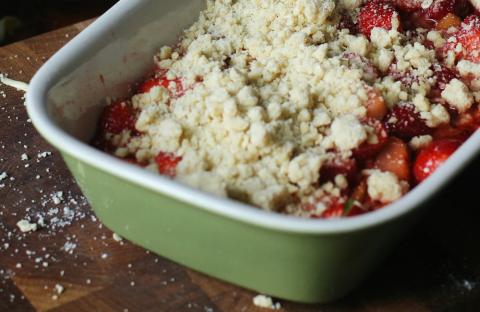
  • 1 Tin (410g) Pears In Juice
  • 1 Tin (410g) Peaches In Juice
  • 4 Level Tablespoons (80g) Plain Flour
  • 5 Tablespoons (75g) Porridge Oats
  • 5 Tablespoons (75g) Low Fat Spread
  • 1 Tablespoon (20g) Sugar
  • 2 Pots (200g) Low Fat Plain Yoghurt

This recipe has been added to your Meal Planner.

Allergy Disclaimer

Always check the label of each ingredient for allergy warnings.

Method

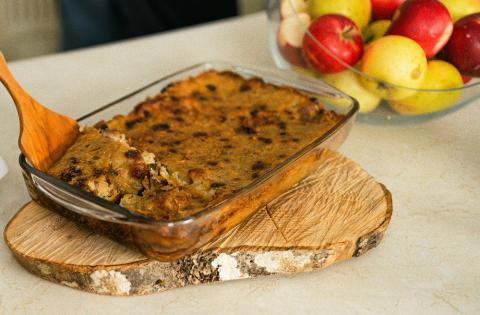
  1. Preheat the oven to 180°C / 160°C fan oven / 360°F / gas mark 4.
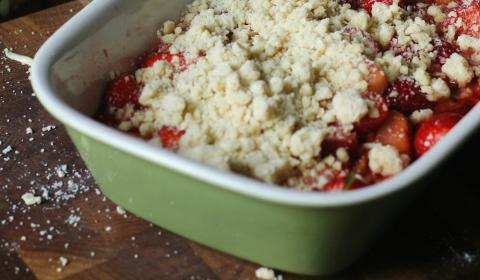
  2. Mix flour and oats in a bowl then rub low fat spread into the mixture. When it looks similar to breadcumbs stir in the sugar.
  3. Drain juice from the fruit and place into the bottom of an overproof dish with no more than two layers of fruit.
  4. Pour crumble mixture over the fruit and level it out with a spoon. Don't press down too much on the crumble.
  5. Bake in the oven for approximately 25 minutes. Serve with yoghurt.

Time Saver Tips

You can make the crumble mixture in advance and store in the fridge.

Tips for Kids

Kids will enjoy making the crumble. You could also try this recipe with their favourite tinned fruit, like apple or summer berries. You could also try using wholemeal flour or adding some ground ginger to the crumble mixture for a different taste. Or why not try serving with custard?

Nutritional Information

Based on a single serving of 219g (% of an adult's reference intake)

Energy

297 kcals ( 15 %)

1,255 kJ ( 15 %)

Fat

2.3 g ( 12 %)

Saturates

49.9 g ( %)

Sugar

20.3 g ( 23 %)

Salt

0.4 g ( 5 %)

Detailed nutritional information

Per 100g Per 219g serving
Energy Kcals 136 297
Energy Kj 573 1,255
Protein 3.1 g 6.8 g
Total Fat g g
Saturated Fat 1 g 2.3 g
Carbohydrates 22.8 g 49.9 g
Total Sugars 9.3 g 20.3 g
NSP Fibre 1 g 2.3 g
Sodium 60 mg 132 mg
Salt 0.2 g 0.4 g

Find out about nutritional labelling

Nutrition labels on the front of packaging

  • Most of the big supermarkets and many food manufacturers display nutritional information on the front of pre-packed food.
  • Front of pack nutrition labels provide information on the number of grams of fat, saturated fat, sugars and salt and the amount of energy (in kJ and kcal) in a serving or portion of a recipe.
  • The labels also include information about reference intakes (expressed as a percentage) which are guidelines about the approximate amount of particular nutrients and energy required for a healthy diet.
  • The colour coding tells you at a glance if the food has high (red), medium (amber) or low (green) amounts of fat, saturated fat, sugars and salt.
  • The more greens on the label, the healthier the choice
  • Amber means neither high nor low, so you can eat foods with all or mostly ambers on the label most of the time.
  • Reds on the label means the food is high in that nutrient and these are the foods we should cut down on. Try to eat these foods less often and in small amounts.

Food shopping tips

If you’re trying to decide which product to choose, check to see if there's a nutrition label on the front of the pack. This will help you to quickly assess how your choices stack up. You will often find a mixture of red, amber and green colour coding for the nutrients. So when you're choosing between similar products, try to go for more greens and ambers and fewer reds if you want to make a healthier choice.
Back to top

Ingredients

  • ½ (Medium Pot) (100ml) Low Fat Vanilla Yoghurt
  • 5 Heaped teaspoons (80g) Peanut Butter
  • 5 Teaspoons (40g) Honey
  • (1g) Ground Cinnamon
  • 2 (Medium) (224g) Apples

This recipe has been added to your Meal Planner.

Allergy Disclaimer

Always check the label of each ingredient for allergy warnings.

Method

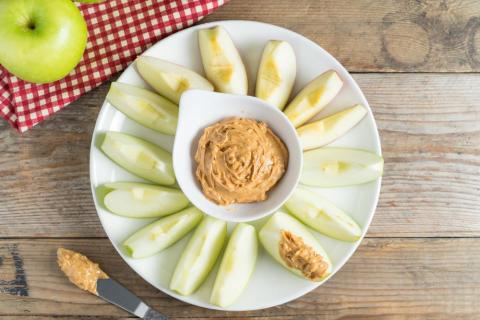
  1. In a bowl mix yoghurt,  peanut butter, honey and cinnamon.
  2. Cut the apples into segments.
  3. Serve the apples with the peanut butter dip.

Time Saver Tips

Dip can be made in advance and stored in the fridge

Cost Saver Tips

Use any fruit you have already for dipping

Tips for Kids

Let them help make the dip. Use their favourite fruit for dipping. As this recipe contains added sugar it’s best kept to mealtimes.

Nutritional Information

Based on a single serving of 105g (% of an adult's reference intake)

Energy

189 kcals ( 9 %)

794 kJ ( 9 %)

Fat

2.7 g ( 14 %)

Saturates

17.9 g ( %)

Sugar

16.6 g ( 18 %)

Salt

0.2 g ( 3 %)

Detailed nutritional information

Per 100g Per 105g serving
Energy Kcals 180 189
Energy Kj 756 794
Protein 5.9 g 6.2 g
Total Fat g g
Saturated Fat 2.6 g 2.7 g
Carbohydrates 17 g 17.9 g
Total Sugars 15.8 g 16.6 g
NSP Fibre 1.6 g 1.7 g
Sodium 88 mg 92 mg
Salt 0.2 g 0.2 g

Find out about nutritional labelling

Nutrition labels on the front of packaging

  • Most of the big supermarkets and many food manufacturers display nutritional information on the front of pre-packed food.
  • Front of pack nutrition labels provide information on the number of grams of fat, saturated fat, sugars and salt and the amount of energy (in kJ and kcal) in a serving or portion of a recipe.
  • The labels also include information about reference intakes (expressed as a percentage) which are guidelines about the approximate amount of particular nutrients and energy required for a healthy diet.
  • The colour coding tells you at a glance if the food has high (red), medium (amber) or low (green) amounts of fat, saturated fat, sugars and salt.
  • The more greens on the label, the healthier the choice
  • Amber means neither high nor low, so you can eat foods with all or mostly ambers on the label most of the time.
  • Reds on the label means the food is high in that nutrient and these are the foods we should cut down on. Try to eat these foods less often and in small amounts.

Food shopping tips

If you’re trying to decide which product to choose, check to see if there's a nutrition label on the front of the pack. This will help you to quickly assess how your choices stack up. You will often find a mixture of red, amber and green colour coding for the nutrients. So when you're choosing between similar products, try to go for more greens and ambers and fewer reds if you want to make a healthier choice.

Back to top

Ingredients

  • 2 (300g) Pears
  • ½ Teaspoon (2g) Mixed Spice

This recipe has been added to your Meal Planner.

Allergy Disclaimer

Always check the label of each ingredient for allergy warnings.

Method

  1. Preheat the oven to 140°C / 120°C fan oven / 280°F / gas mark 1.
  2. Thinly slice the pears into rounds from the base, picking out any pips.
  3. Line a baking tray with greaseproof or baking paper and place the pear slices on the tray. Sprinkle the mixed spice over the slices, a pastry brush is useful to spread it evenly.
  4. Bake in the oven for 40 minutes. Then leave to cool and crisp.
  5. The pears won't feel crisp until cooled. Store in a sealed food bag and eat within 2 days.

Time Saver Tips

You could try making a batch of these and storing them so you’ve always got a handy, healthy snack ready

Cost Saver Tips

These work great with other fruit like apples, or even root vegetables such as carrots or parsnips. Why not use up whatever you’ve got in or see what’s on offer? You could try making these with cinnamon instead of mixed spice, or chilli powder, paprika or ground black pepper if making them with veggies – whatever spices you have in are good!

Tips for Kids

If your wee one finds the spices a bit much, you could always try adding a little less to see if they prefer it.

Nutritional Information

Based on a single serving of 64g (% of an adult's reference intake)

Energy

32 kcals ( 2 %)

134 kJ ( 2 %)

Fat

0.1 g ( 1 %)

Saturates

8.2 g ( %)

Sugar

8.1 g ( 9 %)

Salt

0.1 g ( %)

Detailed nutritional information

Per 100g Per 64g serving
Energy Kcals 50 32
Energy Kj 210 134
Protein 0.4 g 0.3 g
Total Fat g g
Saturated Fat 0.1 g 0.1 g
Carbohydrates 12.7 g 8.2 g
Total Sugars 12.7 g 8.1 g
NSP Fibre 1.9 g 1.2 g
Sodium 2 mg 1 mg
Salt 0.1 g 0.1 g

Find out about nutritional labelling

Nutrition labels on the front of packaging

  • Most of the big supermarkets and many food manufacturers display nutritional information on the front of pre-packed food.
  • Front of pack nutrition labels provide information on the number of grams of fat, saturated fat, sugars and salt and the amount of energy (in kJ and kcal) in a serving or portion of a recipe.
  • The labels also include information about reference intakes (expressed as a percentage) which are guidelines about the approximate amount of particular nutrients and energy required for a healthy diet.
  • The colour coding tells you at a glance if the food has high (red), medium (amber) or low (green) amounts of fat, saturated fat, sugars and salt.
  • The more greens on the label, the healthier the choice
  • Amber means neither high nor low, so you can eat foods with all or mostly ambers on the label most of the time.
  • Reds on the label means the food is high in that nutrient and these are the foods we should cut down on. Try to eat these foods less often and in small amounts.

Food shopping tips
If you’re trying to decide which product to choose, check to see if there's a nutrition label on the front of the pack. This will help you to quickly assess how your choices stack up. You will often find a mixture of red, amber and green colour coding for the nutrients. So when you're choosing between similar products, try to go for more greens and ambers and fewer reds if you want to make a healthier choice.
Back to top

Ingredients

  • (30g) Tuna In Brine
  • 1 Slices (23g) Ham
  • 1 Tablespoon (20g) Grated Reduced Fat Mature Cheddar
  • 2 Tablespoons (30g) Mayonnaise
  • 8 (40g) Lettuce Leaves
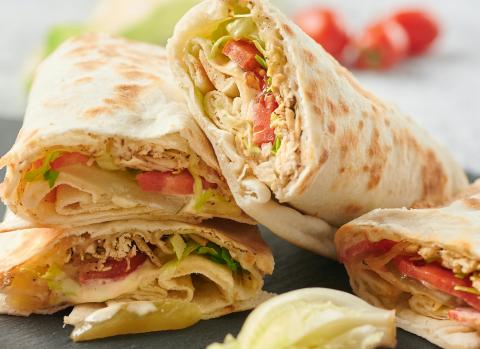
  • 4 (160g) Wholewheat Tortillas

This recipe has been added to your Meal Planner.

Allergy Disclaimer

Always check the label of each ingredient for allergy warnings.

Method

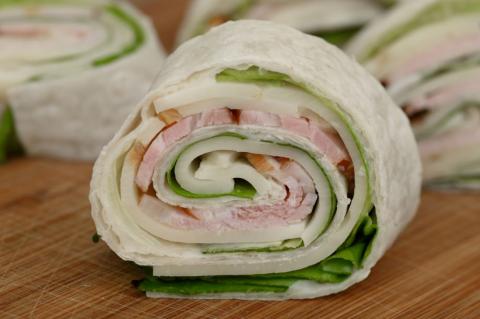
  1. Spread each tortilla evenly with mayonnaise making sure it goes to the edges.
  2. Add one filling and two lettuce leaves to each tortilla.
  3. Roll each tortilla tightly, pressing gently to seal the edges.
  4. Using a sharp knife cut each tortilla into six pieces then serve.

Cost Saver Tips

A good use of leftovers in the fridge.

Tips for Kids

They will enjoy preparing the pinwheels and choosing their favourite fillings.

Nutritional Information

Based on a single serving of 80g (% of an adult's reference intake)

Energy

175 kcals ( 9 %)

736 kJ ( 9 %)

Fat

2 g ( 10 %)

Saturates

23.4 g ( %)

Sugar

1.4 g ( 1 %)

Salt

0.9 g ( 16 %)

Detailed nutritional information

Per 100g Per 80g serving
Energy Kcals 219 175
Energy Kj 920 736
Protein 11 g 8.8 g
Total Fat g g
Saturated Fat 2.5 g 2 g
Carbohydrates 29.3 g 23.4 g
Total Sugars 1.8 g 1.4 g
NSP Fibre 1.1 g 0.9 g
Sodium 471 mg 471 mg
Salt 1.2 g 0.9 g

Find out about nutritional labelling

Nutrition labels on the front of packaging

  • Most of the big supermarkets and many food manufacturers display nutritional information on the front of pre-packed food.
  • Front of pack nutrition labels provide information on the number of grams of fat, saturated fat, sugars and salt and the amount of energy (in kJ and kcal) in a serving or portion of a recipe.
  • The labels also include information about reference intakes (expressed as a percentage) which are guidelines about the approximate amount of particular nutrients and energy required for a healthy diet.
  • The colour coding tells you at a glance if the food has high (red), medium (amber) or low (green) amounts of fat, saturated fat, sugars and salt.
  • The more greens on the label, the healthier the choice
  • Amber means neither high nor low, so you can eat foods with all or mostly ambers on the label most of the time.
  • Reds on the label means the food is high in that nutrient and these are the foods we should cut down on. Try to eat these foods less often and in small amounts.

Food shopping tips

If you’re trying to decide which product to choose, check to see if there's a nutrition label on the front of the pack. This will help you to quickly assess how your choices stack up. You will often find a mixture of red, amber and green colour coding for the nutrients. So when you're choosing between similar products, try to go for more greens and ambers and fewer reds if you want to make a healthier choice.

Back to top

Ingredients

  • 8 Eggs
  • 4 Medium Slices Wholemeal Bread
  • 4 Teaspoons (12g) Vegetable Oil
  • 1 Pinch Black Pepper to taste
  • 4 Teaspoons (20g) Low Fat Spread

This recipe has been added to your Meal Planner.

Allergy Disclaimer

Always check the label of each ingredient for allergy warnings.

Method

  1. Add 1 teaspoon of oil to the frying pan and heat to medium hot.
  2. Crack 2 eggs into a bowl or cup. Beat them together with the black pepper then pour into the frying pan.
  3. Stir with a fork until the egg starts to set then cook until it is set.
  4. Fold the omelette over in the pan. Spread a slice of toast with 1 teaspoon of low fat spread and serve the omelette on top.  
  5. Repeat the steps above to make another 3 omelettes.

Cost Saver Tips

Serve with salad for a light meal option and try adding some boiled potatoes for a main meal.
Tips for Kids

Choose their favourite fillings to make this omelette super tasty – such as cheese, ham, smoked salmon, peppers, mushrooms or sweetcorn. If they aren't keen on wholemeal toast, try 50:50.

Nutritional Information

Based on a single serving of 140g (% of an adult's reference intake)

Energy

286 kcals ( 14 %)

1,199 kJ ( 14 %)

Fat

3.6 g ( 18 %)

Saturates

19.9 g ( %)

Sugar

1.4 g ( 2 %)

Salt

0.9 g ( 15 %)

Detailed nutritional information

Per 100g Per 140g serving
Energy Kcals 204 286
Energy Kj 857 1,199
Protein 12.3 g 17.2 g
Total Fat g g
Saturated Fat 2.6 g 3.6 g
Carbohydrates 14.2 g 19.9 g
Total Sugars 1 g 1.4 g
NSP Fibre 2.4 g 3.4 g
Sodium 271 mg 379 mg
Salt 0.7 g 0.9 g

Find out about nutritional labelling

Nutrition labels on the front of packaging

  • Most of the big supermarkets and many food manufacturers display nutritional information on the front of pre-packed food.
  • Front of pack nutrition labels provide information on the number of grams of fat, saturated fat, sugars and salt and the amount of energy (in kJ and kcal) in a serving or portion of a recipe.
  • The labels also include information about reference intakes (expressed as a percentage) which are guidelines about the approximate amount of particular nutrients and energy required for a healthy diet.
  • The colour coding tells you at a glance if the food has high (red), medium (amber) or low (green) amounts of fat, saturated fat, sugars and salt.
  • The more greens on the label, the healthier the choice
  • Amber means neither high nor low, so you can eat foods with all or mostly ambers on the label most of the time.
  • Reds on the label means the food is high in that nutrient and these are the foods we should cut down on. Try to eat these foods less often and in small amounts.

Food shopping tips
If you’re trying to decide which product to choose, check to see if there's a nutrition label on the front of the pack. This will help you to quickly assess how your choices stack up. You will often find a mixture of red, amber and green colour coding for the nutrients. So when you're choosing between similar products, try to go for more greens and ambers and fewer reds if you want to make a healthier choice.
Back to top

Ingredients

  • 6 (330g) Plums
  • 4 (60g) Digestive Biscuits
  • 3 Tablespoons (120g) Low Fat Plain Yoghurt
  • 6 Tablespoons (90ml) Water

This recipe has been added to your Meal Planner.

Allergy Disclaimer

Always check the label of each ingredient for allergy warnings.

Method

  1. For each plum, cut into the plum with a knife until it touches the stone, then cut around the stone until the plum breaks in half. Remove the stone and cut each plum into quarters.
  2. Put the plums in a saucepan with the water, bring to the boil and then simmer until soft, approximately 7-8 minutes. Allow the plums to cool.
  3. Meanwhile, crush the biscuits with the back of a spoon and divide between 4 small dishes. Press the biscuit down with the back of a spoon.
  4. Spread the yoghurt over the crushed biscuits and add the plums to the top, drizzling on the juice. Then serve, can be eaten hot or cold.

Time Saver Tips

Prepare plums in advance. Could try with tinned fruit e.g. peaches.

Cost Saver Tips

Use leftover fruit.

Tips for Kids

They will enjoy crushing the biscuits

Nutritional Information

Based on a single serving of 144g (% of an adult's reference intake)

Energy

115 kcals ( 6 %)

484 kJ ( 6 %)

Fat

1.4 g ( 7 %)

Saturates

19.7 g ( %)

Sugar

11.5 g ( 13 %)

Salt

0.3 g ( 5 %)

Detailed nutritional information

Per 100g Per 144g serving
Energy Kcals 80 115
Energy Kj 336 484
Protein 2.1 g 3 g
Total Fat g g
Saturated Fat 1 g 1.4 g
Carbohydrates 13.7 g 19.7 g
Total Sugars 8 g 11.5 g
NSP Fibre 1.1 g 1.6 g
Sodium 81 mg 117 mg
Salt 0.2 g 0.3 g

Find out about nutritional labelling

Nutrition labels on the front of packaging

  • Most of the big supermarkets and many food manufacturers display nutritional information on the front of pre-packed food.
  • Front of pack nutrition labels provide information on the number of grams of fat, saturated fat, sugars and salt and the amount of energy (in kJ and kcal) in a serving or portion of a recipe.
  • The labels also include information about reference intakes (expressed as a percentage) which are guidelines about the approximate amount of particular nutrients and energy required for a healthy diet.
  • The colour coding tells you at a glance if the food has high (red), medium (amber) or low (green) amounts of fat, saturated fat, sugars and salt.
  • The more greens on the label, the healthier the choice
  • Amber means neither high nor low, so you can eat foods with all or mostly ambers on the label most of the time.
  • Reds on the label means the food is high in that nutrient and these are the foods we should cut down on. Try to eat these foods less often and in small amounts.

Food shopping tips

If you’re trying to decide which product to choose, check to see if there's a nutrition label on the front of the pack. This will help you to quickly assess how your choices stack up. You will often find a mixture of red, amber and green colour coding for the nutrients. So when you're choosing between similar products, try to go for more greens and ambers and fewer reds if you want to make a healthier choice.

Back to top

Ingredients

  • Eggs

This recipe has been added to your Meal Planner.

Allergy Disclaimer

Always check the label of each ingredient for allergy warnings.

Method


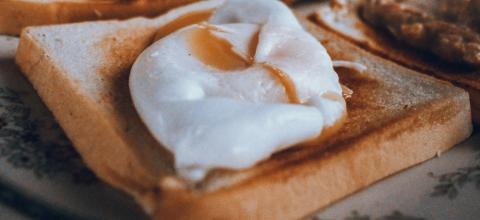
  1. Add boiling water to a medium sized pan and turn down the heat so it's barely simmering.
  2. Crack an egg into a cup, then slowly pour it into the water. Repeat with each egg.
  3. Cook each egg for 3-4 minutes depending how running you like the yolk.
  4. Gently remove from the pan using a slotted spoon to drain the water.


Cost Saver Tips

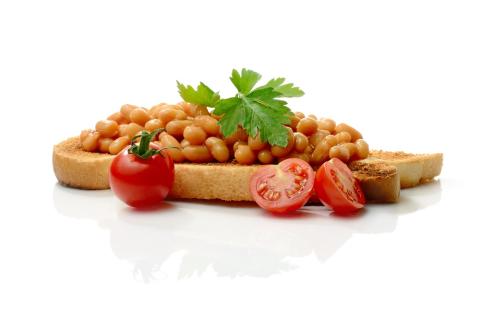
Poached eggs are great served with some toast. Or why not see if your little one enjoys trying poached egg and baked beans for a healthy breakfast or lunch? (Remember, reduced-sugar and low-salt baked beans are healthier.)

Tips for Kids

A poached egg on a slice of wholemeal bread is a great way to get some more fibre into your little one’s meals.

Nutritional Information

Based on a single serving of 50g (% of an adult's reference intake)

Energy

75 kcals ( 4 %)

313 kJ ( 4 %)

Fat

1.3 g ( 8 %)

Saturates

0.1 g ( %)

Sugar

0.1 g ( 1 %)

Salt

0.2 g ( 4 %)

Detailed nutritional information

Per 100g Per 50g serving
Energy Kcals 149 75
Energy Kj 626 313
Protein 13.3 g 6.7 g
Total Fat g g
Saturated Fat 3 g 1.3 g
Carbohydrates 0.1 g 0.1 g
Total Sugars 0.1 g 0.1 g
NSP Fibre 0 g 0 g
Sodium 121 mg 61 mg
Salt 0.3 g 0.2 g

Find out about nutritional labelling

Nutrition labels on the front of packaging

  • Most of the big supermarkets and many food manufacturers display nutritional information on the front of pre-packed food.
  • Front of pack nutrition labels provide information on the number of grams of fat, saturated fat, sugars and salt and the amount of energy (in kJ and kcal) in a serving or portion of a recipe.
  • The labels also include information about reference intakes (expressed as a percentage) which are guidelines about the approximate amount of particular nutrients and energy required for a healthy diet.
  • The colour coding tells you at a glance if the food has high (red), medium (amber) or low (green) amounts of fat, saturated fat, sugars and salt.
  • The more greens on the label, the healthier the choice
  • Amber means neither high nor low, so you can eat foods with all or mostly ambers on the label most of the time.
  • Reds on the label means the food is high in that nutrient and these are the foods we should cut down on. Try to eat these foods less often and in small amounts.

Food shopping tips

If you’re trying to decide which product to choose, check to see if there's a nutrition label on the front of the pack. This will help you to quickly assess how your choices stack up. You will often find a mixture of red, amber and green colour coding for the nutrients. So when you're choosing between similar products, try to go for more greens and ambers and fewer reds if you want to make a healthier choice.

Back to top

Ingredients

  • 1 Teaspoon (2g) Cinnamon
  • 2 Teaspoons (6g) Paprika
  • 2 (320g) Red Peppers
  • 4 (12g) Garlic Cloves
  • 2 Teaspoons (2g) Oregano
  • 2 (190g) Pitta Breads
  • (500g) Pork Mince
  • 2 Eggs
  • 4 Teaspoons (12g) Vegetable Oil
  • 6 (540g) Parsnips
  • ¾ Can (280g) Chopped Tomatoes
  • 2 optional Tablespoons (6g) Parsley

This recipe has been added to your Meal Planner.

Allergy Disclaimer

Always check the label of each ingredient for allergy warnings.

Method

  1. Preheat the oven to 180°C / 160°C fan oven / 325°F / gas mark 4.
  2. Deseed and chop the peppers, peel the garlic and tear the pitta bread into pieces
  3. In a food processor blitz the pepper, 2 cloves of garlic, pitta bread, cinnamon, oregano and half the paprika until finely chopped.
  4. Crack the eggs into a large bowl and beat well with a fork, then add the mince and mixture from food processor and mix together. Add black pepper if desired.
  5. Rub the oil on a baking tray then shape the mixture into 16 meatballs and place evenly spaced on the tray.
  6. Bake in oven for approximately 20 minutes until golden and cooked through.
  7. Meanwhile peel the parsnips and dice into 2cm pieces. In a pan cover with boiling water and cook over a high heat for 10-15 minutes until soft.
  8. Crush 2 garlic cloves or finely chop and put in a small pan along with remaining paprika and chopped tomatoes or passata, cook over a medium heat for approximately 5 minutes.
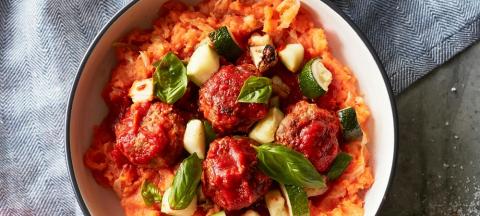
  9. Drain the parsnips and mash together with a fork or masher. Place the mash in the middle of a plate with meatballs on top. Pour some sauce over the top and top with chopped parsley if desired.

Time Saver Tips

Make meatballs in advance and keep in fridge until ready to cook.

Tips for Kids

Let them help to shape the meatballs. They may prefer it with mashed potatoes.

Nutritional Information

Based on a single serving of 435g (% of an adult's reference intake)

Energy

483 kcals ( 24 %)

2,027 kJ ( 24 %)

Fat

6.5 g ( 33 %)

Saturates

47 g ( %)

Sugar

15.7 g ( 17 %)

Salt

0.4 g ( 7 %)

Detailed nutritional information

Per 100g Per 435g serving
Energy Kcals 111 483
Energy Kj 466 2,027
Protein 8.8 g 38.3 g
Total Fat g g
Saturated Fat 1.5 g 6.5 g
Carbohydrates 10.8 g 47 g
Total Sugars 3.6 g 15.7 g
NSP Fibre 2.6 g 11.3 g
Sodium 60 mg 261 mg
Salt 0.1 g 0.4 g

Find out about nutritional labelling

Nutrition labels on the front of packaging

  • Most of the big supermarkets and many food manufacturers display nutritional information on the front of pre-packed food.
  • Front of pack nutrition labels provide information on the number of grams of fat, saturated fat, sugars and salt and the amount of energy (in kJ and kcal) in a serving or portion of a recipe.
  • The labels also include information about reference intakes (expressed as a percentage) which are guidelines about the approximate amount of particular nutrients and energy required for a healthy diet.
  • The colour coding tells you at a glance if the food has high (red), medium (amber) or low (green) amounts of fat, saturated fat, sugars and salt.
  • The more greens on the label, the healthier the choice
  • Amber means neither high nor low, so you can eat foods with all or mostly ambers on the label most of the time.
  • Reds on the label means the food is high in that nutrient and these are the foods we should cut down on. Try to eat these foods less often and in small amounts.

Food shopping tips

If you’re trying to decide which product to choose, check to see if there's a nutrition label on the front of the pack. This will help you to quickly assess how your choices stack up. You will often find a mixture of red, amber and green colour coding for the nutrients. So when you're choosing between similar products, try to go for more greens and ambers and fewer reds if you want to make a healthier choice.

Back to top

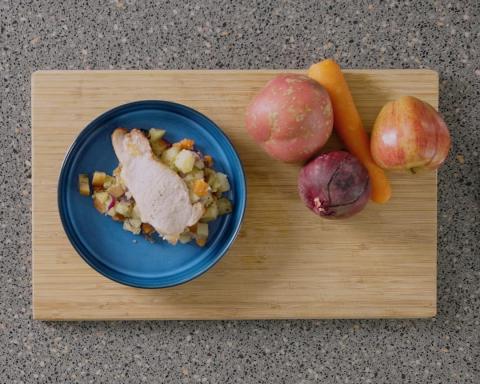
Ingredients

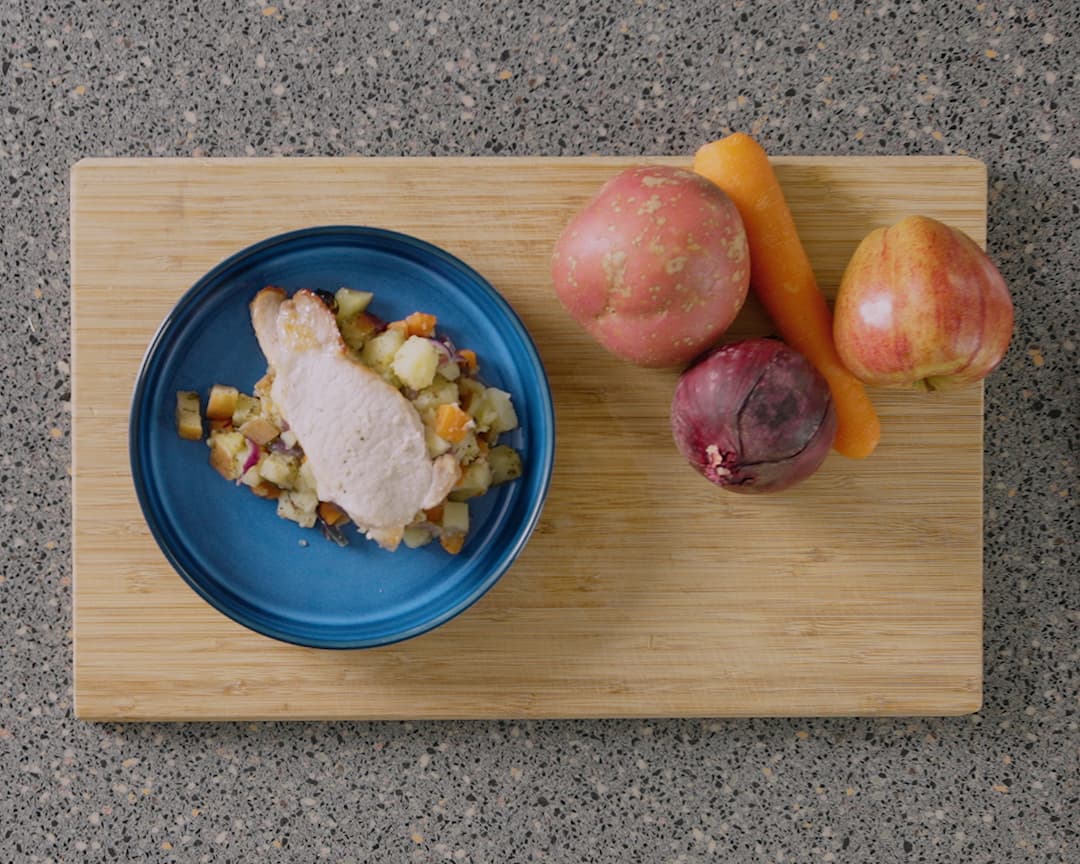
  • 4 (630g) Pork Chops
  • 8 Medium Sized (680g) Potatoes
  • 4 Medium Sized (320g) Carrots
  • 1 Medium Sized (150g) Red onion
  • 2 Medium Sized (200g) Eating Apples
  • 2 Tablespoons (20g) Vegetable Oil
  • 1 Teaspoon (1g) Dried Mixed Herbs
  • 1 Pinch Ground Black Pepper

This recipe has been added to your Meal Planner.

Allergy Disclaimer

Always check the label of each ingredient for allergy warnings.

Method

  1. Preheat the oven to 200°C / 180°C fan oven / 400°F / gas mark 6.
  2. Wash and peel the potatoes and carrots and cut into chunks. Peel and slice the onion. Wash the apples, then core and cut them into quarters.
  3. Boil the potatoes and carrots together for 5 minutes, then drain.
  4. Toss the potatoes, carrots, apple and onion together with the oil, herbs and black pepper on an ovenproof tray.
  5. Trim the fat off the pork chops and lay them on top of the vegetables. Roast in the oven for about 30 minutes, turning the chops halfway through cooking.
  6. Enjoy hot.

Time Saver Tips

Why not make this up to a day ahead (leave out the apples for now) so you can store it in the fridge ready for later? Then just pop the apples in before cooking.

Cost Saver Tips

This is a great way to use whatever vegetables are on offer – you could try courgettes, sweet potatoes, leeks, cherry tomatoes, parsnips or butternut squash for a change. It’s a good idea to try and go for what’s seasonal for the best bargains. You could try pork loin, other types of meat or even fish to add to the vegetables. Bear in mind that the cooking time for these alternatives may vary, so make sure the meat or fish is cooked through before plating up.

Tips for Kids

How about adding some sage or chilli for a different taste? Or you could see if your wee one likes this with wholegrain mustard and some green vegetables. Your little one will love helping you to mix all the veggies.

Nutritional Information

Based on a single serving of 315g (% of an adult's reference intake)

Energy

406 kcals ( 20 %)

1,711 kJ ( 20 %)

Fat

3.5 g ( 18 %)

Saturates

37.8 g ( %)

Sugar

13.2 g ( 15 %)

Salt

0.2 g ( 4 %)

Detailed nutritional information

Per 100g Per 315g serving
Energy Kcals 129 406
Energy Kj 543 1,711
Protein 11 g 34.8 g
Total Fat g g
Saturated Fat 1.1 g 3.5 g
Carbohydrates 12 g 37.8 g
Total Sugars 4.2 g 13.2 g
NSP Fibre 1.5 g 4.7 g
Sodium 26 mg 81 mg
Salt 0.1 g 0.2 g

Find out about nutritional labelling

Nutrition labels on the front of packaging

  • Most of the big supermarkets and many food manufacturers display nutritional information on the front of pre-packed food.
  • Front of pack nutrition labels provide information on the number of grams of fat, saturated fat, sugars and salt and the amount of energy (in kJ and kcal) in a serving or portion of a recipe.
  • The labels also include information about reference intakes (expressed as a percentage) which are guidelines about the approximate amount of particular nutrients and energy required for a healthy diet.
  • The colour coding tells you at a glance if the food has high (red), medium (amber) or low (green) amounts of fat, saturated fat, sugars and salt.
  • The more greens on the label, the healthier the choice
  • Amber means neither high nor low, so you can eat foods with all or mostly ambers on the label most of the time.
  • Reds on the label means the food is high in that nutrient and these are the foods we should cut down on. Try to eat these foods less often and in small amounts.

Food shopping tips

If you’re trying to decide which product to choose, check to see if there's a nutrition label on the front of the pack. This will help you to quickly assess how your choices stack up. You will often find a mixture of red, amber and green colour coding for the nutrients. So when you're choosing between similar products, try to go for more greens and ambers and fewer reds if you want to make a healthier choice.

Back to top

Ingredients

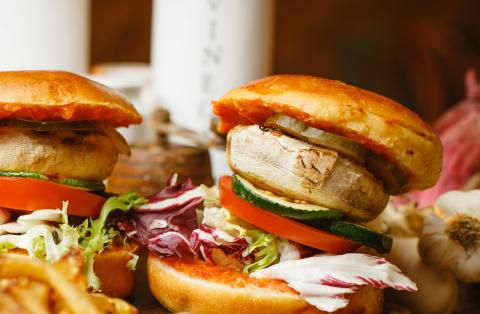
  • 4 large sized (300g) Portobello Mushrooms
  • 2 Tablespoons (30g) Balsamic Vinegar
  • 1 Reduced salt if possible Tablespoon (15g) Soy Sauce
  • 2 Tablespoons (20g) Olive Oil
  • 1 Tablespoon (10g) Chopped Parsley
  • 4 (448g) Wholemeal Rolls
  • 1 (150g) Red onion
  • 4 Leaves (20g) Lettuce
  • 4 (340g) Tomatoes
  • 4 or other reduced fat cheese Slices (80g) Reduced Fat Leerdammer Cheese

This recipe has been added to your Meal Planner.

Allergy Disclaimer

Always check the label of each ingredient for allergy warnings.

Method

  1. In a large bowl, mix together the Balsamic vinegar, soy sauce and oil.
  2. Chop the parsley and add to the bowl.
  3. Wipe the mushrooms, remove their stalks and add them to the bowl with the Balsamic vinegar mixture. Use a spoon or your hands to make sure the mushrooms are evenly coated, and leave to stand for 20-30 minutes.  
  4. While the mushrooms are marinating, peel and slice the onion into 4 thick slices, wash and slice the tomatoes and wash and shred the lettuce.
  5. Place the mushrooms and onion slices on a grill pan, and grill for 5-7 minutes on each side, until they are tender when pierced with a fork.  
  6. Cut the rolls in half, then place the mushrooms, followed by the onions, lettuce, tomatoes and cheese on the bottom half.  Replace top half and enjoy.

Time Saver Tips

Mushrooms can be marinated ahead of time and kept in the fridge.

Cost Saver Tips

Use a teaspoon of dried parsley instead of fresh parsley.

Tips for Kids

They can help to mix the marinade and to coat the mushrooms, and to shred the lettuce with their hands.

Nutritional Information

Based on a single serving of 333g (% of an adult's reference intake)

Energy

411 kcals ( 21 %)

1,730 kJ ( 21 %)

Fat

3.7 g ( 19 %)

Saturates

56.4 g ( %)

Sugar

8.7 g ( 10 %)

Salt

1.6 g ( 27 %)

Detailed nutritional information

Per 100g Per 333g serving
Energy Kcals 123 411
Energy Kj 519 1,730
Protein 6.1 g 20.4 g
Total Fat g g
Saturated Fat 1.1 g 3.7 g
Carbohydrates 16.9 g 56.4 g
Total Sugars 2.6 g 8.7 g
NSP Fibre 1.7 g 5.8 g
Sodium 198 mg 659 mg
Salt 0.5 g 1.6 g

Find out about nutritional labelling

Nutrition labels on the front of packaging

  • Most of the big supermarkets and many food manufacturers display nutritional information on the front of pre-packed food.
  • Front of pack nutrition labels provide information on the number of grams of fat, saturated fat, sugars and salt and the amount of energy (in kJ and kcal) in a serving or portion of a recipe.
  • The labels also include information about reference intakes (expressed as a percentage) which are guidelines about the approximate amount of particular nutrients and energy required for a healthy diet.
  • The colour coding tells you at a glance if the food has high (red), medium (amber) or low (green) amounts of fat, saturated fat, sugars and salt.
  • The more greens on the label, the healthier the choice
  • Amber means neither high nor low, so you can eat foods with all or mostly ambers on the label most of the time.
  • Reds on the label means the food is high in that nutrient and these are the foods we should cut down on. Try to eat these foods less often and in small amounts.

Food shopping tips

If you’re trying to decide which product to choose, check to see if there's a nutrition label on the front of the pack. This will help you to quickly assess how your choices stack up. You will often find a mixture of red, amber and green colour coding for the nutrients. So when you're choosing between similar products, try to go for more greens and ambers and fewer reds if you want to make a healthier choice.

Back to top
Subscribe to Eat Better Feel Better