This article was created with

eat-better-feel-better-logo-2.png

Ingredients

  • 4 Medium Sized (600g) White Fish Fillets
  • 4 Large Sized (800g) Potatoes
  • 1 Tablespoons (10g) Vegetable Oil
  • 1 Medium Sized (150g) Onion
  • 2 Sticks (60g) Celery
  • 6 Frozen Tablespoons (160g) Peas
  • 4 Tablespoons (60g) Margarine
  • 2 ½ Tablespoons (50g) Plain Flour
  • 3 Cups (568ml) Semi-Skimmed Milk
  • 1 Medium Sized (85g) Tomato
  • 3 Reduced Fat Tablespoons (75g) Cheddar Cheese

This recipe has been added to your Meal Planner.

Allergy Disclaimer

Always check the label of each ingredient for allergy warnings.

Method

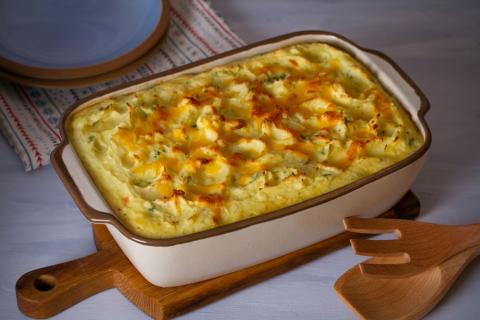
  1. Preheat the oven to 180oC / 160oC fan oven / 350oF / gas mark 4.
  2. Peel the potatoes and cut into small pieces, boil in a pan until soft (approximately 10-15 minutes).
  3. Peel the onion then chop the celery into small pieces. Heat oil in a pan and add onions and celery for around 2 minutes until they soften.
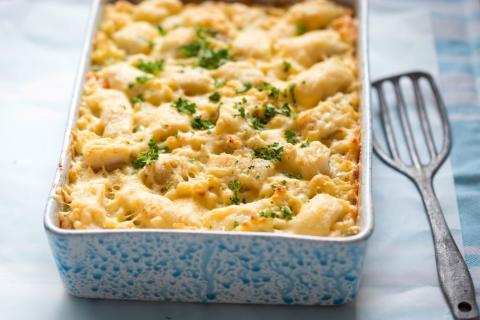
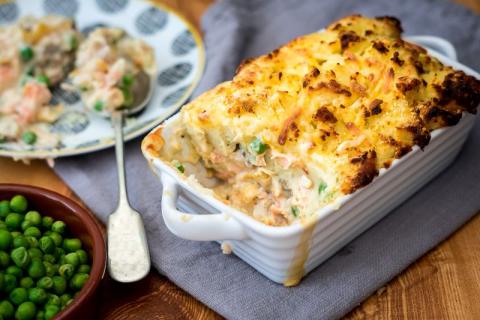
  4. Remove skin from fish if required and then cut into cubes. Place the onion, celery, peas and fish into an oven proof dish and mix together.
  5. Melt the low fat spread in a pan, remove from heat and stir in the flour to make a paste. Heat again for 1 minute and then gradually add the milk, stirring continuously until the sauce thickens. Leave a small amount of milk to mash potatoes. Pour sauce over fish.
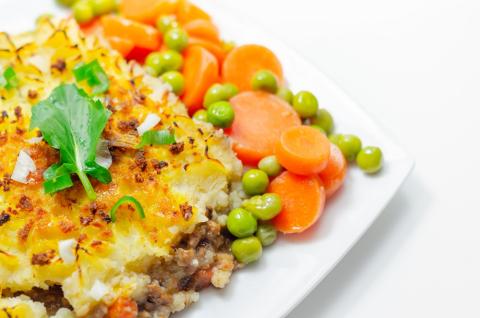
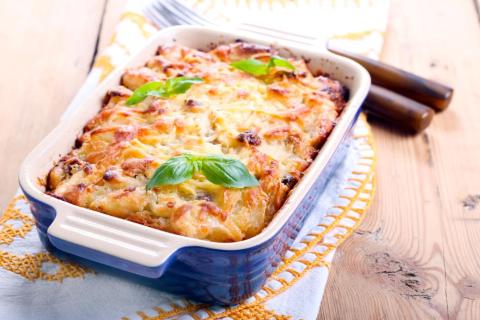
  6. Drain the potatoes and mash using the remaining milk. Spread the mash over the fish, leaving no gaps. Top with grated cheese and sliced tomato.
  7. Bake in oven for 20-25 minutes until golden brown.

Time Saver Tips

Can be prepared in advance and cooked when required, additional cooking time will be required.

Cost Saver Tips

Look for special offers on white fish, frozen may be cheaper.

Tips for Kids

You could take them on a trip to your local fishmonger and have them pick out the fish themselves. Later, why not let them help with assembling the pie?

Nutritional Information

Based on a single serving of 585g (% of an adult's reference intake)

Energy

527 kcals ( 26 %)

2,211 kJ ( 26 %)

Fat

5.9 g ( 29 %)

Saturates

63.2 g ( %)

Sugar

14 g ( 16 %)

Salt

1 g ( 17 %)

Detailed nutritional information

Per 100g Per 585g serving
Energy Kcals 90 527
Energy Kj 378 2,211
Protein 5.8 g 33.9 g
Total Fat g g
Saturated Fat 1 g 5.9 g
Carbohydrates 10.8 g 63.2 g
Total Sugars 2.4 g 14 g
NSP Fibre 1.1 g 6.4 g
Sodium 74 mg 433 mg
Salt 0.2 g 1 g

Find out about nutritional labelling

Nutrition labels on the front of packaging

  • Most of the big supermarkets and many food manufacturers display nutritional information on the front of pre-packed food.
  • Front of pack nutrition labels provide information on the number of grams of fat, saturated fat, sugars and salt and the amount of energy (in kJ and kcal) in a serving or portion of a recipe.
  • The labels also include information about reference intakes (expressed as a percentage) which are guidelines about the approximate amount of particular nutrients and energy required for a healthy diet.
  • The colour coding tells you at a glance if the food has high (red), medium (amber) or low (green) amounts of fat, saturated fat, sugars and salt.
  • The more greens on the label, the healthier the choice
  • Amber means neither high nor low, so you can eat foods with all or mostly ambers on the label most of the time.
  • Reds on the label means the food is high in that nutrient and these are the foods we should cut down on. Try to eat these foods less often and in small amounts.

Food shopping tips

If you’re trying to decide which product to choose, check to see if there's a nutrition label on the front of the pack. This will help you to quickly assess how your choices stack up. You will often find a mixture of red, amber and green colour coding for the nutrients. So when you're choosing between similar products, try to go for more greens and ambers and fewer reds if you want to make a healthier choice.
Back to top

Ingredients

  • Cooked And Peeled (200g) Prawns
  • 13 (200g) Cherry Tomatoes
  • 4 (40g) Spring Onions
  • 4 Portions (120g) Lettuce
  • 2 Tablespoons (20g) Olive Oil
  • 1 Lemon
  • 3 Tablespoons (45g) Reduced Calorie Mayonnaise
  • 2 Tablespoons (30g) Ketchup

This recipe has been added to your Meal Planner.

Allergy Disclaimer

Always check the label of each ingredient for allergy warnings.

Method

  1. Make the dressing by whisking the mayonnaise, ketchup and juice of half a lemon together. Add a splash of water if it’s a little thick.
  2. Wash the tomatoes, spring onions and lettuce.
  3. Halve the tomatoes, slice the spring onions and shred the lettuce.
  4. Put the prawns, tomatoes, spring onions and lettuce into a large bowl. Add the olive oil and juice of half a lemon and toss gently.
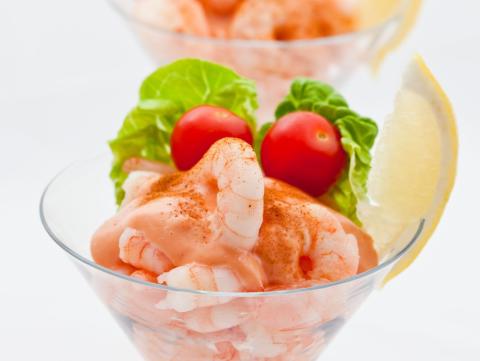
  5. Serve the prawn cocktail in a glass with the dressing drizzled on top.

Cost Saver Tips

Frozen prawns can be used instead of fresh prawns.

Tips for Kids

Get your children to help mix the salad and dressing ingredients together. They might also enjoy shredding the lettuce with their hands.

Nutritional Information

Based on a single serving of 168g (% of an adult's reference intake)

Energy

153 kcals ( 8 %)

640 kJ ( 8 %)

Fat

0.9 g ( 5 %)

Saturates

5.1 g ( %)

Sugar

4.7 g ( 5 %)

Salt

2.6 g ( 43 %)

Detailed nutritional information

Per 100g Per 168g serving
Energy Kcals 91 153
Energy Kj 381 640
Protein 7.4 g 12.4 g
Total Fat g g
Saturated Fat 0.5 g 0.9 g
Carbohydrates 3.1 g 5.1 g
Total Sugars 2.8 g 4.7 g
NSP Fibre 0.6 g 1 g
Sodium 611 mg 1,027 mg
Salt 1.5 g 2.6 g

Find out about nutritional labelling

Nutrition labels on the front of packaging

  • Most of the big supermarkets and many food manufacturers display nutritional information on the front of pre-packed food.
  • Front of pack nutrition labels provide information on the number of grams of fat, saturated fat, sugars and salt and the amount of energy (in kJ and kcal) in a serving or portion of a recipe.
  • The labels also include information about reference intakes (expressed as a percentage) which are guidelines about the approximate amount of particular nutrients and energy required for a healthy diet.
  • The colour coding tells you at a glance if the food has high (red), medium (amber) or low (green) amounts of fat, saturated fat, sugars and salt.
  • The more greens on the label, the healthier the choice
  • Amber means neither high nor low, so you can eat foods with all or mostly ambers on the label most of the time.
  • Reds on the label means the food is high in that nutrient and these are the foods we should cut down on. Try to eat these foods less often and in small amounts.

Food shopping tips

If you’re trying to decide which product to choose, check to see if there's a nutrition label on the front of the pack. This will help you to quickly assess how your choices stack up. You will often find a mixture of red, amber and green colour coding for the nutrients. So when you're choosing between similar products, try to go for more greens and ambers and fewer reds if you want to make a healthier choice.

Back to top

Ingredients

  • 1 Pack (200g) Cooked And Peeled Frozen Prawns
  • 2 Tablespoons (20g) Vegetable Oil
  • 3 (9g) Garlic Cloves or 2 Teaspoons Garlic Puree
  • 2 Medium (300g) Onions
  • 1 Teaspoon (3g) Curry Powder
  • 2 Teaspoons (2g) Dried Coriander
  • 1 (160g) Red Pepper
  • 3 (255g) Tomatoes
  • 2 Cups (350ml) Water
  • 1 (7g) Chicken or Fish Stock Cube (choose reduced salt whenever possible)
  • 1 Pinch Black Pepper to taste
  • 1 Mug (300g) Easy Cook Rice

This recipe has been added to your Meal Planner.

Allergy Disclaimer

Always check the label of each ingredient for allergy warnings.

Method

  1. Defrost prawns before use. Defrost on a covered plate or in a sealed container on the bottom shelf of the fridge overnight
  2. Peel onions and garlic then dice the onions and finely chop the garlic. Wash and dice the pepper.
  3. Heat the oil in large pan. Fry the onion and garlic for 2 minutes and then add the pepper for a further 2 minutes.
  4. Wash the tomatoes and chop into chunks. Disolve the stock cube in boiling water and add to pan with the tomatoes, curry powder and coriander.
  5. Bring to the boil and then simmer until the sauce begins to thicken. Meanwhile cook the rice as per the instructions on the packet.
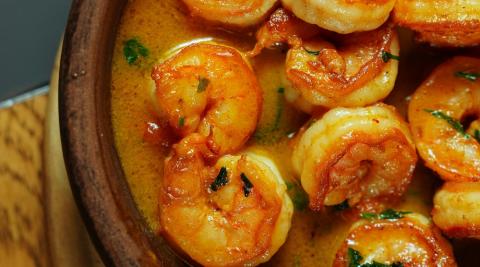
  6. Add prawns to the sauce and bring back to boil and simmer for a further 2 minutes.
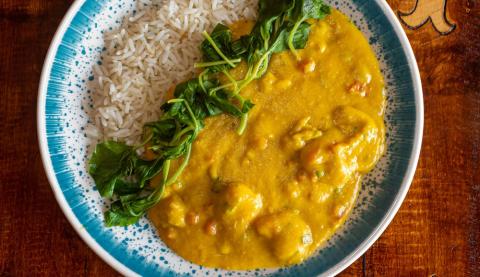
  7. Serve curry on top of rice.

Cost Saver Tips

You could use fresh prawns if you spot them on offer. But frozen prawns are usually a cheaper option, plus they’re really handy to have in your freezer for whenever you want to cook them. Just pop your frozen prawns in the fridge to defrost the night before. Why not try popping any leftover vegetable you have in this? You could even throw in any frozen veg you have in the freezer as a quick and tasty option. If you don’t have fresh tomatoes to hand, tomatoes out of a can work just as well in this.

Tips for Kids

Wee one not the biggest fan of spicy food? You could try a mild curry paste or use less of it to keep things on the cooler side. Why not try a mix of white fish like haddock or pollock and use a few less prawns? It’s a great way for your little one to try different flavours. If you’d like to give your wee one a fibre boost, you could give brown rice a go. Remember, it just takes a little bit longer to cook.
Nutritional Information

Based on a single serving of 469g (% of an adult's reference intake)

Energy

405 kcals ( 20 %)

1,718 kJ ( 20 %)

Fat

0.6 g ( 3 %)

Saturates

81.6 g ( %)

Sugar

7.5 g ( 8 %)

Salt

1 g ( 17 %)

Detailed nutritional information

Per 100g Per 469g serving
Energy Kcals 86 405
Energy Kj 366 1,718
Protein 2.3 g 10.8 g
Total Fat g g
Saturated Fat 0.1 g 0.6 g
Carbohydrates 17.4 g 81.6 g
Total Sugars 1.6 g 7.5 g
NSP Fibre 0.9 g 4.4 g
Sodium 87 mg 409 mg
Salt 0.2 g 1 g

Find out about nutritional labelling

Nutrition labels on the front of packaging

  • Most of the big supermarkets and many food manufacturers display nutritional information on the front of pre-packed food.
  • Front of pack nutrition labels provide information on the number of grams of fat, saturated fat, sugars and salt and the amount of energy (in kJ and kcal) in a serving or portion of a recipe.
  • The labels also include information about reference intakes (expressed as a percentage) which are guidelines about the approximate amount of particular nutrients and energy required for a healthy diet.
  • The colour coding tells you at a glance if the food has high (red), medium (amber) or low (green) amounts of fat, saturated fat, sugars and salt.
  • The more greens on the label, the healthier the choice
  • Amber means neither high nor low, so you can eat foods with all or mostly ambers on the label most of the time.
  • Reds on the label means the food is high in that nutrient and these are the foods we should cut down on. Try to eat these foods less often and in small amounts.

Food shopping tips

If you’re trying to decide which product to choose, check to see if there's a nutrition label on the front of the pack. This will help you to quickly assess how your choices stack up. You will often find a mixture of red, amber and green colour coding for the nutrients. So when you're choosing between similar products, try to go for more greens and ambers and fewer reds if you want to make a healthier choice.

Back to top

Ingredients

  • 11 Tablespoons (225g) Plain Flour
  • ½ Pinch (1g) Salt
  • 7  Tablespoons (110g) Margarine (Don't allow this to soften)
  • 10 Tablespoons (100ml) Water
  • 1 medium sized (4kg) Pumpkin
  • 2 (100g) Eggs
  • 5 Tablespoons (100g) Sugar
  • 2 Teaspoons (6g) Cinnamon

This recipe has been added to your Meal Planner.

Allergy Disclaimer

Always check the label of each ingredient for allergy warnings.

Method

  1. Place flour and salt into a bowl and add margarine. It is important to use the margarine straight from the fridge so it is chilled. Rub the margarine and flour between fingers and thumbs until it looks like breadcrumbs.
  2. Gradually add the water and stir until the ingredients stick together. The pastry should not be too sticky you may not use all the water. Wrap in cling film and put in fridge for 1 hour.
  3. Preheat the oven to 180°C / 160°C fan oven / 350°F / gas mark 4.
  4. Roll pastry out flat using a rolling pin or a glass bottle (or similar). Try to keep it cool, you could wash your hands in cold water before taking it out of the fridge.  The pastry should be a big enough circle to fill a 20cm wide flan dish/ tin.
  5. Line the ring with greaseproof (baking) paper and then place the pastry into the tin. Use your fingers to ensure it molds into the sides, then use a table knife to trim any overlapping the edges. Prick the pastry gently with a fork.
  6. Place another piece of greaseproof paper on top of the pastry and fill the tin with baking beans (you could use dried pulses or rice as an alternative). Bake in oven for 12 minutes then remove the beans and paper from the top of the pastry and return to oven for a further 5 minutes.
  7. Meanwhile remove the flesh from the pumpkin by cutting the top off and use a knife and spoon to remove the flesh, discarding any seeds.
  8. Cut the pumpkin flesh into similar size pieces and cook in boiling water until soft, approximately 15 minutes. Drain and mash with a masher or fork then leave to cool.
  9. Once the pastry has been removed from the oven set temperature to 190°C / 170°C fan oven / 375°F / gas mark 5.
  10. Crack the eggs in a bowl and mix using a fork or whisk, adding in the sugar then stir into the pumpkin. Add cinnamon if desired.
  11. Pour the pumpkin filling into the pastry case and bake in oven for about 45 minutes until the filling has set. Allow to cool then portion and serve.

Time Saver Tips

Make pastry in advance or buy a ready made sweet pastry case.

Cost Saver Tips

A good use of the inside of a carved pumpkin

Tips for Kids

This recipe uses the inside of their pumpkin and they will enjoy scooping out the flesh and carving it. They can also help with rolling out the pastry.

Nutritional Information

Based on a single serving of 155g (% of an adult's reference intake)

Energy

267 kcals ( 13 %)

1,113 kJ ( 13 %)

Fat

4 g ( 20 %)

Saturates

36.6 g ( %)

Sugar

14.9 g ( 17 %)

Salt

0.3 g ( 5 %)

Detailed nutritional information

Per 100g Per 155g serving
Energy Kcals 172 267
Energy Kj 718 1,113
Protein 3.1 g 4.8 g
Total Fat g g
Saturated Fat 2.6 g 4 g
Carbohydrates 23.6 g 36.6 g
Total Sugars 9.6 g 14.9 g
NSP Fibre 1.1 g 1.7 g
Sodium 82 mg 127 mg
Salt 0.2 g 0.3 g

Find out about nutritional labelling

Nutrition labels on the front of packaging

  • Most of the big supermarkets and many food manufacturers display nutritional information on the front of pre-packed food.
  • Front of pack nutrition labels provide information on the number of grams of fat, saturated fat, sugars and salt and the amount of energy (in kJ and kcal) in a serving or portion of a recipe.
  • The labels also include information about reference intakes (expressed as a percentage) which are guidelines about the approximate amount of particular nutrients and energy required for a healthy diet.
  • The colour coding tells you at a glance if the food has high (red), medium (amber) or low (green) amounts of fat, saturated fat, sugars and salt.
  • The more greens on the label, the healthier the choice
  • Amber means neither high nor low, so you can eat foods with all or mostly ambers on the label most of the time.
  • Reds on the label means the food is high in that nutrient and these are the foods we should cut down on. Try to eat these foods less often and in small amounts.

Food shopping tips

If you’re trying to decide which product to choose, check to see if there's a nutrition label on the front of the pack. This will help you to quickly assess how your choices stack up. You will often find a mixture of red, amber and green colour coding for the nutrients. So when you're choosing between similar products, try to go for more greens and ambers and fewer reds if you want to make a healthier choice.

Back to top

Ingredients

  • 11 Level measuress Tablespoons (225g) Self-Raising Flour
  • 12 Tablespoons (175g) Low Fat Spread
  • 9 Tablespoons (175g) Sugar
  • 1 fresh or defrosted Tub (300g) Raspberries
  • 12 Tablespoons (175g) Oats

This recipe has been added to your Meal Planner.

Allergy Disclaimer

Always check the label of each ingredient for allergy warnings.

Method

  1. Preheat the oven to 190°C / 170°C fan oven / 375°F / gas mark 5
  2. Put the flour into a bowl and mix in the low fat spread using fingers to rub them together
  3. Stir in the oats and sugar then rub in a little more
  4. Line a deep baking tin (20cm x30cm) with greaseproof paper and press half of the mixture into the tin
  5. Squash the raspberries slightly then scatter over the top of the mix
  6. Cover with the remaining mixture and press down firmly
  7. Bake in oven for 20-25 minutes or until golden brown
  8. Leave to cool for 10 minutes then cut into squares

Time Saver Tips

Can be made in advance and once cooled stored in an airtight container

Cost Saver Tips

Frozen raspberries can be cheaper

Tips for Kids

They can help with mixing and squashing the raspberries. As this recipe contains added sugar it’s best kept to mealtimes.

Nutritional Information

Based on a single serving of 50g (% of an adult's reference intake)

Energy

139 kcals ( 7 %)

584 kJ ( 7 %)

Fat

1 g ( 5 %)

Saturates

23.9 g ( %)

Sugar

10.3 g ( 11 %)

Salt

0.3 g ( 5 %)

Detailed nutritional information

Per 100g Per 50g serving
Energy Kcals 278 139
Energy Kj 1,168 584
Protein 5.2 g 2.6 g
Total Fat g g
Saturated Fat 1.9 g 1 g
Carbohydrates 47.8 g 23.9 g
Total Sugars 20.6 g 10.3 g
NSP Fibre 2.9 g 1.5 g
Sodium 197 mg 99 mg
Salt 0.5 g 0.3 g

Find out about nutritional labelling

Nutrition labels on the front of packaging

  • Most of the big supermarkets and many food manufacturers display nutritional information on the front of pre-packed food.
  • Front of pack nutrition labels provide information on the number of grams of fat, saturated fat, sugars and salt and the amount of energy (in kJ and kcal) in a serving or portion of a recipe.
  • The labels also include information about reference intakes (expressed as a percentage) which are guidelines about the approximate amount of particular nutrients and energy required for a healthy diet.
  • The colour coding tells you at a glance if the food has high (red), medium (amber) or low (green) amounts of fat, saturated fat, sugars and salt.
  • The more greens on the label, the healthier the choice
  • Amber means neither high nor low, so you can eat foods with all or mostly ambers on the label most of the time.
  • Reds on the label means the food is high in that nutrient and these are the foods we should cut down on. Try to eat these foods less often and in small amounts.

Food shopping tips

If you’re trying to decide which product to choose, check to see if there's a nutrition label on the front of the pack. This will help you to quickly assess how your choices stack up. You will often find a mixture of red, amber and green colour coding for the nutrients. So when you're choosing between similar products, try to go for more greens and ambers and fewer reds if you want to make a healthier choice.

Back to top

Ingredients

  • 2 Tablespoons (32g) Peanut Butter
  • 2 Teaspoons (16g) Honey
  • 25 Tablespoons (100g) Rice Crispy Cereal
  • 4 (32g) Dried Apricots
  • 4 Tablespoons (40g) Sunflower Seeds

This recipe has been added to your Meal Planner.

Allergy Disclaimer

Always check the label of each ingredient for allergy warnings.

Method

  1. Cut the apricots into small pieces and leave to one side.
  2. Add peanut butter and honey to a small saucepan. Place over a medium heat for 2-3 minutes and stir until the mixture melts.
  3. Remove mixture from the heat and stir in the cereal. Transfer the mixture to a large bowl and then add the apricots and sunflower seeds. Use a wooden spoon or hands to mix together.
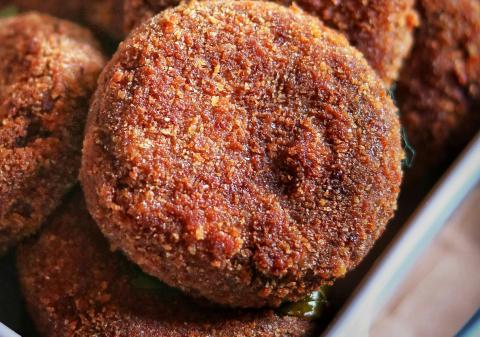
  4. Form mixture into 8 logs or balls then leave to cool, for around 30 minutes.
  5. Once cooled wrap in cling film until required.

Time Saver Tips

Can be made in advance. Try making in bulk and saving for another day.

Cost Saver Tips

Try with other dried fruit, seeds or cereal you already have.

Tips for Kids

They will enjoy mixing it all together with their hands! As this recipe contains added sugar it’s best kept to mealtimes.

Nutritional Information

Based on a single serving of 55g (% of an adult's reference intake)

Energy

224 kcals ( 11 %)

940 kJ ( 11 %)

Fat

1.7 g ( 8 %)

Saturates

31.7 g ( %)

Sugar

9.8 g ( 11 %)

Salt

0.3 g ( 5 %)

Detailed nutritional information

Per 100g Per 55g serving
Energy Kcals 407 224
Energy Kj 1,709 940
Protein 10.1 g 5.6 g
Total Fat g g
Saturated Fat 3 g 1.7 g
Carbohydrates 57.6 g 31.7 g
Total Sugars 17.8 g 9.8 g
NSP Fibre 3.1 g 1.7 g
Sodium 223 mg 123 mg
Salt 0.5 g 0.3 g

Find out about nutritional labelling

Nutrition labels on the front of packaging

  • Most of the big supermarkets and many food manufacturers display nutritional information on the front of pre-packed food.
  • Front of pack nutrition labels provide information on the number of grams of fat, saturated fat, sugars and salt and the amount of energy (in kJ and kcal) in a serving or portion of a recipe.
  • The labels also include information about reference intakes (expressed as a percentage) which are guidelines about the approximate amount of particular nutrients and energy required for a healthy diet.
  • The colour coding tells you at a glance if the food has high (red), medium (amber) or low (green) amounts of fat, saturated fat, sugars and salt.
  • The more greens on the label, the healthier the choice
  • Amber means neither high nor low, so you can eat foods with all or mostly ambers on the label most of the time.
  • Reds on the label means the food is high in that nutrient and these are the foods we should cut down on. Try to eat these foods less often and in small amounts.

Food shopping tips

If you’re trying to decide which product to choose, check to see if there's a nutrition label on the front of the pack. This will help you to quickly assess how your choices stack up. You will often find a mixture of red, amber and green colour coding for the nutrients. So when you're choosing between similar products, try to go for more greens and ambers and fewer reds if you want to make a healthier choice.

Back to top

Ingredients

  • 18 Heaped Measures, Cooked and left to cool Tablespoons (720g) Rice
  • (160g) Baby Spinach
  • 1 Tins (400g) Chickpeas
  • 4 Tablespoons (120g) Raisins
  • 1 Lemon

This recipe has been added to your Meal Planner.

Allergy Disclaimer

Always check the label of each ingredient for allergy warnings.

Method

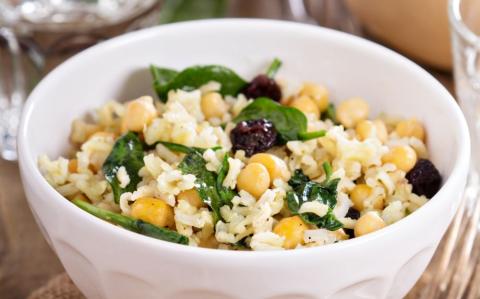
  1. Drain the chickpeas and rinse well.
  2. Wash the spinach and tear into very small pieces.
  3. Mix the rice, spinach, chickpeas and raisins together.
  4. Squeeze the juice of one lemon over the salad and serve cold.

Try adding peas, sweetcorn, peppers, grated carrot, sultanas, dried cranberries, chopped apple or chopped tomatoes to your rice salad. To add more flavour, try adding black pepper, chilli powder, paprika or dried mixed herbs to taste.

Time Saver Tips

You can have this dish cold. Just cook the rice the night before – but remember don't reheat it.

Cost Saver Tips

This recipe is a really good use of leftover rice.

Tips for Kids

You can mix it up by using their favourite vegetables or fruit.

Nutritional Information

Based on a single serving of 315g (% of an adult's reference intake)

Energy

425 kcals ( 21 %)

1,799 kJ ( 21 %)

Fat

0.2 g ( 1 %)

Saturates

85.4 g ( %)

Sugar

20.6 g ( 23 %)

Salt

0.5 g ( 9 %)

Detailed nutritional information

Per 100g Per 315g serving
Energy Kcals 135 425
Energy Kj 571 1,799
Protein 3.8 g 11.8 g
Total Fat g g
Saturated Fat 0.1 g 0.2 g
Carbohydrates 27.1 g 85.4 g
Total Sugars 6.5 g 20.6 g
NSP Fibre 1.2 g 3.8 g
Sodium 69 mg 217 mg
Salt 0.2 g 0.5 g

Find out about nutritional labelling

Nutrition labels on the front of packaging

  • Most of the big supermarkets and many food manufacturers display nutritional information on the front of pre-packed food.
  • Front of pack nutrition labels provide information on the number of grams of fat, saturated fat, sugars and salt and the amount of energy (in kJ and kcal) in a serving or portion of a recipe.
  • The labels also include information about reference intakes (expressed as a percentage) which are guidelines about the approximate amount of particular nutrients and energy required for a healthy diet.
  • The colour coding tells you at a glance if the food has high (red), medium (amber) or low (green) amounts of fat, saturated fat, sugars and salt.
  • The more greens on the label, the healthier the choice
  • Amber means neither high nor low, so you can eat foods with all or mostly ambers on the label most of the time.
  • Reds on the label means the food is high in that nutrient and these are the foods we should cut down on. Try to eat these foods less often and in small amounts.

Food shopping tips

If you’re trying to decide which product to choose, check to see if there's a nutrition label on the front of the pack. This will help you to quickly assess how your choices stack up. You will often find a mixture of red, amber and green colour coding for the nutrients. So when you're choosing between similar products, try to go for more greens and ambers and fewer reds if you want to make a healthier choice.

Back to top

Ingredients

  • 1 (160g) Red Pepper
  • 1 (160g) Yellow Pepper
  • 1 (100g) Courgette
  • 10 Medium (100g) Mushrooms
  • 1 Large (240g) Red onion
  • 2 Tablespoons (20g) Vegetable Oil
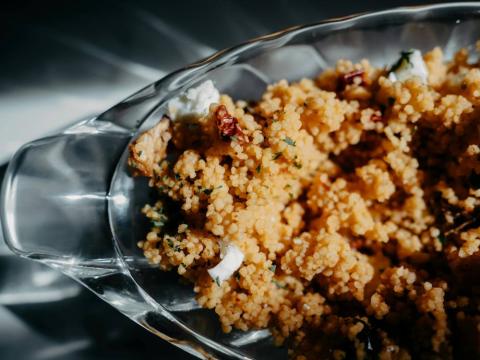
  • 1 Pack (320g) Couscous
  • ¾ Pint (450ml) Water
  • 1 Reduced Salt (7g) Vegetable Stock Cube
  • 3 Medium (255g) Tomatoes
  • 1 Pinch Ground Black Pepper

This recipe has been added to your Meal Planner.

Allergy Disclaimer

Always check the label of each ingredient for allergy warnings.

Method

  1. Preheat the oven to 200°C / 180°C fan oven / 380°F / gas mark 6.
  2. Peel the onion and deseed the peppers and then chop along with the courgette and mushrooms. Mix the vegetables with the oil in a roasting tin.
  3. Roast in the oven for 25-30 minutes, turning over after 15 minutes.
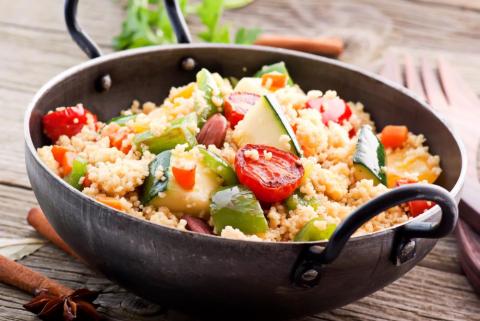
  4. Dissolve the stock cube in boiling water. Place the couscous into a heatproof bowl and add the hot stock, stirring to mix. Cover with a lid or plate and leave for 10-15 minutes then stir with a fork.
  5. Chop the tomatoes into chunks, remove the vegetables from the oven and add the tomatoes and couscous to the tin, mix together and add pepper as required.
  6. Return to the oven for a further 5 minutes to heat through, then serve.

Time Saver Tips

Why not make this in bulk? That way you can just pop it in the fridge, ready to enjoy the next day.

Cost Saver Tips

You could try making this with whatever vegetables you’ve already got in. Don’t worry about following exact recipe amounts, just aim to have around 600g or more of veggies to roast.

Tips for Kids

Your little one will love helping you to chop and mix things up – especially if they get to pick their favourite veggies! If you want your little one to get a bit more goodness, a really easy way is to add some pulses like canned chickpeas at the same time as adding the tomatoes.

Nutritional Information

Based on a single serving of 397g (% of an adult's reference intake)

Energy

413 kcals ( 21 %)

1,743 kJ ( 21 %)

Fat

1.2 g ( 6 %)

Saturates

77.8 g ( %)

Sugar

11.5 g ( 13 %)

Salt

0.1 g ( 2 %)

Detailed nutritional information

Per 100g Per 397g serving
Energy Kcals 104 413
Energy Kj 437 1,743
Protein 3.3 g 13.1 g
Total Fat g g
Saturated Fat 0.3 g 1.2 g
Carbohydrates 19.6 g 77.8 g
Total Sugars 2.9 g 11.5 g
NSP Fibre 1.6 g 6.4 g
Sodium 12 mg 48 mg
Salt 0.0 g 0.1 g

Find out about nutritional labelling

Nutrition labels on the front of packaging

  • Most of the big supermarkets and many food manufacturers display nutritional information on the front of pre-packed food.
  • Front of pack nutrition labels provide information on the number of grams of fat, saturated fat, sugars and salt and the amount of energy (in kJ and kcal) in a serving or portion of a recipe.
  • The labels also include information about reference intakes (expressed as a percentage) which are guidelines about the approximate amount of particular nutrients and energy required for a healthy diet.
  • The colour coding tells you at a glance if the food has high (red), medium (amber) or low (green) amounts of fat, saturated fat, sugars and salt.
  • The more greens on the label, the healthier the choice
  • Amber means neither high nor low, so you can eat foods with all or mostly ambers on the label most of the time.
  • Reds on the label means the food is high in that nutrient and these are the foods we should cut down on. Try to eat these foods less often and in small amounts.

Food shopping tips

If you’re trying to decide which product to choose, check to see if there's a nutrition label on the front of the pack. This will help you to quickly assess how your choices stack up. You will often find a mixture of red, amber and green colour coding for the nutrients. So when you're choosing between similar products, try to go for more greens and ambers and fewer reds if you want to make a healthier choice.

Back to top

Ingredients

  • 4 (400g) Salmon Fillets
  • 8 Spears (360g) Broccoli
  • 1 Pack (250g) Dried Egg Noodles
  • 5 Teaspoons (25g) Soy Sauce

This recipe has been added to your Meal Planner.

Allergy Disclaimer

Always check the label of each ingredient for allergy warnings.

Method

  1. Place the salmon fillets skin side up on the base of the grill pan. Cook under a medium grill for 20 minutes, turning once halfway through. Make sure to use different utensils for raw and cooked fish.
  2. Rinse the broccoli and cut into small pieces. Cook in a pan of boiling water for 4-5 minutes until tender.
  3. Cook the noodles according to the instructions on the packet.
  4. Drain the noodles, add the soy sauce and stir well.
  5. Drain the broccoli and serve with the noodles. Place the salmon on top.

Cost Saver Tips

Why not try using frozen salmon fillets? They’re cheaper than fresh ones and will last in your freezer, handy for whenever you want to cook them. Just pop your frozen fish in the fridge to defrost the night before so it has a chance to thaw. Any canned or leftover vegetables you already have at home will work great in this, too. Just remember that any leftovers should only be reheated once and used within 24 hours. You could also try this recipe with tofu or any diced meat.

Tips for Kids

What vegetables are they loving at the moment? Add them to this dish and get the kids closer to eating their 5 a day.

Nutritional Information

Based on a single serving of 333g (% of an adult's reference intake)

Energy

341 kcals ( 17 %)

1,432 kJ ( 17 %)

Fat

3 g ( 5 %)

Saturates

22.4 g ( %)

Sugar

2.8 g ( 3 %)

Salt

1 g ( 17 %)

Detailed nutritional information

Per 100g Per 333g serving
Energy Kcals 102 341
Energy Kj 430 1,432
Protein 8.7 g 29.1 g
Total Fat g g
Saturated Fat 0.9 g 3 g
Carbohydrates 6.7 g 22.4 g
Total Sugars 0.8 g 2.8 g
NSP Fibre 1.2 g 3.9 g
Sodium 125 mg 416 mg
Salt 0.3 g 1 g

Find out about nutritional labelling

Nutrition labels on the front of packaging

  • Most of the big supermarkets and many food manufacturers display nutritional information on the front of pre-packed food.
  • Front of pack nutrition labels provide information on the number of grams of fat, saturated fat, sugars and salt and the amount of energy (in kJ and kcal) in a serving or portion of a recipe.
  • The labels also include information about reference intakes (expressed as a percentage) which are guidelines about the approximate amount of particular nutrients and energy required for a healthy diet.
  • The colour coding tells you at a glance if the food has high (red), medium (amber) or low (green) amounts of fat, saturated fat, sugars and salt.
  • The more greens on the label, the healthier the choice
  • Amber means neither high nor low, so you can eat foods with all or mostly ambers on the label most of the time.
  • Reds on the label means the food is high in that nutrient and these are the foods we should cut down on. Try to eat these foods less often and in small amounts.

Food shopping tips

If you’re trying to decide which product to choose, check to see if there's a nutrition label on the front of the pack. This will help you to quickly assess how your choices stack up. You will often find a mixture of red, amber and green colour coding for the nutrients. So when you're choosing between similar products, try to go for more greens and ambers and fewer reds if you want to make a healthier choice.

Back to top

Ingredients

  • 4 Cups (300g) Pasta
  • ¾ Large Tin Or 2 Small Tins (280g) Pink Salmon
  • 1 Small Tin (200g) Sweetcorn
  • 1 Medium Sized (160g) Red Pepper
  • 2 Medium Sized (170g) Tomatoes
  • 6 Tablespoons (90g) Reduced Calorie Mayonnaise
  • 1 Pinch (1g) Ground Black Pepper

This recipe has been added to your Meal Planner.

Allergy Disclaimer

Always check the label of each ingredient for allergy warnings.

Method

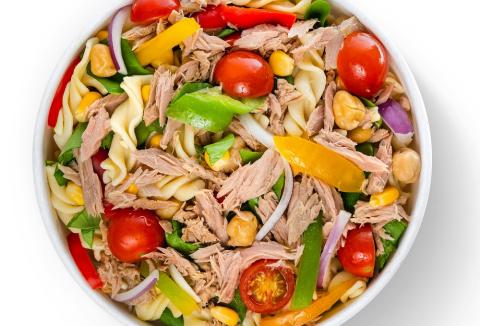
  1. Cook pasta as per the instructions on the packet and rinse with cold water
  2. Remove any unwanted skin and bones from salmon by separating fish with a fork.
  3. Drain the sweetcorn.
  4. Chop the pepper into small pieces and slice the tomatoes into bite size pieces.
  5. Mix the vegetables, salmon and pasta together with mayonnaise.
  6. Add black pepper to taste then serve.

Time Saver Tips

Try cooking extra – you can keep the rest in the fridge for lunch the next day.

Cost Saver Tips

It's often cheaper to buy a large tin of salmon.

Tips for Kids

Kids can use a table knife to help chop the softer vegetables and will love mixing it all up together. Try using their favourite shaped pasta.

Nutritional Information

Based on a single serving of 375g (% of an adult's reference intake)

Energy

401 kcals ( 20 %)

1,683 kJ ( 20 %)

Fat

2.3 g ( 11 %)

Saturates

53.3 g ( %)

Sugar

9 g ( 10 %)

Salt

1.5 g ( 25 %)

Detailed nutritional information

Per 100g Per 375g serving
Energy Kcals 107 401
Energy Kj 449 1,683
Protein 5.9 g 22.1 g
Total Fat g g
Saturated Fat 0.6 g 2.3 g
Carbohydrates 14.2 g 53.3 g
Total Sugars 2.4 g 9 g
NSP Fibre 1 g 3.8 g
Sodium 156 mg 585 mg
Salt 0.4 g 1.5 g

Find out about nutritional labelling

Nutrition labels on the front of packaging

  • Most of the big supermarkets and many food manufacturers display nutritional information on the front of pre-packed food.
  • Front of pack nutrition labels provide information on the number of grams of fat, saturated fat, sugars and salt and the amount of energy (in kJ and kcal) in a serving or portion of a recipe.
  • The labels also include information about reference intakes (expressed as a percentage) which are guidelines about the approximate amount of particular nutrients and energy required for a healthy diet.
  • The colour coding tells you at a glance if the food has high (red), medium (amber) or low (green) amounts of fat, saturated fat, sugars and salt.
  • The more greens on the label, the healthier the choice
  • Amber means neither high nor low, so you can eat foods with all or mostly ambers on the label most of the time.
  • Reds on the label means the food is high in that nutrient and these are the foods we should cut down on. Try to eat these foods less often and in small amounts.

Food shopping tips

If you’re trying to decide which product to choose, check to see if there's a nutrition label on the front of the pack. This will help you to quickly assess how your choices stack up. You will often find a mixture of red, amber and green colour coding for the nutrients. So when you're choosing between similar products, try to go for more greens and ambers and fewer reds if you want to make a healthier choice.

Back to top
Subscribe to Eat Better Feel Better