This article was created with

eat-better-feel-better-logo-2.png

Ingredients

  • 4 (200g) Free Range Eggs
  • 1 (160g) Red Pepper
  • 1 Teaspoon (6g) Reduced Sugar And Salt Tomato Ketchup
  • 1 Can (400g) Chopped Tomatoes
  • 1 Tablespoon (10g) Vegetable Oil
  • 4 Slices (144g) Wholemeal Bread
  • 1 to taste Pinch (1g) Ground Black Pepper

This recipe has been added to your Meal Planner.

Allergy Disclaimer

Always check the label of each ingredient for allergy warnings.

Method

  1. Wash, de-seed and finely chop the pepper.
  2. Fry the pepper in a large frying pan in the oil until it is tender, then add the chopped tomatoes and tomato ketchup. Simmer for 5-10 minutes.
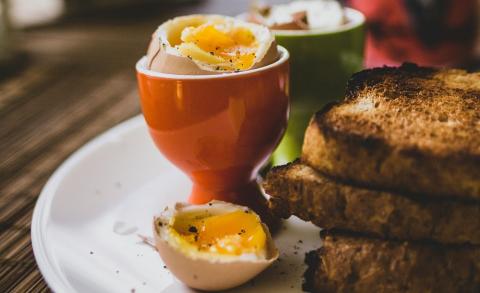
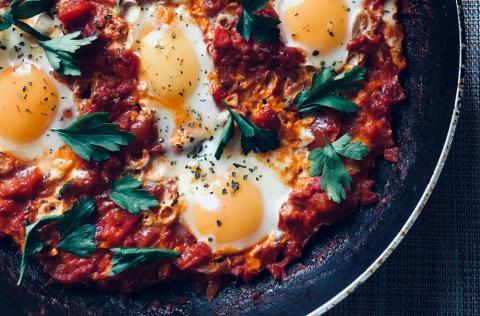
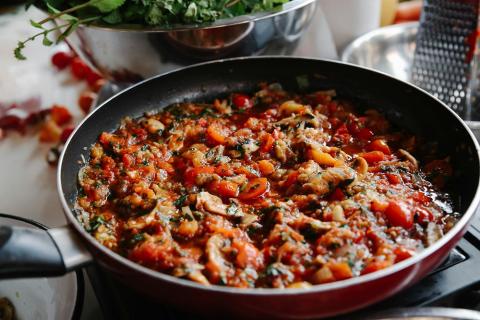
  3. Make 4 'holes' in the tomato and pepper mix, and crack an egg into each one. Continue to cook gently until the eggs are done to your liking.  
  4. Meanwhile, toast the bread.
  5. Serve the eggs and tomatoes on toast, sprinkled with black pepper to taste. 

Cost Saver Tips

You can buy frozen mixed peppers cheaply; they would work well in this dish. You could also add courgettes, cherry tomatoes or jalapeno peppers if you like spicy food.

Tips for Kids

Use tomatoes on their own if peppers are not popular, or add some sweetcorn.

Nutritional Information

Based on a single serving of 213g (% of an adult's reference intake)

Energy

208 kcals ( 10 %)

873 kJ ( 10 %)

Fat

1.8 g ( 9 %)

Saturates

20 g ( %)

Sugar

7 g ( 8 %)

Salt

0.7 g ( 11 %)

Detailed nutritional information

Per 100g Per 213g serving
Energy Kcals 98 208
Energy Kj 410 873
Protein 5.4 g 11.6 g
Total Fat g g
Saturated Fat 0.8 g 1.8 g
Carbohydrates 9.4 g 20 g
Total Sugars 3.3 g 7 g
NSP Fibre 1.5 g 3.2 g
Sodium 125 mg 267 mg
Salt 0.3 g 0.7 g

Find out about nutritional labelling

Nutrition labels on the front of packaging

  • Most of the big supermarkets and many food manufacturers display nutritional information on the front of pre-packed food.
  • Front of pack nutrition labels provide information on the number of grams of fat, saturated fat, sugars and salt and the amount of energy (in kJ and kcal) in a serving or portion of a recipe.
  • The labels also include information about reference intakes (expressed as a percentage) which are guidelines about the approximate amount of particular nutrients and energy required for a healthy diet.
  • The colour coding tells you at a glance if the food has high (red), medium (amber) or low (green) amounts of fat, saturated fat, sugars and salt.
  • The more greens on the label, the healthier the choice
  • Amber means neither high nor low, so you can eat foods with all or mostly ambers on the label most of the time.
  • Reds on the label means the food is high in that nutrient and these are the foods we should cut down on. Try to eat these foods less often and in small amounts.

Food shopping tips

If you’re trying to decide which product to choose, check to see if there's a nutrition label on the front of the pack. This will help you to quickly assess how your choices stack up. You will often find a mixture of red, amber and green colour coding for the nutrients. So when you're choosing between similar products, try to go for more greens and ambers and fewer reds if you want to make a healthier choice.
Back to top

Ingredients

  • 10 Tablespoons (300g) Dried Mixed Fruit
  • 5 Dessert spoons (50ml) Freshly Squeezed Orange Juice
  • 2 ½ Heaped Tablespoons (75g) Self-Raising Flour
  • ½ Teaspoon (2g) Ground Cinnamon
  • ½ Teaspoon (2g) Ground Mixed Spice
  • 3 Tablespoons (50g) Breadcrumbs
  • 2 ½ Tablespoons (50g) Brown (Demerara) Sugar
  • 2 Medium sized (224g) Apples
  • 2 (100g) Eggs
  • 4 Tablespoons (60ml) Semi-Skimmed Milk
  • 3 Heaped Teaspoons (51g) Honey
  • 12 Tablespoons (480g) Fat Free Plain Yoghurt

This recipe has been added to your Meal Planner.

Allergy Disclaimer

Always check the label of each ingredient for allergy warnings.

Method

  1. Soak dried fruit overnight in the orange juice.
  2. In a large (1.2 ltr) microwavable bowl mix flour, cinnamon, mixed spice, breadcrumbs and sugar.
  3. Add dried fruit and orange juice to the bowl.
  4. Peel and grate the apple and add to the bowl.
  5. Crack eggs into another bowl and beat with a fork and mix in the milk and honey.
  6. Add the egg mixture slowly to the other ingredients, continually stirring.
  7. Place a plate upturned on top of the bowl and microwave on high for 5 minutes. Leave to stand for 5 minutes and then heat for a further 5 minutes.
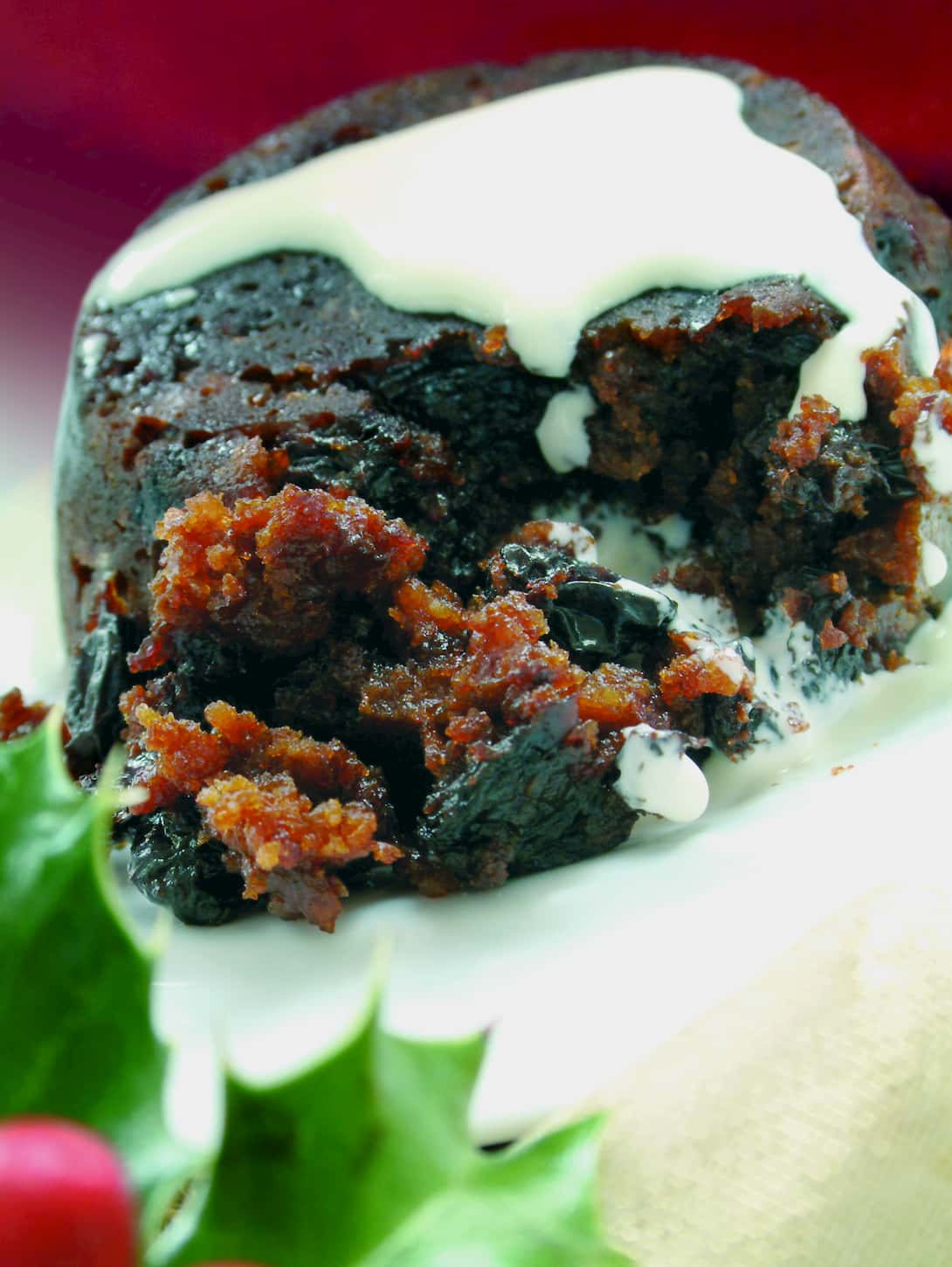
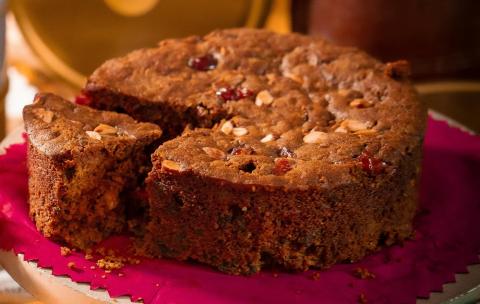
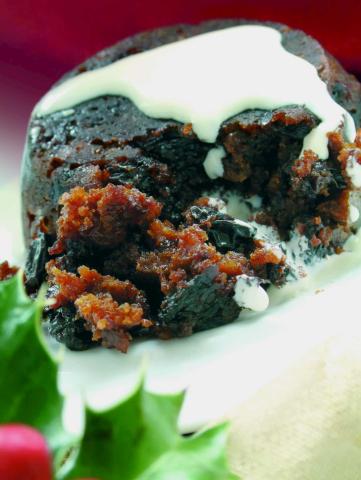
  8. Serve your Christmas pudding with yoghurt.

Time Saver Tips

Can be made in advance and cooked when ready to serve.

Cost Saver Tips

Look for offers on fruit, can use any leftover dried fruit instead of a mixed bag. Also, try to make your own breadcrumbs.

Tips for Kids

They will enjoy weighing and mixing the ingredients together.

Nutritional Information

Based on a single serving of 172g (% of an adult's reference intake)

Energy

263 kcals ( 13 %)

1,104 kJ ( 13 %)

Fat

0.5 g ( 0 %)

Saturates

57.3 g ( %)

Sugar

45.8 g ( 51 %)

Salt

0.3 g ( 6 %)

Detailed nutritional information

Per 100g Per 172g serving
Energy Kcals 2,153 263
Energy Kj 642 1,104
Protein 4.4 g 7.6 g
Total Fat g g
Saturated Fat 0.3 g 0.5 g
Carbohydrates 33.3 g 57.3 g
Total Sugars 26.6 g 45.8 g
NSP Fibre 0.9 g 1.5 g
Sodium 82 mg 141 mg
Salt 0.2 g 0.3 g

Find out about nutritional labelling

Nutrition labels on the front of packaging

  • Most of the big supermarkets and many food manufacturers display nutritional information on the front of pre-packed food.
  • Front of pack nutrition labels provide information on the number of grams of fat, saturated fat, sugars and salt and the amount of energy (in kJ and kcal) in a serving or portion of a recipe.
  • The labels also include information about reference intakes (expressed as a percentage) which are guidelines about the approximate amount of particular nutrients and energy required for a healthy diet.
  • The colour coding tells you at a glance if the food has high (red), medium (amber) or low (green) amounts of fat, saturated fat, sugars and salt.
  • The more greens on the label, the healthier the choice
  • Amber means neither high nor low, so you can eat foods with all or mostly ambers on the label most of the time.
  • Reds on the label means the food is high in that nutrient and these are the foods we should cut down on. Try to eat these foods less often and in small amounts.

Food shopping tips

If you’re trying to decide which product to choose, check to see if there's a nutrition label on the front of the pack. This will help you to quickly assess how your choices stack up. You will often find a mixture of red, amber and green colour coding for the nutrients. So when you're choosing between similar products, try to go for more greens and ambers and fewer reds if you want to make a healthier choice.

Back to top

Ingredients

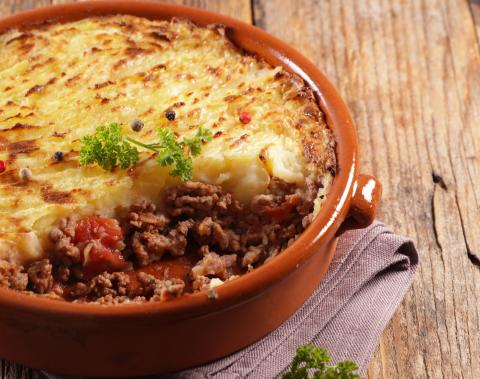
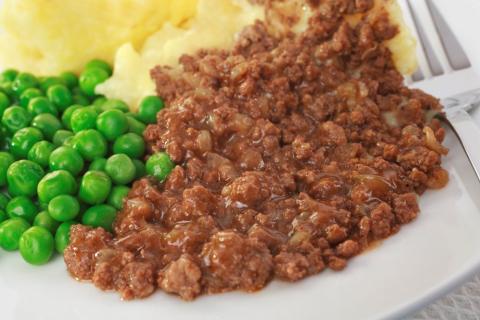
  • 1 Pack (500g) Lean Minced Beef
  • 1 Medium Sized (150g) Onion
  • 2 Medium Sized (160g) Carrots
  • 1 Stick (30g) Celery
  • 2 Tablespoons (20g) Vegetable Oil
  • 2 Tablespoons (40g) Plain Flour
  • 1 (7g) Beef Stock Cube (used reduced salt whenever possible)
  • 1 Pint (600ml) Boiling Water
  • 2 Tablespoons (30g) Worcestershire Sauce
  • 1 Pinch Ground Black Pepper
  • 6 Medium (520g) Potatoes
  • 2 Cups (320g) Peas

This recipe has been added to your Meal Planner.

Allergy Disclaimer

Always check the label of each ingredient for allergy warnings.

Method

  1. Peel and slice the onion, carrots and potatoes. Wash and slice the celery.
  2. Fry the onion, carrots and celery in the vegetable oil over a medium heat for about 5 minutes until softened.
  3. Increase the heat and add the minced beef to the pan and fry until it is well browned (8-10 minutes).
  4. Reduce the heat and sprinkle the flour over the meat and vegetables and stir for a couple of minutes to cook the flour.
  5. Dissolve the stock cube in the water then add the stock, Worcestershire sauce and pepper to the pan. Stir until the sauce comes to the boil and starts to thicken. Cover the pan and simmer for about 30 minutes until everything is tender, adding more stock if needed.
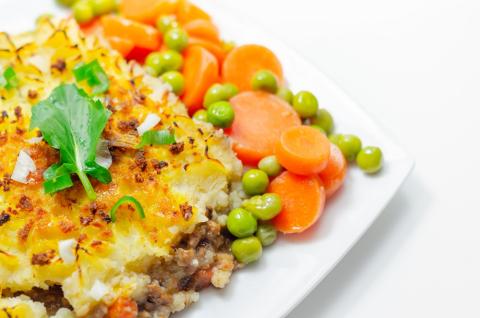
  6. Meanwhile, cook the potatoes in boiling water for 20-25 minutes until soft. Use a potato masher or fork and mash the potatoes until smooth.
  7. Cook the peas in boiling water and serve with mash and mince.

Time Saver Tips

There’s no need to peel the potatoes. Leaving the skins on gives your little one some extra goodness and it’s quicker and easier anyway – a win-win!

Cost Saver Tips

You could also make this with lamb or turkey mince instead of beef mince, so look out for offers on these, too. To make this meal go further, why not add different vegetables? It can be also be served with any fresh, frozen or canned vegetables.

Tips for Kids

Little ones can help by preparing and chopping vegetables with a table knife. Knowing they’ve helped make a meal could even make them more likely to eat it. Letting your wee one choose the vegetables to use can also make this meal extra appealing – just how they like it!

Nutritional Information

Based on a single serving of 498g (% of an adult's reference intake)

Energy

405 kcals ( 20 %)

1,710 kJ ( 20 %)

Fat

3.2 g ( 16 %)

Saturates

42.1 g ( %)

Sugar

11.5 g ( 13 %)

Salt

1.2 g ( 20 %)

Detailed nutritional information

Per 100g Per 498g serving
Energy Kcals 81 405
Energy Kj 343 1,710
Protein 7.1 g 35.5 g
Total Fat g g
Saturated Fat 0.6 g 3.2 g
Carbohydrates 8.5 g 42.1 g
Total Sugars 2.3 g 11.5 g
NSP Fibre 1.7 g 8.5 g
Sodium 99 mg 495 mg
Salt 0.2 g 1.2 g

Find out about nutritional labelling

Nutrition labels on the front of packaging

  • Most of the big supermarkets and many food manufacturers display nutritional information on the front of pre-packed food.
  • Front of pack nutrition labels provide information on the number of grams of fat, saturated fat, sugars and salt and the amount of energy (in kJ and kcal) in a serving or portion of a recipe.
  • The labels also include information about reference intakes (expressed as a percentage) which are guidelines about the approximate amount of particular nutrients and energy required for a healthy diet.
  • The colour coding tells you at a glance if the food has high (red), medium (amber) or low (green) amounts of fat, saturated fat, sugars and salt.
  • The more greens on the label, the healthier the choice
  • Amber means neither high nor low, so you can eat foods with all or mostly ambers on the label most of the time.
  • Reds on the label means the food is high in that nutrient and these are the foods we should cut down on. Try to eat these foods less often and in small amounts.

Food shopping tips

If you’re trying to decide which product to choose, check to see if there's a nutrition label on the front of the pack. This will help you to quickly assess how your choices stack up. You will often find a mixture of red, amber and green colour coding for the nutrients. So when you're choosing between similar products, try to go for more greens and ambers and fewer reds if you want to make a healthier choice.

Back to top

Ingredients

  • 1 Tablespoon (10g) Vegetable Oil
  • 1 (150g) Onion
  • 1 (140g) Carrot
  • 1 Stick (30g) Celery
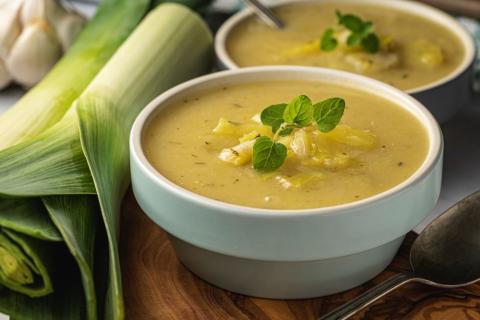
  • 1 (160g) Leek
  • 2 (6g) Garlic Cloves
  • 1 ½ Pints (850ml) Water
  • 1 (7g) Reduced Salt Vegetable Stock Cube
  • 1 Can (200g) Chopped Tomatoes
  • 1 Tablespoon (15g) Tomato Puree
  • ¼ (50g) Green Cabbage
  • ½ Cup (30g) Pasta

This recipe has been added to your Meal Planner.

Allergy Disclaimer

Always check the label of each ingredient for allergy warnings.

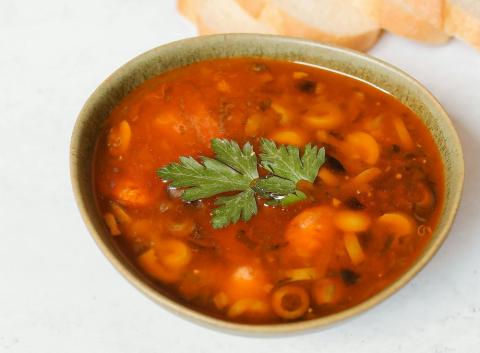
Method

  1. Peel onion, garlic and leek then chop. Wash carrot, celery and cabbage then slice.
  2. Heat oil in a large pan then add the onion, garlic and leek cook for 2 minutes. Add carrot and celery and cook for a further 2 minutes.
  3. Dissolve stock cube in boiling water and add to pan along with tomato puree and chopped tomatoes. Bring to the boil then cook for 15 minutes on a low heat.
  4. Add cabbage and pasta and cook for a further 10 minutes serving once pasta is cooked through.

Time Saver Tips

Prepare in advance without adding cabbage and pasta then reheat and complete the final step of recipe. Soup can be frozen on the day of making.

Cost Saver Tips

A variety of vegetables fresh, frozen or canned in water.

Tips for Kids

Use their favourite pasta shape.

Nutritional Information

Based on a single serving of 331g (% of an adult's reference intake)

Energy

99 kcals ( 5 %)

417 kJ ( %)

Fat

0.3 g ( 2 %)

Saturates

14.9 g ( %)

Sugar

7.6 g ( 8 %)

Salt

0.3 g ( 5 %)

Detailed nutritional information

Per 100g Per 331g serving
Energy Kcals 30 99
Energy Kj 126 417
Protein 0.9 g 3 g
Total Fat g g
Saturated Fat 0.1 g 0.3 g
Carbohydrates 4.5 g 14.9 g
Total Sugars 2.3 g 7.6 g
NSP Fibre 0.9 g 3 g
Sodium 24 mg 79 mg
Salt 0.1 g 0.3 g

Find out about nutritional labelling

Nutrition labels on the front of packaging

  • Most of the big supermarkets and many food manufacturers display nutritional information on the front of pre-packed food.
  • Front of pack nutrition labels provide information on the number of grams of fat, saturated fat, sugars and salt and the amount of energy (in kJ and kcal) in a serving or portion of a recipe.
  • The labels also include information about reference intakes (expressed as a percentage) which are guidelines about the approximate amount of particular nutrients and energy required for a healthy diet.
  • The colour coding tells you at a glance if the food has high (red), medium (amber) or low (green) amounts of fat, saturated fat, sugars and salt.
  • The more greens on the label, the healthier the choice
  • Amber means neither high nor low, so you can eat foods with all or mostly ambers on the label most of the time.
  • Reds on the label means the food is high in that nutrient and these are the foods we should cut down on. Try to eat these foods less often and in small amounts.

Food shopping tips

If you’re trying to decide which product to choose, check to see if there's a nutrition label on the front of the pack. This will help you to quickly assess how your choices stack up. You will often find a mixture of red, amber and green colour coding for the nutrients. So when you're choosing between similar products, try to go for more greens and ambers and fewer reds if you want to make a healthier choice.

Back to top

Ingredients

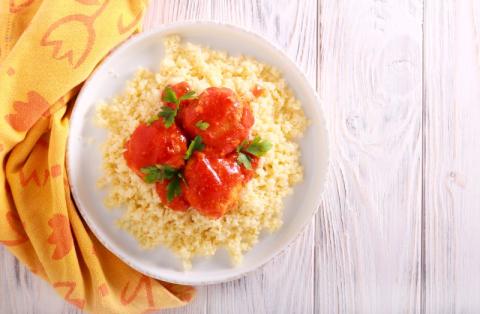
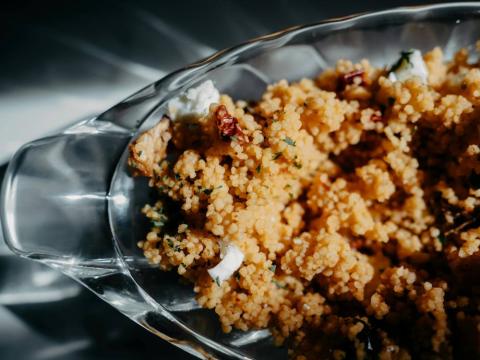
  • 1 Pack (320g) Couscous
  • 1 (80g) Lemon
  • ¾ for the couscous Pint (450ml) Water
  • 1 Tablespoon (10g) Vegetable Oil
  • 1 Tablespoon (30g) Clear Honey
  • 4 (400g) Chicken Breasts
  • 1 Teaspoon (1g) Ground Cinnamon
  • 1 Can (400g) Chopped Tomatoes
  • ½ Reduced salt (4g) Chicken Stock Cube
  • 10 For stock Tablespoons (150ml) Water
  • 1 Teaspoon (1g) Ground Cumin
  • 4 Tablespoons (200g) Green Beans

This recipe has been added to your Meal Planner.

Allergy Disclaimer

Always check the label of each ingredient for allergy warnings.

Method

  1. Slice the chicken into strips and drizzle with honey
  2. Heat the oil in a large pan then add chicken carefully to the pan. Fry over a medium heat for 5-6 minutes until golden brown
  3. Half the lemon and squeeze juice from one half into the pan along with finely grated zest from half the lemon. Trim the ends off the green beans if needed and cut them in half and add to the pan with the chopped tomatoes, cumin and cinnamon
  4. Dissolve stock cube in boiling water and add to the pan, bring to the boil and then turn down to a simmer, uncovered for 8-10 minutes until the beans are tender
  5. In a large bowl add the cous cous with remaining lemon juice and zest. Pour boiling water over and cover with cling film
  6. Once the green beans have softened separate the cous cous by mixing gently with a fork and serve

Tips for Kids

Let them help drizzle the honey and separate the cous cous.

Nutritional Information

Based on a single serving of 469g (% of an adult's reference intake)

Energy

553 kcals ( 28 %)

2,326 kJ ( 28 %)

Fat

2.3 g ( 12 %)

Saturates

78.3 g ( %)

Sugar

12.2 g ( 14 %)

Salt

0.5 g ( 8 %)

Detailed nutritional information

Per 100g Per 469g serving
Energy Kcals 118 553
Energy Kj 496 2,326
Protein 9 g 42.2 g
Total Fat g g
Saturated Fat 0.5 g 2.3 g
Carbohydrates 16.7 g 78.3 g
Total Sugars 2.6 g 12.2 g
NSP Fibre 1 g 4.7 g
Sodium 35 mg 164 mg
Salt 0.1 g 0.5 g

Find out about nutritional labelling

Nutrition labels on the front of packaging

  • Most of the big supermarkets and many food manufacturers display nutritional information on the front of pre-packed food.
  • Front of pack nutrition labels provide information on the number of grams of fat, saturated fat, sugars and salt and the amount of energy (in kJ and kcal) in a serving or portion of a recipe.
  • The labels also include information about reference intakes (expressed as a percentage) which are guidelines about the approximate amount of particular nutrients and energy required for a healthy diet.
  • The colour coding tells you at a glance if the food has high (red), medium (amber) or low (green) amounts of fat, saturated fat, sugars and salt.
  • The more greens on the label, the healthier the choice
  • Amber means neither high nor low, so you can eat foods with all or mostly ambers on the label most of the time.
  • Reds on the label means the food is high in that nutrient and these are the foods we should cut down on. Try to eat these foods less often and in small amounts.

Food shopping tips

If you’re trying to decide which product to choose, check to see if there's a nutrition label on the front of the pack. This will help you to quickly assess how your choices stack up. You will often find a mixture of red, amber and green colour coding for the nutrients. So when you're choosing between similar products, try to go for more greens and ambers and fewer reds if you want to make a healthier choice.

Back to top

Ingredients

  • 2 Tablespoons (20g) Vegetable Oil
  • 1 Medium Sized (240g) Onion
  • 60 Medium Sized (600g) Mushrooms
  • 2 Sticks (60g) Celery
  • 2 Heaped Spoonful Tablespoons (60g) Cornflour
  • 1 Reduced Salt (7g) Vegetable Stock Cube
  • (500ml) Semi-Skimmed Milk
  • To Taste (1g) Ground Black Pepper
  • 6 Heaped Spoonfuls Tablespoons (260g) White Rice

This recipe has been added to your Meal Planner.

Allergy Disclaimer

Always check the label of each ingredient for allergy warnings.

Method

  1. Peel and chop the onion, wash and slice the celery, and fry them in oil until golden brown.
  2. Wash and slice the mushrooms and add to the pan.
  3. Put a lid on the pan and sweat the vegetables for 10 minutes.
  4. Stir in the cornflour and the crumbled stock cube then slowly add the milk, stirring all the time.
  5. Simmer with the lid on for 10 minutes. Add black pepper to taste.
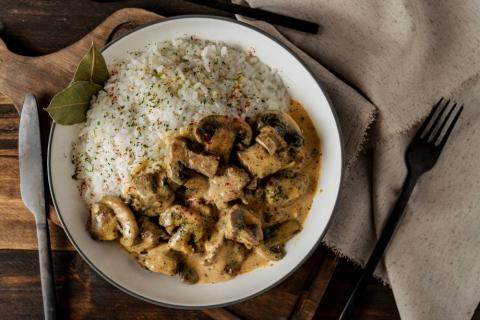
  6. Cook the rice according to the instructions on the packet whilst you are cooking the vegetables and serve with the muchroom stroganoff.

Tips for Kids

Sneak veggies in by chopping them up small.

Nutritional Information

Based on a single serving of 496g (% of an adult's reference intake)

Energy

479 kcals ( 24 %)

2,022 kJ ( 24 %)

Fat

1.9 g ( 10 %)

Saturates

81.2 g ( %)

Sugar

9.6 g ( 11 %)

Salt

0.6 g ( 10 %)

Detailed nutritional information

Per 100g Per 496g serving
Energy Kcals 97 479
Energy Kj 408 2,022
Protein 3.4 g 16.8 g
Total Fat g g
Saturated Fat 0.4 g 1.9 g
Carbohydrates 16.4 g 81.2 g
Total Sugars 1.9 g 9.6 g
NSP Fibre 0.6 g 2.5 g
Sodium 49 mg 245 mg
Salt 0.1 g 0.6 g

Find out about nutritional labelling

Nutrition labels on the front of packaging

  • Most of the big supermarkets and many food manufacturers display nutritional information on the front of pre-packed food.
  • Front of pack nutrition labels provide information on the number of grams of fat, saturated fat, sugars and salt and the amount of energy (in kJ and kcal) in a serving or portion of a recipe.
  • The labels also include information about reference intakes (expressed as a percentage) which are guidelines about the approximate amount of particular nutrients and energy required for a healthy diet.
  • The colour coding tells you at a glance if the food has high (red), medium (amber) or low (green) amounts of fat, saturated fat, sugars and salt.
  • The more greens on the label, the healthier the choice
  • Amber means neither high nor low, so you can eat foods with all or mostly ambers on the label most of the time.
  • Reds on the label means the food is high in that nutrient and these are the foods we should cut down on. Try to eat these foods less often and in small amounts.

Food shopping tips

If you’re trying to decide which product to choose, check to see if there's a nutrition label on the front of the pack. This will help you to quickly assess how your choices stack up. You will often find a mixture of red, amber and green colour coding for the nutrients. So when you're choosing between similar products, try to go for more greens and ambers and fewer reds if you want to make a healthier choice.

Back to top

Ingredients

  • 25 (1kg) New Potatoes
  • 2 Teaspoons (2g) Dried Parsley
  • 2 Tablespoons (20g) Olive Oil
  • 2 (6g) Garlic Cloves
  • 1 (80g) Lemon
  • 5 (50g) Spring Onions
  • ¼ (90g) Cucumber
  • 2 (170g) Tomatoes
  • 1 Can (400g) Red Kidney Beans In Water
  • 1 Can (198g) Sweetcorn

This recipe has been added to your Meal Planner.

Allergy Disclaimer

Always check the label of each ingredient for allergy warnings.

Method

  1. Cook the potatoes in boiling water until tender, approximately 15 minutes.
  2. Peel and finely chop the garlic and mix in a large bowl with parsley and olive oil.
  3. Grate the zest of the lemon into the bowl using a fine grater, then cut it in half and squeeze the juice in too.
  4. Drain the potatoes and mix into the bowl with the dressing.
  5. Chop the tomatoes, cucumber and spring onions and drain the kidney beans and sweetcorn and add to the bowl and mix together gently and serve while warm.
 

Cost Saver Tips

Use left over salad ingredients such as pepper.

Tips for Kids

They will enjoy chopping and mixing the ingredients

Nutritional Information

Based on a single serving of 455g (% of an adult's reference intake)

Energy

337 kcals ( 17 %)

1,415 kJ ( 17 %)

Fat

1.4 g ( 7 %)

Saturates

63.2 g ( %)

Sugar

10 g ( 11 %)

Salt

0.9 g ( 15 %)

Detailed nutritional information

Per 100g Per 455g serving
Energy Kcals 74 337
Energy Kj 311 1,415
Protein 2 g 9.1 g
Total Fat g g
Saturated Fat 0.3 g 1.4 g
Carbohydrates 13.9 g 63.2 g
Total Sugars 2.2 g 10 g
NSP Fibre 1.8 g 8.2 g
Sodium 67 mg 305 mg
Salt 0.2 g 0.9 g

Find out about nutritional labelling

Nutrition labels on the front of packaging

  • Most of the big supermarkets and many food manufacturers display nutritional information on the front of pre-packed food.
  • Front of pack nutrition labels provide information on the number of grams of fat, saturated fat, sugars and salt and the amount of energy (in kJ and kcal) in a serving or portion of a recipe.
  • The labels also include information about reference intakes (expressed as a percentage) which are guidelines about the approximate amount of particular nutrients and energy required for a healthy diet.
  • The colour coding tells you at a glance if the food has high (red), medium (amber) or low (green) amounts of fat, saturated fat, sugars and salt.
  • The more greens on the label, the healthier the choice
  • Amber means neither high nor low, so you can eat foods with all or mostly ambers on the label most of the time.
  • Reds on the label means the food is high in that nutrient and these are the foods we should cut down on. Try to eat these foods less often and in small amounts.

Food shopping tips

If you’re trying to decide which product to choose, check to see if there's a nutrition label on the front of the pack. This will help you to quickly assess how your choices stack up. You will often find a mixture of red, amber and green colour coding for the nutrients. So when you're choosing between similar products, try to go for more greens and ambers and fewer reds if you want to make a healthier choice.

Back to top

Ingredients

  • 4 (52g) Plain Oatcakes
  • 4 (32g) Water Biscuits
  • 5 Heaped teaspoons (80g) Peanut Butter
  • 1 (100g) Banana
  • 1 (112g) Apple

This recipe has been added to your Meal Planner.

Allergy Disclaimer

Always check the label of each ingredient for allergy warnings.

Method

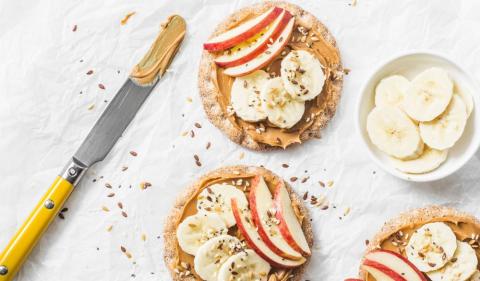
  1. Peel and slice the banana. Wash and slice the apple.
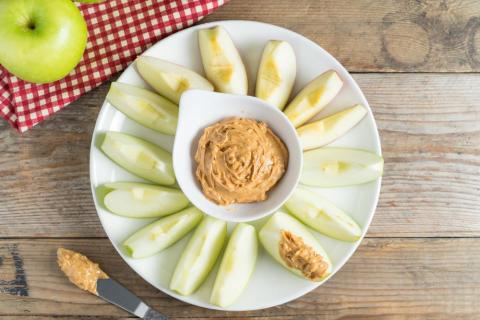
  2. Divide the peanut butter between the oatcakes and water biscuits and spread.
  3. Place the banana and apple slices onto each oatcake and water biscuit.

Time Saver Tips

Top with other fruit that you have in the house.

Tips for Kids

This is a quick snack that they can help prepare. Use their favourite fruit as a topping.

Nutritional Information

Based on a single serving of 91g (% of an adult's reference intake)

Energy

242 kcals ( 12 %)

1,016 kJ ( 12 %)

Fat

3.2 g ( 16 %)

Saturates

24.4 g ( 10 %)

Sugar

9.4 g ( 10 %)

Salt

0.5 g ( 8 %)

Detailed nutritional information

Per 100g Per 91g serving
Energy Kcals 266 242
Energy Kj 1,117 1,016
Protein 7.6 g 6.9 g
Total Fat g g
Saturated Fat 3.5 g 3.2 g
Carbohydrates 26.8 g 24.4 g
Total Sugars 10.3 g 9.4 g
NSP Fibre 3.2 g 2.9 g
Sodium 225 mg 205 mg
Salt 0.6 g 0.5 g

Find out about nutritional labelling

Nutrition labels on the front of packaging

  • Most of the big supermarkets and many food manufacturers display nutritional information on the front of pre-packed food.
  • Front of pack nutrition labels provide information on the number of grams of fat, saturated fat, sugars and salt and the amount of energy (in kJ and kcal) in a serving or portion of a recipe.
  • The labels also include information about reference intakes (expressed as a percentage) which are guidelines about the approximate amount of particular nutrients and energy required for a healthy diet.
  • The colour coding tells you at a glance if the food has high (red), medium (amber) or low (green) amounts of fat, saturated fat, sugars and salt.
  • The more greens on the label, the healthier the choice
  • Amber means neither high nor low, so you can eat foods with all or mostly ambers on the label most of the time.
  • Reds on the label means the food is high in that nutrient and these are the foods we should cut down on. Try to eat these foods less often and in small amounts.

Food shopping tips

If you’re trying to decide which product to choose, check to see if there's a nutrition label on the front of the pack. This will help you to quickly assess how your choices stack up. You will often find a mixture of red, amber and green colour coding for the nutrients. So when you're choosing between similar products, try to go for more greens and ambers and fewer reds if you want to make a healthier choice.

Back to top

Ingredients

  • 4 (250g) Plums
  • 3 (340g) Apples
  • 30 (150g) Blackberries
  • 2 Heaped tablespoons (60g) Self-Raising Flour
  • 9 Teaspoons (45g) Sugar
  • 6 Dessert spoons (60ml) Fresh Orange Juice
  • 2 ½ Tablespoons (40g) Low Fat Spread
  • 1 (50g) Egg

This recipe has been added to your Meal Planner.

Allergy Disclaimer

Always check the label of each ingredient for allergy warnings.

Method

  1. Preheat the oven to 180°C / 160°C fan oven / 350°F / gas mark 4.
  2. Cut plums in half and remove stones then cut into thick slices. Wash and drain blackberries. Peel and core the apples then slice.
  3. Put the fruit into a 1.2 litre (2 pint) ovenproof dish and mix together. Drizzle 4 dessertspoons of orange juice over the fruit.
  4. Bake in the oven for 10 minutes. Meanwhile put the sugar, spread and flour into a bowl, crack in the egg. Mix together with a hand-held electric mixer or wooden spoon until smooth.
  5. Add the remaining orange juice and stir gently until all ingredients are mixed together.
  6. Remove the fruit from the oven and pat down gently with the wooden spoon before spooning the sponge mixture on top. Spread until even and return to the oven for a further 25-30 minutes.
  7. Remove from oven once the sponge is well risen, golden and springs back when pressed with a fingertip. 

Time Saver Tips

Use frozen fruit or canned in juice.

Cost Saver Tips

Use frozen fruit or a mix of fruit you have already. E.g. pears

Tips for Kids

They would enjoy blackberry picking. Try with just one fruit at first if they are unsure.

Nutritional Information

Based on a single serving of 185g (% of an adult's reference intake)

Energy

205 kcals ( 10 %)

862 kJ ( 10 %)

Fat

1.3 g ( %)

Saturates

37.4 g ( %)

Sugar

26.3 g ( 29 %)

Salt

0.4 g ( 7 %)

Detailed nutritional information

Per 100g Per 185g serving
Energy Kcals 111 205
Energy Kj 466 862
Protein 2.3 g 4.3 g
Total Fat g g
Saturated Fat 0.7 g 1.3 g
Carbohydrates 20.2 g 37.4 g
Total Sugars 14.2 g 26.3 g
NSP Fibre 1.8 g 3.3 g
Sodium 77 mg 142 mg
Salt 0.2 g 0.4 g

Find out about nutritional labelling

Nutrition labels on the front of packaging

  • Most of the big supermarkets and many food manufacturers display nutritional information on the front of pre-packed food.
  • Front of pack nutrition labels provide information on the number of grams of fat, saturated fat, sugars and salt and the amount of energy (in kJ and kcal) in a serving or portion of a recipe.
  • The labels also include information about reference intakes (expressed as a percentage) which are guidelines about the approximate amount of particular nutrients and energy required for a healthy diet.
  • The colour coding tells you at a glance if the food has high (red), medium (amber) or low (green) amounts of fat, saturated fat, sugars and salt.
  • The more greens on the label, the healthier the choice
  • Amber means neither high nor low, so you can eat foods with all or mostly ambers on the label most of the time.
  • Reds on the label means the food is high in that nutrient and these are the foods we should cut down on. Try to eat these foods less often and in small amounts.

Food shopping tips

If you’re trying to decide which product to choose, check to see if there's a nutrition label on the front of the pack. This will help you to quickly assess how your choices stack up. You will often find a mixture of red, amber and green colour coding for the nutrients. So when you're choosing between similar products, try to go for more greens and ambers and fewer reds if you want to make a healthier choice.

Back to top

Ingredients

  • 5 Level Tablespoons (100g) Plain Flour
  • 1 Level Teaspoon (4g) Baking Powder
  • 1 Medium Egg
  • 7 Tablespoons (100ml) Semi-Skimmed Milk
  • 3 Tablespoons (100g) Frozen Sweetcorn
  • 3 Tablespoons (100g) Frozen Peas
  • 1 (10g) Spring Onion
  • 1 Pinch Black Pepper
  • 2 Teaspoons (6g) Vegetable Oil
  • 2 Heaped tablespoons (60g) Half Fat Crème Fraîche

This recipe has been added to your Meal Planner.

Allergy Disclaimer

Always check the label of each ingredient for allergy warnings.

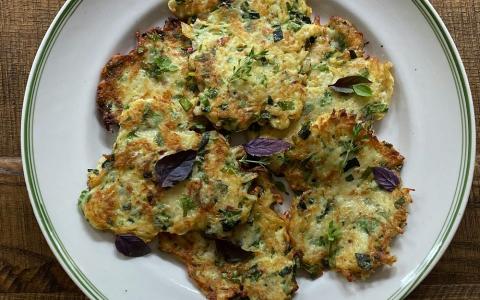
Method

  1. Sieve the four and baking powder into a large bowl. Crack the egg into the bowl then add the milk and mix well.
  2. Trim the tops and tails of the spring onion and then slice. Add spring onion, peas and sweetcorn to the bowl and mix well. Hold back a small handful of spring onion for garnishing at the end.
  3. Add black pepper to taste and mix in.
  4. Add half the oil to a frying pan and heat on a medium heat. Add a tablespoon of mixture to the pan and press down with a spatula or the back of a spoon. Repeat until you have 4 fritters.
  5. Turn the fritters over after approximately 5 minutes or until golden brown. Once cooked, repeat for the remainder of the mixture. It should make 8 fritters.
  6. Garnish with spring onion and serve while hot with crème fraîche for dipping.

Time Saver Tips

Why not prepare this in advance and keep in the fridge until you’re ready to cook it? Talk about an easy meal!
Cost Saver Tips

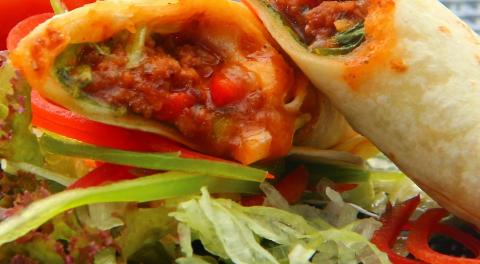
This is a great recipe to use any leftovers you’ve got. You could try using ingredients like red onions and finely chopped peppers or courgette, too. Don’t worry if you don’t have plain flour – any type of flour works, including wholemeal or cornflour. If using self-raising, just leave out the baking powder. Soured cream can be used instead of half fat creme fraiche, however the fat content will be a little higher. Alternatively you could try the fritters with salsa or guacamole.
Tips for Kids

Fritters are great on their own as a light meal. You could even serve them with other vegetables and potatoes or rice to make this into a main meal. Or why not see if your wee one likes them in a bread roll with salad? Yum!

Nutritional Information

Based on a single serving of 125g (% of an adult's reference intake)

Energy

188 kcals ( 9 %)

793 kJ ( 9 %)

Fat

2.4 g ( 12 %)

Saturates

27.2 g ( %)

Sugar

3.8 g ( 4 %)

Salt

0.4 g ( 6 %)

Detailed nutritional information

Per 100g Per 125g serving
Energy Kcals 160 188
Energy Kj 634 793
Protein 5.9 g 7.4 g
Total Fat g g
Saturated Fat 1.9 g 2.4 g
Carbohydrates 21.8 g 27.2 g
Total Sugars 3 g 3.8 g
NSP Fibre 2.4 g 3 g
Sodium 124 mg 155 mg
Salt 0.3 g 0.4 g

Find out about nutritional labelling

Nutrition labels on the front of packaging

  • Most of the big supermarkets and many food manufacturers display nutritional information on the front of pre-packed food.
  • Front of pack nutrition labels provide information on the number of grams of fat, saturated fat, sugars and salt and the amount of energy (in kJ and kcal) in a serving or portion of a recipe.
  • The labels also include information about reference intakes (expressed as a percentage) which are guidelines about the approximate amount of particular nutrients and energy required for a healthy diet.
  • The colour coding tells you at a glance if the food has high (red), medium (amber) or low (green) amounts of fat, saturated fat, sugars and salt.
  • The more greens on the label, the healthier the choice
  • Amber means neither high nor low, so you can eat foods with all or mostly ambers on the label most of the time.
  • Reds on the label means the food is high in that nutrient and these are the foods we should cut down on. Try to eat these foods less often and in small amounts.

Food shopping tips

If you’re trying to decide which product to choose, check to see if there's a nutrition label on the front of the pack. This will help you to quickly assess how your choices stack up. You will often find a mixture of red, amber and green colour coding for the nutrients. So when you're choosing between similar products, try to go for more greens and ambers and fewer reds if you want to make a healthier choice.

Back to top
Subscribe to Eat Better Feel Better