This article was created with

eat-better-feel-better-logo-2.png

Ingredients

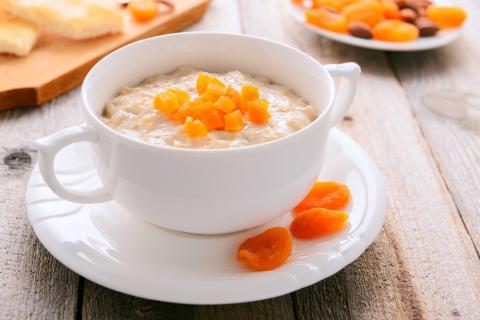
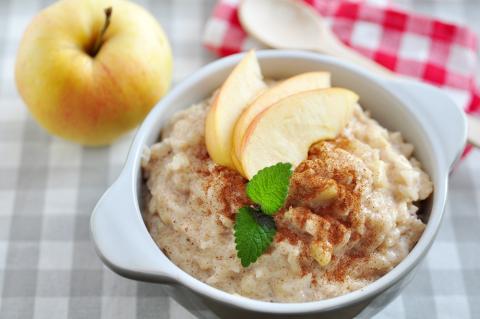
  • 10 Tablespoons (150g) Porridge Oats
  • 1 Teaspoon (3g) Ground Cinnamon
  • 2 ½ Tablespoons (75g) Sultanas
  • 2 (224g) Apples
  • 1 Pint (600g) Semi-Skimmed Milk

This recipe has been added to your Meal Planner.

Allergy Disclaimer

Always check the label of each ingredient for allergy warnings.

Method

  1. Preheat the oven to 180°C / 160°C fan oven / 350°F / gas mark 4.
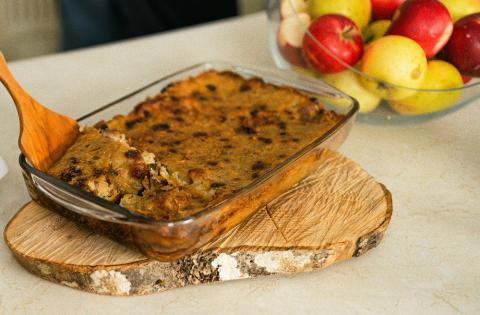
  2. Mix the oats, cinnamon and sultanas together with the milk in a large ovenproof dish.
  3. Wash, core and chop the apples, then mix them into the oats and milk.
  4. Bake for about 30 minutes in the oven, until the oats have absorbed the milk and the dish is creamy.
  5. Serve hot.  

Time Saver Tips

You can prepare this the night before and put it in the fridge until the morning.

Cost Saver Tips

Use any dried or fresh fruit which is on offer - pears work very well, and so do dried cranberries or apricots. You can also top with bananas or blueberries.

Tips for Kids

They can help with stirring the oat, fruit and milk mixture.

Nutritional Information

Based on a single serving of 246g (% of an adult's reference intake)

Energy

296 kcals ( 15 %)

1,249 kJ ( 15 %)

Fat

2.2 g ( 11 %)

Saturates

48.9 g ( %)

Sugar

24.7 g ( 27 %)

Salt

0.2 g ( 3 %)

Detailed nutritional information

Per 100g Per 246g serving
Energy Kcals 120 296
Energy Kj 508 1,249
Protein 4.1 g 10.1 g
Total Fat g g
Saturated Fat 0.9 g 2.2 g
Carbohydrates 19.9 g 48.9 g
Total Sugars 10 g 24.7 g
NSP Fibre 1.5 g 3.7 g
Sodium 29 mg 71 mg
Salt 0.1 g 0.2 g

Find out about nutritional labelling

Nutrition labels on the front of packaging

  • Most of the big supermarkets and many food manufacturers display nutritional information on the front of pre-packed food.
  • Front of pack nutrition labels provide information on the number of grams of fat, saturated fat, sugars and salt and the amount of energy (in kJ and kcal) in a serving or portion of a recipe.
  • The labels also include information about reference intakes (expressed as a percentage) which are guidelines about the approximate amount of particular nutrients and energy required for a healthy diet.
  • The colour coding tells you at a glance if the food has high (red), medium (amber) or low (green) amounts of fat, saturated fat, sugars and salt.
  • The more greens on the label, the healthier the choice
  • Amber means neither high nor low, so you can eat foods with all or mostly ambers on the label most of the time.
  • Reds on the label means the food is high in that nutrient and these are the foods we should cut down on. Try to eat these foods less often and in small amounts.

Food shopping tips

If you’re trying to decide which product to choose, check to see if there's a nutrition label on the front of the pack. This will help you to quickly assess how your choices stack up. You will often find a mixture of red, amber and green colour coding for the nutrients. So when you're choosing between similar products, try to go for more greens and ambers and fewer reds if you want to make a healthier choice.
Back to top

Ingredients

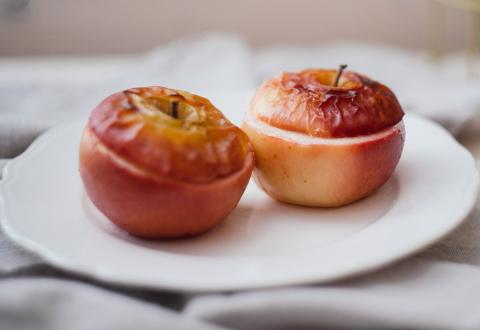
  • 4 Large sized (760g) Cooking Apples
  • 2 Tablespoons (60g) Raisins
  • 4 Teaspoons (16g) Sugar
  • 1 Teaspoons (3g) Ground Cinnamon

This recipe has been added to your Meal Planner.

Allergy Disclaimer

Always check the label of each ingredient for allergy warnings.

Method

  1. Set the oven to 180°C / 160°C fan oven / 350°F / gas mark 4.
  2. Wash the apples and remove the cores with an apple corer or sharp knife.
  3. Mix the raisins, sugar and cinnamon together in a small bowl.
  4. Fill the gaps left by the apple cores with the raisin mixture.
  5. Place the apples on a baking sheet or tray and bake in the oven for 30-40 minutes. The apples are ready when the side of the apples feel soft when pierced with a sharp knife.

Time Saver Tips

Don't peel the apples.

Cost Saver Tips

You don't have to use cooking apples – normal ones will do and will probably be cheaper.

Tips for Kids

Get children to mix the raisins, sugar and cinnamon mixture.

Nutritional Information

Based on a single serving of 175g (% of an adult's reference intake)

Energy

126 kcals ( 6 %)

533 kJ ( 6 %)

Fat

0.0 g ( 1 %)

Saturates

27.9 g ( %)

Sugar

27.9 g ( 31 %)

Salt

0.0 g ( 1 %)

Detailed nutritional information

Per 100g Per 175g serving
Energy Kcals 72 126
Energy Kj 304 533
Protein 0.5 g 0.9 g
Total Fat g g
Saturated Fat 0.0 g 0.0 g
Carbohydrates 16 g 27.9 g
Total Sugars 16 g 27.9 g
NSP Fibre 1.7 g 3 g
Sodium 7 mg 13 mg
Salt 0.0 g 0.0 g

Find out about nutritional labelling

Nutrition labels on the front of packaging

  • Most of the big supermarkets and many food manufacturers display nutritional information on the front of pre-packed food.
  • Front of pack nutrition labels provide information on the number of grams of fat, saturated fat, sugars and salt and the amount of energy (in kJ and kcal) in a serving or portion of a recipe.
  • The labels also include information about reference intakes (expressed as a percentage) which are guidelines about the approximate amount of particular nutrients and energy required for a healthy diet.
  • The colour coding tells you at a glance if the food has high (red), medium (amber) or low (green) amounts of fat, saturated fat, sugars and salt.
  • The more greens on the label, the healthier the choice
  • Amber means neither high nor low, so you can eat foods with all or mostly ambers on the label most of the time.
  • Reds on the label means the food is high in that nutrient and these are the foods we should cut down on. Try to eat these foods less often and in small amounts.

Food shopping tips

If you’re trying to decide which product to choose, check to see if there's a nutrition label on the front of the pack. This will help you to quickly assess how your choices stack up. You will often find a mixture of red, amber and green colour coding for the nutrients. So when you're choosing between similar products, try to go for more greens and ambers and fewer reds if you want to make a healthier choice.

Back to top

Ingredients

  • 8 (80g) Spring Onions
  • 2 (320g) Red Peppers
  • 4 Medium Sized (320g) Carrots
  • 16 Medium Sized (160g) Mushrooms
  • (400g) Butter Beans
  • 2 Tablespoons (20g) Vegetable Oil
  • 4 Portions (600g) Egg Noodles
  • 2 Tablespoons (30g) Soy Sauce

This recipe has been added to your Meal Planner.

Allergy Disclaimer

Always check the label of each ingredient for allergy warnings.

Method

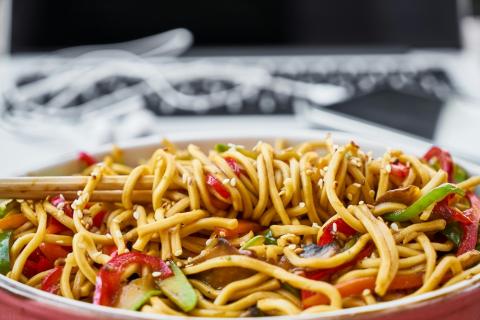
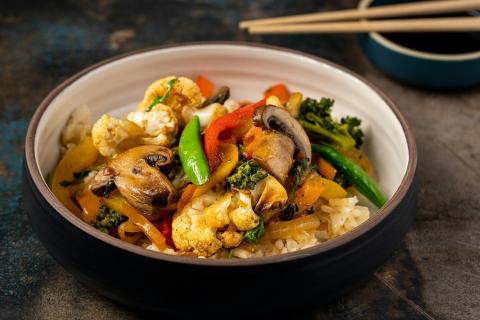
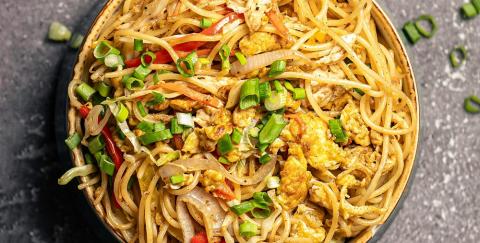
  1. Peel and slice the spring onions. De-seed the red pepper and slice it into strips. Peel the carrots and cut them into matchsticks. Slice the mushrooms.
  2. Fry the vegetables and butter beans (drained contents) in the oil in a frying pan or wok over a medium to high heat for 2-3 minutes until they're soft.
  3. Cook the noodles according to the instructions on the packet and add to the pan with the vegetables. Stir well.
  4. Add soy sauce to taste and serve.

Cost Saver Tips

This dish can be made with many types of vegetables so check to see what is on offer, e.g. regular onions instead of spring onions, courgettes, baby sweetcorn or sugar snap peas.

Tips for Kids

Ask your children to choose which vegetables to use - this can be a colourful dish. Try eating with chopsticks for fun!

Nutritional Information

Based on a single serving of 410g (% of an adult's reference intake)

Energy

428 kcals ( 21 %)

1,803 kJ ( 21 %)

Fat

1.1 g ( 6 %)

Saturates

66.8 g ( %)

Sugar

11.8 g ( 13 %)

Salt

2.5 g ( 42 %)

Detailed nutritional information

Per 100g Per 410g serving
Energy Kcals 104 428
Energy Kj 440 1,803
Protein 4 g 16.5 g
Total Fat g g
Saturated Fat 0.3 g 1.1 g
Carbohydrates 16.3 g 66.8 g
Total Sugars 2.9 g 11.8 g
NSP Fibre 2.4 g 9.8 g
Sodium 247 mg 1,011 mg
Salt 0.6 g 2.5 g

Find out about nutritional labelling

Nutrition labels on the front of packaging

  • Most of the big supermarkets and many food manufacturers display nutritional information on the front of pre-packed food.
  • Front of pack nutrition labels provide information on the number of grams of fat, saturated fat, sugars and salt and the amount of energy (in kJ and kcal) in a serving or portion of a recipe.
  • The labels also include information about reference intakes (expressed as a percentage) which are guidelines about the approximate amount of particular nutrients and energy required for a healthy diet.
  • The colour coding tells you at a glance if the food has high (red), medium (amber) or low (green) amounts of fat, saturated fat, sugars and salt.
  • The more greens on the label, the healthier the choice
  • Amber means neither high nor low, so you can eat foods with all or mostly ambers on the label most of the time.
  • Reds on the label means the food is high in that nutrient and these are the foods we should cut down on. Try to eat these foods less often and in small amounts.

Food shopping tips

If you’re trying to decide which product to choose, check to see if there's a nutrition label on the front of the pack. This will help you to quickly assess how your choices stack up. You will often find a mixture of red, amber and green colour coding for the nutrients. So when you're choosing between similar products, try to go for more greens and ambers and fewer reds if you want to make a healthier choice.

Back to top

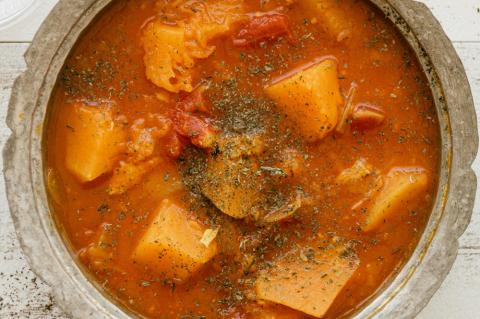
Ingredients

  • 8 Large (1kg) Potatoes
  • 1 Large (240g) Onion
  • 3 ½ Tablespoons (55g) Low Fat Spread
  • 1 (7g) Beef Stock Cube (used reduced salt whenever possible)
  • ½ Pint (300ml) Boiling Water
  • 1 Pinch Black Pepper to taste
  • 1 Small Pack (300g) Cooked Lean Beef
  • 16 Slices (160g) Pickled Beetroot

This recipe has been added to your Meal Planner.

Allergy Disclaimer

Always check the label of each ingredient for allergy warnings.

Method

  1. Peel the potatoes and onion. Slice them thickly.
  2. Melt the low fat spread in a pan. Add the potatoes and onion and fry for a few minutes. If you're using raw meat, you'll need to dice it and add it to the pan at this point too.
  3. Dissolve the stock cube in the water. Add the stock and pepper to the pan. Cover and bring to the boil. Simmer for 1 hour, stirring occasionally to prevent sticking.
  4. Add the meat (if you're using pre-cooked not raw meat) and cook until the potatoes are slightly brown and the meat is hot.
  5. Serve with sliced beetroot.

Time Saver Tips

Don’t peel the potatoes.

Cost Saver Tips

This is a great recipe to make use of any leftover meat. Remember if you're using raw meat it needs to be added at step 2 to ensure it's cooked thoroughly. This can also be really tasty served with oatcakes, which are another healthy choice for wee ones. Why not try adding vegetables, such as carrot or turnip? You could even use lots of vegetables instead of meat.

Tips for Kids

Chop up the onions or any other vegetables very small.

Nutritional Information

Based on a single serving of 342g (% of an adult's reference intake)

Energy

434 kcals ( 22 %)

1,828 kJ ( 22 %)

Fat

4.3 g ( 22 %)

Saturates

42.4 g ( %)

Sugar

6.5 g ( 7 %)

Salt

1.1 g ( 18 %)

Detailed nutritional information

Per 100g Per 342g serving
Energy Kcals 127 434
Energy Kj 534 1,828
Protein 10.9 g 37.3 g
Total Fat g g
Saturated Fat 1.2 g 4.3 g
Carbohydrates 12.4 g 42.4 g
Total Sugars 1.9 g 6.5 g
NSP Fibre 1 g 3.5 g
Sodium 126 mg 429 mg
Salt 0.3 g 1.1 g

Find out about nutritional labelling

Nutrition labels on the front of packaging

  • Most of the big supermarkets and many food manufacturers display nutritional information on the front of pre-packed food.
  • Front of pack nutrition labels provide information on the number of grams of fat, saturated fat, sugars and salt and the amount of energy (in kJ and kcal) in a serving or portion of a recipe.
  • The labels also include information about reference intakes (expressed as a percentage) which are guidelines about the approximate amount of particular nutrients and energy required for a healthy diet.
  • The colour coding tells you at a glance if the food has high (red), medium (amber) or low (green) amounts of fat, saturated fat, sugars and salt.
  • The more greens on the label, the healthier the choice
  • Amber means neither high nor low, so you can eat foods with all or mostly ambers on the label most of the time.
  • Reds on the label means the food is high in that nutrient and these are the foods we should cut down on. Try to eat these foods less often and in small amounts.

Food shopping tips

If you’re trying to decide which product to choose, check to see if there's a nutrition label on the front of the pack. This will help you to quickly assess how your choices stack up. You will often find a mixture of red, amber and green colour coding for the nutrients. So when you're choosing between similar products, try to go for more greens and ambers and fewer reds if you want to make a healthier choice.

Back to top

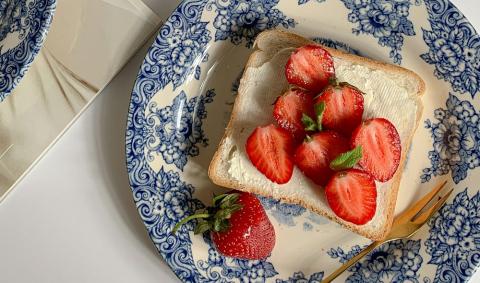
Ingredients

  • 4 Medium Slices Slices (144g) Wholemeal Bread
  • 4 Tablespoons (120g) Reduced Fat Cream Cheese
  • 2 Teaspoons (16g) Honey
  • 8 (96g) Strawberries

This recipe has been added to your Meal Planner.

Allergy Disclaimer

Always check the label of each ingredient for allergy warnings.

Method

  1. Toast the bread.
  2. Place the cream cheese in a bowl and whisk using an electric or hand whisk if you have one, or a fork, until smooth.
  3. Wash and slice the strawberries
  4. Spread the cream cheese evenly over each slice of bread. Drizzle honey over the top of each slice and then add the strawberries.
  5. Cut each slice diagonally and serve.

Time Saver Tips

Other berries or soft fruits could be used. Try with tinned peaches in juice.

Tips for Kids

They will enjoy whisking and drizzling. As this recipe contains added sugar it’s best kept to mealtimes.

Nutritional Information

Based on a single serving of 89g (% of an adult's reference intake)

Energy

145 kcals ( 7 %)

610 kJ ( 7 %)

Fat

2.4 g ( 12 %)

Saturates

21 g ( %)

Sugar

6.6 g ( 7 %)

Salt

0.5 g ( 8 %)

Detailed nutritional information

Per 100g Per 89g serving
Energy Kcals 163 145
Energy Kj 685 610
Protein 7.5 g 6.7 g
Total Fat g g
Saturated Fat 2.7 g 2.4 g
Carbohydrates 23.6 g 21 g
Total Sugars 7.4 g 6.6 g
NSP Fibre 2.3 g 2 g
Sodium 259 mg 231 mg
Salt 0.6 g 0.5 g

Find out about nutritional labelling

Nutrition labels on the front of packaging

  • Most of the big supermarkets and many food manufacturers display nutritional information on the front of pre-packed food.
  • Front of pack nutrition labels provide information on the number of grams of fat, saturated fat, sugars and salt and the amount of energy (in kJ and kcal) in a serving or portion of a recipe.
  • The labels also include information about reference intakes (expressed as a percentage) which are guidelines about the approximate amount of particular nutrients and energy required for a healthy diet.
  • The colour coding tells you at a glance if the food has high (red), medium (amber) or low (green) amounts of fat, saturated fat, sugars and salt.
  • The more greens on the label, the healthier the choice
  • Amber means neither high nor low, so you can eat foods with all or mostly ambers on the label most of the time.
  • Reds on the label means the food is high in that nutrient and these are the foods we should cut down on. Try to eat these foods less often and in small amounts.

Food shopping tips

If you’re trying to decide which product to choose, check to see if there's a nutrition label on the front of the pack. This will help you to quickly assess how your choices stack up. You will often find a mixture of red, amber and green colour coding for the nutrients. So when you're choosing between similar products, try to go for more greens and ambers and fewer reds if you want to make a healthier choice.

Back to top

Ingredients

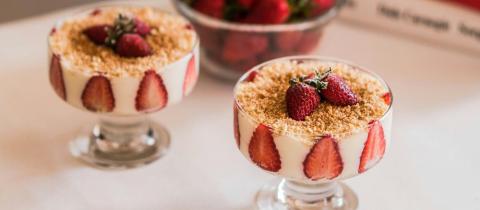
  • 8 (96g) Strawberries
  • 2 (30g) Digestive Biscuits
  • 4 Tablespoon (160g) Ricotta Cheese

This recipe has been added to your Meal Planner.

Allergy Disclaimer

Always check the label of each ingredient for allergy warnings.

Method

  1. Wash strawberries and then chop into small pieces
  2. In a bowl mix ricotta cheese and strawberries together gently.
  3. Divide into portions and crumble digestive biscuit on top then serve.


Time Saver Tips

Prepare in advance and kee refrigerated until ready to serve

Cost Saver Tips

Use any soft fruit available and in season

Tips for Kids

Try with their favourite fruit. Fruit can be served on top or on the side if preferred. As this recipe contains added sugar it’s best kept to mealtimes.

Nutritional Information

Based on a single serving of 71g (% of an adult's reference intake)

Energy

99 kcals ( 5 %)

417 kJ ( 5 %)

Fat

3.5 g ( 17 %)

Saturates

7.4 g ( %)

Sugar

3.2 g ( 4 %)

Salt

0.2 g ( 4 %)

Detailed nutritional information

Per 100g Per 71g serving
Energy Kcals 140 99
Energy Kj 588 417
Protein 6.3 g 4.5 g
Total Fat g g
Saturated Fat 4.9 g 3.5 g
Carbohydrates 10.4 g 7.4 g
Total Sugars 4.5 g 3.2 g
NSP Fibre 0.6 g 0.4 g
Sodium 123 mg 87 mg
Salt 0.3 g 0.2 g

Find out about nutritional labelling

Nutrition labels on the front of packaging

  • Most of the big supermarkets and many food manufacturers display nutritional information on the front of pre-packed food.
  • Front of pack nutrition labels provide information on the number of grams of fat, saturated fat, sugars and salt and the amount of energy (in kJ and kcal) in a serving or portion of a recipe.
  • The labels also include information about reference intakes (expressed as a percentage) which are guidelines about the approximate amount of particular nutrients and energy required for a healthy diet.
  • The colour coding tells you at a glance if the food has high (red), medium (amber) or low (green) amounts of fat, saturated fat, sugars and salt.
  • The more greens on the label, the healthier the choice
  • Amber means neither high nor low, so you can eat foods with all or mostly ambers on the label most of the time.
  • Reds on the label means the food is high in that nutrient and these are the foods we should cut down on. Try to eat these foods less often and in small amounts.

Food shopping tips

If you’re trying to decide which product to choose, check to see if there's a nutrition label on the front of the pack. This will help you to quickly assess how your choices stack up. You will often find a mixture of red, amber and green colour coding for the nutrients. So when you're choosing between similar products, try to go for more greens and ambers and fewer reds if you want to make a healthier choice.

Back to top

Ingredients

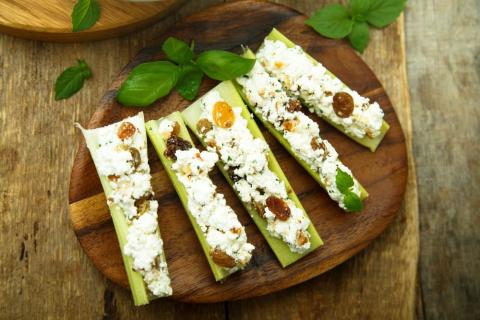
  • 8 Sticks (240g) Celery
  • 1 Tub (200g) Low Fat Soft Cheese
  • 1 Tub (90g) Low Fat Crème Fraîche
  • 1 ½ Tablespoons (40g) Sweetcorn
  • 6 Slices (36g) Cucumber
  • 2 Slices (40g) Red Pepper
  • (12g) Olives
  • 1 (optional) Tablespoon (20g) Chopped Nuts

This recipe has been added to your Meal Planner.

Allergy Disclaimer

Always check the label of each ingredient for allergy warnings.

Method

  1. Wash the celery and trim the ends if required.
  2. In a small bowl mix the soft cheese and crème fraiche together with a spoon.
  3. Chop the pepper, cucumber and olives into small cubes. Mix all the vegetables with the cheese then spread into the groove of each celery stick.
  4. Sprinkle with chopped nuts if using them and then serve.


Time Saver Tips

The filling could be made in advance and stored in the fridge.

Cost Saver Tips

Use leftover vegetables or fruit.

Tips for Kids

The celery can be cut into bite size pieces and they can then add the topping of their choice using their favourite fruit and vegetables.

Nutritional Information

Based on a single serving of 169g (% of an adult's reference intake)

Energy

144 kcals ( 7 %)

603 kJ ( 7 %)

Fat

4.2 g ( 20 %)

Saturates

7.6 g ( %)

Sugar

5.6 g ( 6 %)

Salt

0.7 g ( 11 %)

Detailed nutritional information

Per 100g Per 169g serving
Energy Kcals 85 144
Energy Kj 357 603
Protein 5.2 g 8.8 g
Total Fat g g
Saturated Fat 2.5 g 4.2 g
Carbohydrates 4.5 g 7.6 g
Total Sugars 3.3 g 5.6 g
NSP Fibre 0.8 g 1.4 g
Sodium 171 mg 289 mg
Salt 0.4 g 0.7 g

Find out about nutritional labelling

Nutrition labels on the front of packaging

  • Most of the big supermarkets and many food manufacturers display nutritional information on the front of pre-packed food.
  • Front of pack nutrition labels provide information on the number of grams of fat, saturated fat, sugars and salt and the amount of energy (in kJ and kcal) in a serving or portion of a recipe.
  • The labels also include information about reference intakes (expressed as a percentage) which are guidelines about the approximate amount of particular nutrients and energy required for a healthy diet.
  • The colour coding tells you at a glance if the food has high (red), medium (amber) or low (green) amounts of fat, saturated fat, sugars and salt.
  • The more greens on the label, the healthier the choice
  • Amber means neither high nor low, so you can eat foods with all or mostly ambers on the label most of the time.
  • Reds on the label means the food is high in that nutrient and these are the foods we should cut down on. Try to eat these foods less often and in small amounts.

Food shopping tips

If you’re trying to decide which product to choose, check to see if there's a nutrition label on the front of the pack. This will help you to quickly assess how your choices stack up. You will often find a mixture of red, amber and green colour coding for the nutrients. So when you're choosing between similar products, try to go for more greens and ambers and fewer reds if you want to make a healthier choice.

Back to top

Ingredients

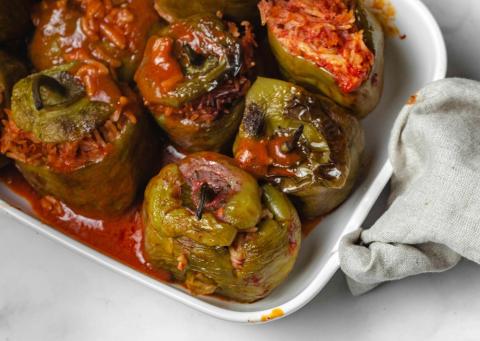
  • 5 Heaped spoonfuls Tablespoons (200g) Brown Rice
  • 2 Tablespoons (20g) Vegetable Oil
  • 1 Large sized (240g) Onion
  • 2 Sticks (60g) Celery
  • 2 (6g) Garlic Cloves
  • 8 Medium sized (80g) Mushrooms
  • 1 Medium sized (100g) Courgette
  • 1 Teaspoon (1g) Mixed Herbs
  • 4 (600g) Beef Tomatoes
  • 4 (640g) Peppers
  • 1 Pinch (1g) Ground Black Pepper
  • 4 Low fat Tablespoons (40g) Cheddar Cheese

This recipe has been added to your Meal Planner.

Allergy Disclaimer

Always check the label of each ingredient for allergy warnings.

Method

  1. Preheat the oven to 190°C / 170°C fan oven / 360°F / gas mark 5
  2. Gently boil the rice as per manufacturers instructions. Meanwhile peel the onion and garlic then slice along with the celery, mushrooms and courgette into small cubes
  3. Heat the oil in a large non-stick frying pan and cook the onion, celery, garlic, mushrooms and courgette for 8-10 minutes, until soft. Set aside
  4. Drain the rice and mix with the cooked vegetables and herbs. Season with black pepper
  5. Slice the tops from the peppers and tomatoes, scoop out the seeds and arrange them in a roasting tin
  6. Fill with the rice mixture and sprinkle with grated cheese, put the tops back on and bake for approximately 20 minutes, until the vegetables are tender


Tips for Kids

Kids will love to help to prepare the toamtoes and peppers. Let them choose their favourite colour pepper.

Nutritional Information

Based on a single serving of 456g (% of an adult's reference intake)

Energy

287 kcals ( 14 %)

1,117 kJ ( 14 %)

Fat

2.3 g ( 12 %)

Saturates

43.8 g ( %)

Sugar

15.5 g ( 17 %)

Salt

0.2 g ( 3 %)

Detailed nutritional information

Per 100g Per 456g serving
Energy Kcals 63 287
Energy Kj 245 1,117
Protein 2.1 g 9.6 g
Total Fat g g
Saturated Fat 0.5 g 2.3 g
Carbohydrates 9.6 g 43.8 g
Total Sugars 3.4 g 15.5 g
NSP Fibre 1.3 g 5.9 g
Sodium 22 mg 100 mg
Salt 0.1 g 0.2 g

Find out about nutritional labelling

Nutrition labels on the front of packaging

  • Most of the big supermarkets and many food manufacturers display nutritional information on the front of pre-packed food.
  • Front of pack nutrition labels provide information on the number of grams of fat, saturated fat, sugars and salt and the amount of energy (in kJ and kcal) in a serving or portion of a recipe.
  • The labels also include information about reference intakes (expressed as a percentage) which are guidelines about the approximate amount of particular nutrients and energy required for a healthy diet.
  • The colour coding tells you at a glance if the food has high (red), medium (amber) or low (green) amounts of fat, saturated fat, sugars and salt.
  • The more greens on the label, the healthier the choice
  • Amber means neither high nor low, so you can eat foods with all or mostly ambers on the label most of the time.
  • Reds on the label means the food is high in that nutrient and these are the foods we should cut down on. Try to eat these foods less often and in small amounts.

Food shopping tips

If you’re trying to decide which product to choose, check to see if there's a nutrition label on the front of the pack. This will help you to quickly assess how your choices stack up. You will often find a mixture of red, amber and green colour coding for the nutrients. So when you're choosing between similar products, try to go for more greens and ambers and fewer reds if you want to make a healthier choice.

Back to top

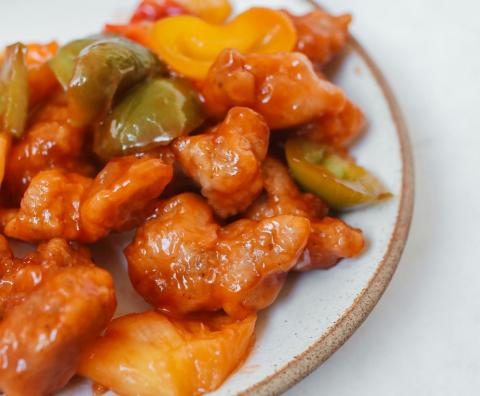
Ingredients

  • 1 Pack (400g) Pork
  • 1 Medium Sized (150g) Onion
  • 2 Medium Sized (160g) Carrots
  • 10 Medium Sized (100g) Mushrooms
  • 1 (160g) Green Pepper
  • 1 Tablespoons (20g) Sugar
  • 2 Tablespoons (30g) Vinegar
  • 1 Can (400g) Pineapple Chunks In Juice
  • 2 Teaspoons (10g) Ketchup
  • 1 Heaped Spoonful (If Required) Teaspoons (10g) Cornflour
  • 2 Tablespoons (20g) Vegetable Oil
  • (250g) Egg Noodles

This recipe has been added to your Meal Planner.

Allergy Disclaimer

Always check the label of each ingredient for allergy warnings.

Method

  1. Dice the pork into bite size pieces, heat the oil in a pan then add the pork and cook until sealed (2-3 minutes).
  2. Prepare and chop all the vegetables and add to the pan, cook for a further 5 minutes.
  3. Add the sugar and vinegar and cook until the vegetables are tender (5 minutes). Meanwhile cook the noodles as per the instructions on the packet.
  4. Drain the pineapple and add it with the tomato ketchup to the meat.
  5. Thicken if required using cornflour mixed first with 3-4 teaspoons of juice from pineapple.
  6. Serve with noodles.

You can use any type of noodles for this meal. If you don't have cornflour to thicken the sauce you can use any type of flour. 

Time Saver Tips

Frozen vegetables are a quick and easy option – just make sure the pan’s hot before adding them so the dish doesn’t get soggy.

Cost Saver Tips

This recipe works great with any type of meat. So why not keep a lookout for offers on lamb, chicken, turkey, or beef? You could even try making it with salmon. Fancy making this veggie? Courgettes or bean sprouts are really tasty. Chickpeas or butter beans are a great meat-free option, too. To save, why not use whatever vegetables you’ve already got in? No need to worry about exact quantities, as long as it’s a mix of at least 500g. This works just as great with rice if you don’t have any noodles in your cupboard.

Tips for Kids

Why not try eating with chopsticks?

Nutritional Information

Based on a single serving of 415g (% of an adult's reference intake)

Energy

490 kcals ( 25 %)

2,473 kJ ( 25 %)

Fat

2.5 g ( 12 %)

Saturates

71.4 g ( %)

Sugar

23.2 g ( 26 %)

Salt

0.8 g ( 14 %)

Detailed nutritional information

Per 100g Per 415g serving
Energy Kcals 118 490
Energy Kj 596 2,473
Protein 7.3 g 30.3 g
Total Fat g g
Saturated Fat 0.6 g 2.5 g
Carbohydrates 17.2 g 71.4 g
Total Sugars 5.6 g 23.2 g
NSP Fibre 1.3 g 5.4 g
Sodium 73 mg 303 mg
Salt 0.2 g 0.8 g

Find out about nutritional labelling

Nutrition labels on the front of packaging

  • Most of the big supermarkets and many food manufacturers display nutritional information on the front of pre-packed food.
  • Front of pack nutrition labels provide information on the number of grams of fat, saturated fat, sugars and salt and the amount of energy (in kJ and kcal) in a serving or portion of a recipe.
  • The labels also include information about reference intakes (expressed as a percentage) which are guidelines about the approximate amount of particular nutrients and energy required for a healthy diet.
  • The colour coding tells you at a glance if the food has high (red), medium (amber) or low (green) amounts of fat, saturated fat, sugars and salt.
  • The more greens on the label, the healthier the choice
  • Amber means neither high nor low, so you can eat foods with all or mostly ambers on the label most of the time.
  • Reds on the label means the food is high in that nutrient and these are the foods we should cut down on. Try to eat these foods less often and in small amounts.

Food shopping tips

If you’re trying to decide which product to choose, check to see if there's a nutrition label on the front of the pack. This will help you to quickly assess how your choices stack up. You will often find a mixture of red, amber and green colour coding for the nutrients. So when you're choosing between similar products, try to go for more greens and ambers and fewer reds if you want to make a healthier choice.

Back to top

Ingredients

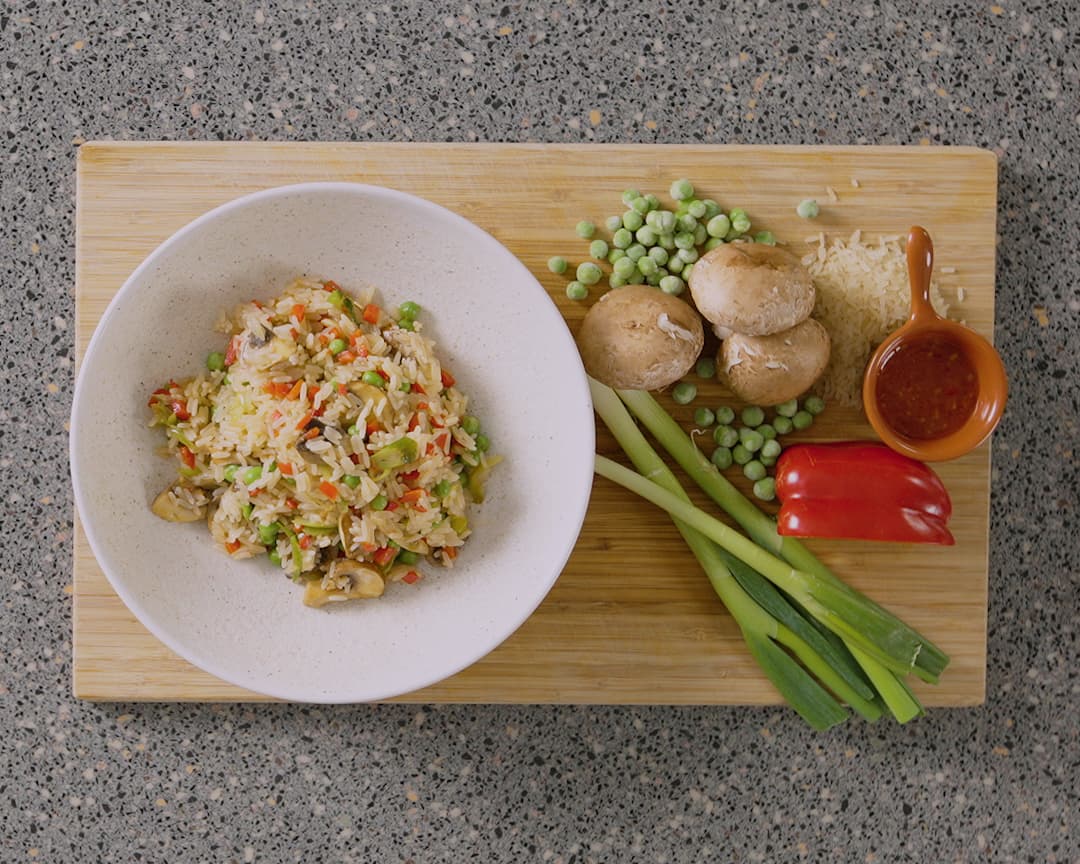
  • 1 Mug (300g) Rice
  • 1 Tablespoon (10g) Vegetable Oil
  • 6 (60g) Spring Onions
  • 1 Medium Sized (160g) Red Pepper
  • 10 Medium Sized (100g) Mushrooms
  • 3 Tablespoons (90g) Frozen Peas
  • 4 Tablespoons (40g) Sweet Chilli Sauce

This recipe has been added to your Meal Planner.

Allergy Disclaimer

Always check the label of each ingredient for allergy warnings.

Method

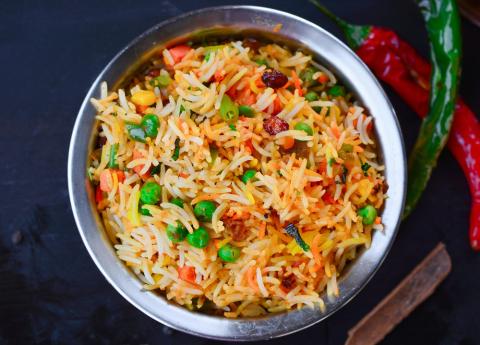
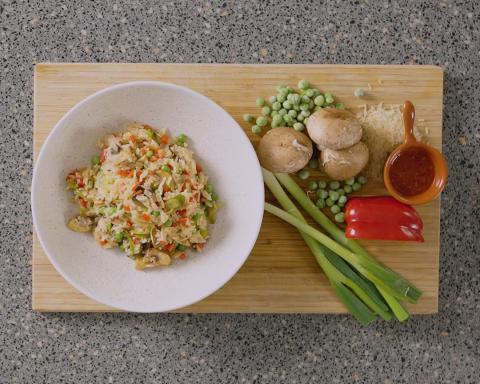
  1. Cook rice as per manufacturer's instructions and rinse with boiling water.
  2. Meanwhile wash and trim tops and ends of the spring onions and chop finely. De-seed the pepper and dice, then wipe and slice the mushrooms.
  3. Heat oil in a large frying pan, fry spring onions for 2 -3 minutes and then add the pepper and mushrooms for a further 2-3 minutes.
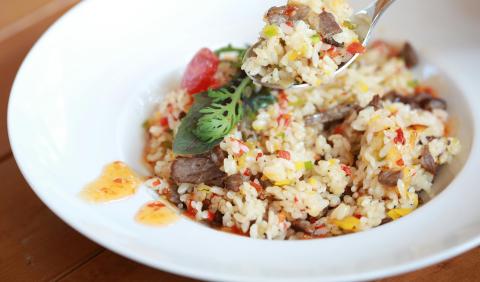
  4. Add peas and the rice to the pan and stir continuously for 2-3 minutes then stir in the sweet chilli sauce.
  5. Serve when heated through.

Time Saver Tips

To save time, you could use microwavable or boil in the bag rice.

Cost Saver Tips

This is a great way to use any leftover rice and fresh or frozen vegetables you’ve got in. (Just remember to always let rice cool down before you put it in the fridge and only reheat it once.)
Tips for Kids

Your wee one will love helping you prepare and chop the vegetables – knowing they’ve been your little helper in the kitchen might even make them more likely to eat it! Swap in their favourite vegetables if that helps.
Nutritional Information

Based on a single serving of 305g (% of an adult's reference intake)

Energy

396 kcals ( 20 %)

1,575 kJ ( 20 %)

Fat

0.4 g ( 2 %)

Saturates

82.1 g ( %)

Sugar

8.5 g ( 9 %)

Salt

0.5 g ( 8 %)

Detailed nutritional information

Per 100g Per 305g serving
Energy Kcals 127 396
Energy Kj 539 1,575
Protein 2.8 g 8.2 g
Total Fat g g
Saturated Fat 0.1 g 0.4 g
Carbohydrates 27.7 g 82.1 g
Total Sugars 2.9 g 8.5 g
NSP Fibre 0.8 g 2.4 g
Sodium 64 mg 190 mg
Salt 0.2 g 0.5 g

Find out about nutritional labelling

Nutrition labels on the front of packaging

  • Most of the big supermarkets and many food manufacturers display nutritional information on the front of pre-packed food.
  • Front of pack nutrition labels provide information on the number of grams of fat, saturated fat, sugars and salt and the amount of energy (in kJ and kcal) in a serving or portion of a recipe.
  • The labels also include information about reference intakes (expressed as a percentage) which are guidelines about the approximate amount of particular nutrients and energy required for a healthy diet.
  • The colour coding tells you at a glance if the food has high (red), medium (amber) or low (green) amounts of fat, saturated fat, sugars and salt.
  • The more greens on the label, the healthier the choice
  • Amber means neither high nor low, so you can eat foods with all or mostly ambers on the label most of the time.
  • Reds on the label means the food is high in that nutrient and these are the foods we should cut down on. Try to eat these foods less often and in small amounts.

Food shopping tips

If you’re trying to decide which product to choose, check to see if there's a nutrition label on the front of the pack. This will help you to quickly assess how your choices stack up. You will often find a mixture of red, amber and green colour coding for the nutrients. So when you're choosing between similar products, try to go for more greens and ambers and fewer reds if you want to make a healthier choice.

Back to top
Subscribe to Eat Better Feel Better