This article was created with

eat-better-feel-better-logo-2.png

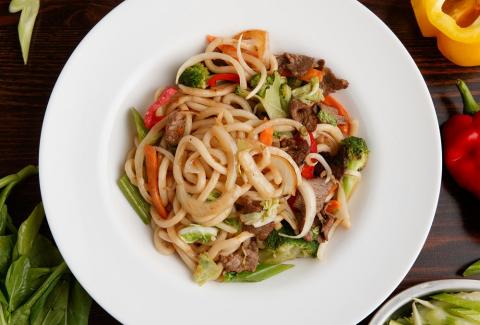
Ingredients

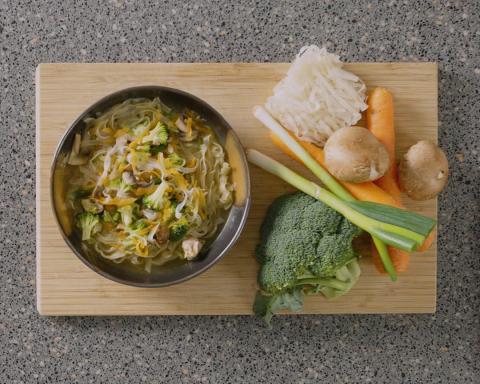
  • 6 (60g) Spring Onions
  • 1 large size Head (260g) Broccoli
  • 2 (6g) Garlic Cloves
  • 2 Tablespoons (20g) Vegetable Oil
  • 2 Teaspoon (6g) Ground Ginger
  • Boiling (1L) Water
  • 1 thin slice Pack (400g) Lean Beef Frying Steak
  • 1 Teaspoon (5g) Chinese Five Spice Powder
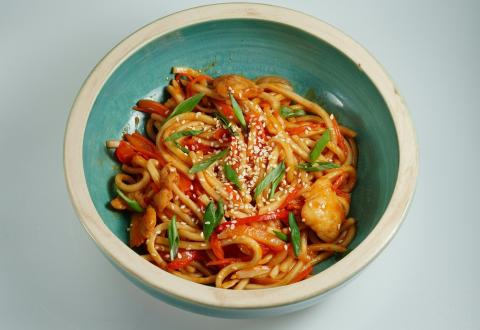
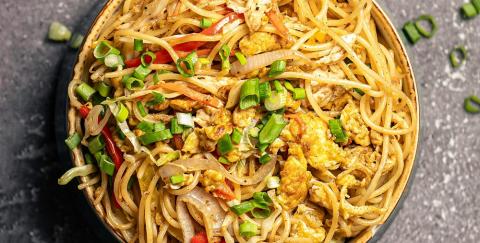
  • 1 Pack (375g) Dried Fine Egg Noodles

This recipe has been added to your Meal Planner.

Allergy Disclaimer

Always check the label of each ingredient for allergy warnings.

Method

  1. Slice the beef into thin strips, trimming off the fat.
  2. Cut the broccoli and spring onions into thin slices.
  3. Peel and finely chop the garlic.
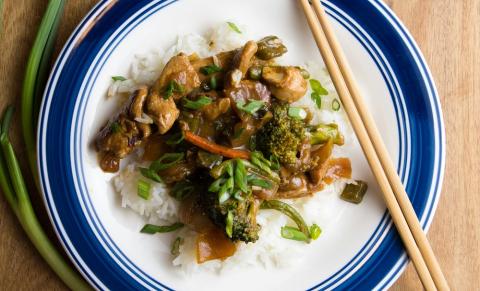
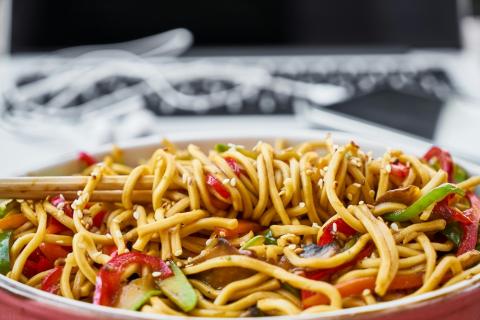
  4. Heat a wok or large frying pan, then add the oil, followed by the beef, spring onions,  garlic and broccoli when it is  hot.  Sprinkle in the Chinese five spice and ginger after 1-2 minutes.  
  5. Stir fry for 4-5 minutes until the beef is cooked, making sure that you keep stirring the pan and that you keep the heat high.  
  6. Meanwhile, pour the water into a large saucepan, bring back to the boil, and cook the noodles for about 3-4 minutes until they are just tender.
  7. Drain the noodles and serve hot with the beef and vegetables.

Time Saver Tips

You can use frozen defrosted broccoli for this dish, or a pack of frozen stir fry vegetables. If you can get it, tenderstem broccoli works well in this dish.

Cost Saver Tips

Can be made with any fresh or seasonal vegetables, so choose whatever is on offer. Just remember to chop them into similar sized pieces, so they cook at the same time.

Tips for Kids

Use their favourite vegetables, or use chopsticks for eating!

Nutritional Information

Based on a single serving of 346g (% of an adult's reference intake)

Energy

461 kcals ( 23 %)

1,940 kJ ( 23 %)

Fat

2.9 g ( 15 %)

Saturates

49.8 g ( %)

Sugar

1.8 g ( 2 %)

Salt

0.5 g ( 9 %)

Detailed nutritional information

Per 100g Per 346g serving
Energy Kcals 133 461
Energy Kj 561 1,940
Protein 10 g 34.6 g
Total Fat g g
Saturated Fat 0.8 g 2.9 g
Carbohydrates 14.4 g 49.8 g
Total Sugars 0.5 g 1.8 g
NSP Fibre 1.5 g 5.2 g
Sodium 61 mg 212 mg
Salt 0.2 g 0.5 g

Find out about nutritional labelling

Nutrition labels on the front of packaging

  • Most of the big supermarkets and many food manufacturers display nutritional information on the front of pre-packed food.
  • Front of pack nutrition labels provide information on the number of grams of fat, saturated fat, sugars and salt and the amount of energy (in kJ and kcal) in a serving or portion of a recipe.
  • The labels also include information about reference intakes (expressed as a percentage) which are guidelines about the approximate amount of particular nutrients and energy required for a healthy diet.
  • The colour coding tells you at a glance if the food has high (red), medium (amber) or low (green) amounts of fat, saturated fat, sugars and salt.
  • The more greens on the label, the healthier the choice
  • Amber means neither high nor low, so you can eat foods with all or mostly ambers on the label most of the time.
  • Reds on the label means the food is high in that nutrient and these are the foods we should cut down on. Try to eat these foods less often and in small amounts.

Food shopping tips

If you’re trying to decide which product to choose, check to see if there's a nutrition label on the front of the pack. This will help you to quickly assess how your choices stack up. You will often find a mixture of red, amber and green colour coding for the nutrients. So when you're choosing between similar products, try to go for more greens and ambers and fewer reds if you want to make a healthier choice.
Back to top

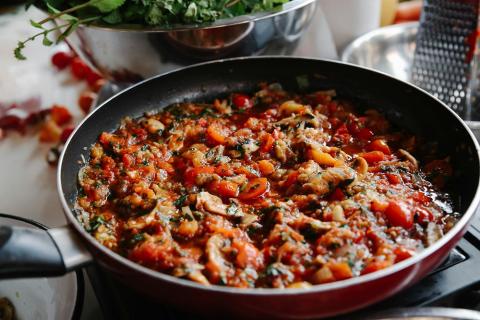
Ingredients

  • 1 Lean Pack (440g) Beef
  • 1 Medium (150g) Red onion
  • 2 (6g) Garlic Cloves
  • 1 Can (400g) Chopped Tomatoes
  • 1 Teaspoons (1g) Mixed Herbs
  • 1 Reduced Salt (7g) Beef Stock Cube
  • 1 Boiling Cups (150ml) Water
  • 1 (160g) Red Pepper
  • 1 (160g) Green Pepper
  • 1 Large (150g) Courgette
  • 1 (260g) Aubergine
  • 1 To Taste Pinch (1g) Ground Black Pepper
  • 6 ½ Tablespoons (260g) White Rice

This recipe has been added to your Meal Planner.

Allergy Disclaimer

Always check the label of each ingredient for allergy warnings.

Method

  1. Heat the oven to 180°C / 350°F / 160°C fan oven / gas mark 4.
  2. Cut the beef into chunky cubes.
  3. Peel and chop the onion and garlic.
  4. Dissolve the stock cube in the boiling water.
  5. Brown the beef in the oil in a frying pan over a medium to high heat.
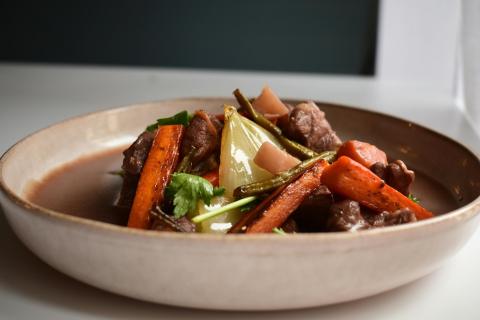
  6. When the meat is browned, place the beef, onion, garlic, chopped tomatoes, herbs and stock in a large ovenproof dish and stir. Place in the oven for 1 to 1 1/2 hours.
  7. Wash the peppers, courgette and aubergine and chop into large chunks.
  8. Add the vegetables and black pepper to the casserole and stir. Return to the oven for 30 minutes to 1 hour until the vegetables are soft and the meat is tender.
  9. Cook the rice according to the instructions on the packet and serve with the beef ratatouille.

Time Saver Tips

To make this recipe quicker, you could buy meat that's already been cut into cubes.

Cost Saver Tips

Can be left to cook on the hob rather than using the oven.

Tips for Kids

The more veggies the better – if your kids have favourites, such as carrots or mushrooms, pop them in too.

Nutritional Information

Based on a single serving of 509g (% of an adult's reference intake)

Energy

522 kcals ( 26 %)

2,198 kJ ( 26 %)

Fat

3.9 g ( 20 %)

Saturates

62 g ( %)

Sugar

9.8 g ( 11 %)

Salt

0.6 g ( 10 %)

Detailed nutritional information

Per 100g Per 509g serving
Energy Kcals 102 522
Energy Kj 429 2,198
Protein 6.4 g 32.8 g
Total Fat g g
Saturated Fat 0.8 g 3.9 g
Carbohydrates 12.1 g 62 g
Total Sugars 1.9 g 9.8 g
NSP Fibre 0.9 g 4.6 g
Sodium 50 mg 252 mg
Salt 0.1 g 0.6 g

Find out about nutritional labelling

Nutrition labels on the front of packaging

  • Most of the big supermarkets and many food manufacturers display nutritional information on the front of pre-packed food.
  • Front of pack nutrition labels provide information on the number of grams of fat, saturated fat, sugars and salt and the amount of energy (in kJ and kcal) in a serving or portion of a recipe.
  • The labels also include information about reference intakes (expressed as a percentage) which are guidelines about the approximate amount of particular nutrients and energy required for a healthy diet.
  • The colour coding tells you at a glance if the food has high (red), medium (amber) or low (green) amounts of fat, saturated fat, sugars and salt.
  • The more greens on the label, the healthier the choice
  • Amber means neither high nor low, so you can eat foods with all or mostly ambers on the label most of the time.
  • Reds on the label means the food is high in that nutrient and these are the foods we should cut down on. Try to eat these foods less often and in small amounts.

Food shopping tips

If you’re trying to decide which product to choose, check to see if there's a nutrition label on the front of the pack. This will help you to quickly assess how your choices stack up. You will often find a mixture of red, amber and green colour coding for the nutrients. So when you're choosing between similar products, try to go for more greens and ambers and fewer reds if you want to make a healthier choice.

Back to top

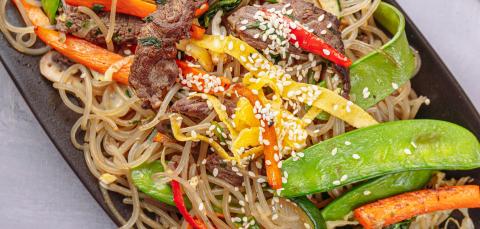
Ingredients

  • 1 Pack (440g) Diced Frying Beef
  • 1 Tablespoon (10g) Vegetable Oil
  • 4 (40g) Spring Onions
  • 1 (160g) Pepper
  • 1 Pack (200g) Sugar Snap Peas
  • 8 Teaspoons (40g) Reduced Salt Soy Sauce
  • 1 Tablespoon (20g) Sugar
  • 2 (6g) Garlic Cloves
  • 1 1 cm Piece (10g) Ginger
  • 1 Level Tablespoon Tablespoon (20g) Cornflour
  • 1 Mug (300g) Rice

This recipe has been added to your Meal Planner.

Allergy Disclaimer

Always check the label of each ingredient for allergy warnings.

Method


  1. Peel garlic and use a knife remove outer layer of ginger using a knife or vegetable peeler. Chop both into small pieces.
  2. In a small bowl mix 3 teaspoons of soy sauce with the cornflour, sugar, garlic and ginger then add the beef. Leave to one side while preparing other ingredients or if time leave to marinade for 20 minutes.
  3. Deseed the pepper and slice. Prepare spring onions by chopping off top and bottom and removing outer layer if required. Slice into small pieces.
  4. Heat oil in a large frying pan or wok. Add beef to pan and fry for 3 minutes until it begins to brown.
  5. Meanwhile cook the rice as per manufacturers' instructions.
  6. Add the pepper and sugar- snap peas to the pan and cook for 2-3 minutes then add the spring onion and the remaining soy sauce.
  7. Cook for a further 2 minutes then serve with the rice.

Time Saver Tips

Prepare marinade and leave beef to marinade in advance or even overnight (cover with marinade and refrigerate).

Tips for Kids

Use their favourite vegetables. They could try eating with chopsticks.

Nutritional Information

Based on a single serving of 409g (% of an adult's reference intake)

Energy

552 kcals ( 28 %)

2,319 kJ ( 28 %)

Fat

3.7 g ( 19 %)

Saturates

83 g ( %)

Sugar

10.6 g ( 12 %)

Salt

1.2 g ( 20 %)

Detailed nutritional information

Per 100g Per 409g serving
Energy Kcals 135 552
Energy Kj 567 2,319
Protein 8 g 32.7 g
Total Fat g g
Saturated Fat 0.9 g 3.7 g
Carbohydrates 20.3 g 83 g
Total Sugars 2.6 g 10.6 g
NSP Fibre 0.4 g 1.6 g
Sodium 126 mg 515 mg
Salt 0.3 g 1.2 g

Find out about nutritional labelling

Nutrition labels on the front of packaging

  • Most of the big supermarkets and many food manufacturers display nutritional information on the front of pre-packed food.
  • Front of pack nutrition labels provide information on the number of grams of fat, saturated fat, sugars and salt and the amount of energy (in kJ and kcal) in a serving or portion of a recipe.
  • The labels also include information about reference intakes (expressed as a percentage) which are guidelines about the approximate amount of particular nutrients and energy required for a healthy diet.
  • The colour coding tells you at a glance if the food has high (red), medium (amber) or low (green) amounts of fat, saturated fat, sugars and salt.
  • The more greens on the label, the healthier the choice
  • Amber means neither high nor low, so you can eat foods with all or mostly ambers on the label most of the time.
  • Reds on the label means the food is high in that nutrient and these are the foods we should cut down on. Try to eat these foods less often and in small amounts.

Food shopping tips

If you’re trying to decide which product to choose, check to see if there's a nutrition label on the front of the pack. This will help you to quickly assess how your choices stack up. You will often find a mixture of red, amber and green colour coding for the nutrients. So when you're choosing between similar products, try to go for more greens and ambers and fewer reds if you want to make a healthier choice.

Back to top

Ingredients

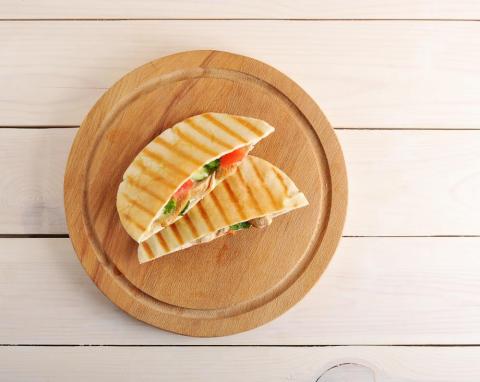
  • 4 Pitta Breads
  • 8 Rashers (200g) Back Bacon
  • 4 Leaves (100g) Lettuce
  • 4 Medium Sized (340g) Tomatoes
  • 4 Level Spoonfuls Tablespoons (60g) Reduced Calorie Mayonnaise

This recipe has been added to your Meal Planner.

Allergy Disclaimer

Always check the label of each ingredient for allergy warnings.

Method

  1. Trim the fat off the bacon and grill until it is crispy.
  2. Wash the lettuce and tomatoes. Then shred the lettuce into small pieces and slice the tomatoes.
  3. Warm the pittas in a toaster or under the grill.
  4. Open the pitta breads and spread 1 tablespoon of light mayonnaise in each.
  5. Add 2 bacon rashers, lettuce and tomato to each pitta bread and serve.

Tips for Kids

Encourage the kids to fill the pitta breads themselves.

Nutritional Information

Based on a single serving of 238g (% of an adult's reference intake)

Energy

311 kcals ( 16 %)

1,303 kJ ( 16 %)

Fat

2.6 g ( 13 %)

Saturates

29.4 g ( %)

Sugar

5.1 g ( 6 %)

Salt

3.6 g ( 60 %)

Detailed nutritional information

Per 100g Per 238g serving
Energy Kcals 131 311
Energy Kj 547 1,303
Protein 8.3 g 19.7 g
Total Fat g g
Saturated Fat 1.1 g 2.6 g
Carbohydrates 12.4 g 29.4 g
Total Sugars 2.1 g 5.1 g
NSP Fibre 2.3 g 5.5 g
Sodium 600 mg 1,429 mg
Salt 1.5 g 3.6 g

Find out about nutritional labelling

Nutrition labels on the front of packaging

  • Most of the big supermarkets and many food manufacturers display nutritional information on the front of pre-packed food.
  • Front of pack nutrition labels provide information on the number of grams of fat, saturated fat, sugars and salt and the amount of energy (in kJ and kcal) in a serving or portion of a recipe.
  • The labels also include information about reference intakes (expressed as a percentage) which are guidelines about the approximate amount of particular nutrients and energy required for a healthy diet.
  • The colour coding tells you at a glance if the food has high (red), medium (amber) or low (green) amounts of fat, saturated fat, sugars and salt.
  • The more greens on the label, the healthier the choice
  • Amber means neither high nor low, so you can eat foods with all or mostly ambers on the label most of the time.
  • Reds on the label means the food is high in that nutrient and these are the foods we should cut down on. Try to eat these foods less often and in small amounts.

Food shopping tips

If you’re trying to decide which product to choose, check to see if there's a nutrition label on the front of the pack. This will help you to quickly assess how your choices stack up. You will often find a mixture of red, amber and green colour coding for the nutrients. So when you're choosing between similar products, try to go for more greens and ambers and fewer reds if you want to make a healthier choice.

Back to top

Ingredients

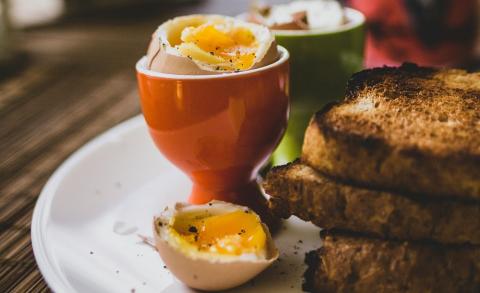
  • 4 Medium Eggs

This recipe has been added to your Meal Planner.

Allergy Disclaimer

Always check the label of each ingredient for allergy warnings.

Method

  1. Add boiling water to a medium sized pan and bring to the boil then turn down the heat.
  2. Using a spoon gently lower each egg into the pan.
  3. Keeping the water gently simmering, boil eggs for 5-6 minutes for a soft boiled egg or 10-12 minutes for a hard boiled egg.
  4. Soft boiled eggs should be removed from the water and served in an egg cup.
  5. Hard boiled eggs should be cooled quickly by running cold water into the pan. Once cooled, crack the shells all over on a a hard surface and then peel the shell off.

Time Saver Tips

It’s easy to have hard-boiled eggs ready in advance. Just cook them, let them cool, and then pop them in the fridge.

Tips for Kids

Giving wholemeal bread a go is an easy way to help your little one get more fibre – they probably won’t even tell the difference!

Nutritional Information

Based on a single serving of 60g (% of an adult's reference intake)

Energy

86 kcals ( 4 %)

360 kJ ( 4 %)

Fat

1.6 g ( 8 %)

Saturates

0.1 g ( %)

Sugar

0.1 g ( 1 %)

Salt

0.2 g ( 4 %)

Detailed nutritional information

Per 100g Per 60g serving
Energy Kcals 143 86
Energy Kj 601 360
Protein 14.1 g 8.5 g
Total Fat g g
Saturated Fat 2.7 g 1.6 g
Carbohydrates 0.1 g 0.1 g
Total Sugars 0.1 g 0.1 g
NSP Fibre 0 g 0 g
Sodium 150 mg 90 mg
Salt 0.4 g 0.2 g

Find out about nutritional labelling

Nutrition labels on the front of packaging

  • Most of the big supermarkets and many food manufacturers display nutritional information on the front of pre-packed food.
  • Front of pack nutrition labels provide information on the number of grams of fat, saturated fat, sugars and salt and the amount of energy (in kJ and kcal) in a serving or portion of a recipe.
  • The labels also include information about reference intakes (expressed as a percentage) which are guidelines about the approximate amount of particular nutrients and energy required for a healthy diet.
  • The colour coding tells you at a glance if the food has high (red), medium (amber) or low (green) amounts of fat, saturated fat, sugars and salt.
  • The more greens on the label, the healthier the choice
  • Amber means neither high nor low, so you can eat foods with all or mostly ambers on the label most of the time.
  • Reds on the label means the food is high in that nutrient and these are the foods we should cut down on. Try to eat these foods less often and in small amounts.

Food shopping tips

If you’re trying to decide which product to choose, check to see if there's a nutrition label on the front of the pack. This will help you to quickly assess how your choices stack up. You will often find a mixture of red, amber and green colour coding for the nutrients. So when you're choosing between similar products, try to go for more greens and ambers and fewer reds if you want to make a healthier choice.

Back to top

Ingredients

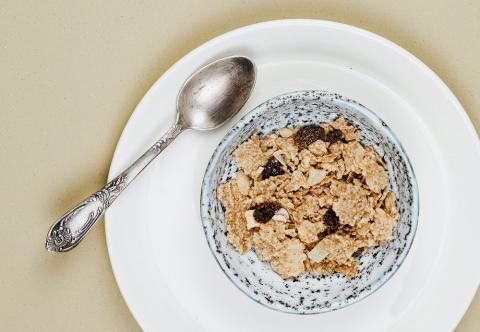
  • 15 Tablespoons (120g) Bran Flakes
  • 2 Tablespoons (60g) Raisins
  • 2 Tablespoons (60g) Sultanas
  • 3 Cups (568ml) Semi-Skimmed Milk

This recipe has been added to your Meal Planner.

Allergy Disclaimer

Always check the label of each ingredient for allergy warnings.

Method

  1. Pour bran flakes into 4 bowls.
  2. Sprinkle the raisins and sultanas on top.
  3. Add milk and enjoy!

Tips for Kids

Try with any of their favourite fruit, fresh, dried or canned.

Nutritional Information

Based on a single serving of 200g (% of an adult's reference intake)

Energy

244 kcals ( 12 %)

1,024 kJ ( 12 %)

Fat

1.6 g ( 8 %)

Saturates

48.4 g ( %)

Sugar

34 g ( 38 %)

Salt

0.8 g ( 13 %)

Detailed nutritional information

Per 100g Per 200g serving
Energy Kcals 122 244
Energy Kj 512 1,024
Protein 4.3 g 8.6 g
Total Fat g g
Saturated Fat 0.8 g 1.6 g
Carbohydrates 24.2 g 48.4 g
Total Sugars 17 g 34 g
NSP Fibre 2.2 g 4.4 g
Sodium 155 mg 310 mg
Salt 0.4 g 0.8 g

Find out about nutritional labelling

Nutrition labels on the front of packaging

  • Most of the big supermarkets and many food manufacturers display nutritional information on the front of pre-packed food.
  • Front of pack nutrition labels provide information on the number of grams of fat, saturated fat, sugars and salt and the amount of energy (in kJ and kcal) in a serving or portion of a recipe.
  • The labels also include information about reference intakes (expressed as a percentage) which are guidelines about the approximate amount of particular nutrients and energy required for a healthy diet.
  • The colour coding tells you at a glance if the food has high (red), medium (amber) or low (green) amounts of fat, saturated fat, sugars and salt.
  • The more greens on the label, the healthier the choice
  • Amber means neither high nor low, so you can eat foods with all or mostly ambers on the label most of the time.
  • Reds on the label means the food is high in that nutrient and these are the foods we should cut down on. Try to eat these foods less often and in small amounts.

Food shopping tips

If you’re trying to decide which product to choose, check to see if there's a nutrition label on the front of the pack. This will help you to quickly assess how your choices stack up. You will often find a mixture of red, amber and green colour coding for the nutrients. So when you're choosing between similar products, try to go for more greens and ambers and fewer reds if you want to make a healthier choice.

Back to top

Ingredients

  • 4 (240g) Flour Tortillas
  • 4 (200g) Eggs
  • 5 Tablespoons (75ml) Semi-Skimmed Milk
  • 1 (85g) Tomato
  • 1 (10g) Spring Onion
  • 1 (160g) Green Pepper
  • 1 Tablespoon (10g) Vegetable Oil
  • 8 (80g) Mushrooms
  • 1 to taste Pinch (1g) Ground Black Pepper

This recipe has been added to your Meal Planner.

Allergy Disclaimer

Always check the label of each ingredient for allergy warnings.

Method

  1. Crack eggs into a bowl and beat together with a fork and stir in the milk.
  2. Finely chop the tomato, spring onion, pepper and mushrooms.
  3. Heat quarter of oil in a medium frying pan, pour in quarter of the egg mixture and cook for a few moments before adding quarter of the chopped vegetables to the pan.
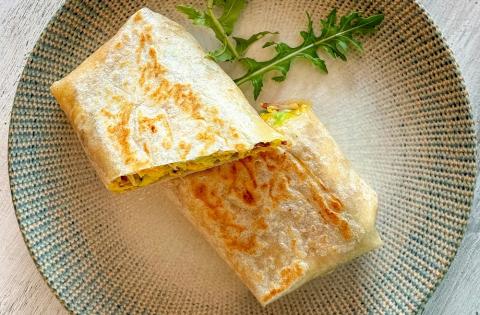
  4. Once the egg has set, slide the omelette onto a tortilla and add black pepper to taste. Repeat for the remaining tortillas.
  5. Roll up the tortilla once cooled slightly, slice in half and serve or wrap in tin foil to enjoy later.

Time Saver Tips

Can be cooked and then wrap in tin foil to eat on the go.

Cost Saver Tips

Try with other vegetables you have left over.

Tips for Kids

They will enjoy rolling their own wraps. Use their favourite coloured pepper

Nutritional Information

Based on a single serving of 190g (% of an adult's reference intake)

Energy

312 kcals ( 16 %)

1,309 kJ ( 16 %)

Fat

3.8 g ( 19 %)

Saturates

35 g ( %)

Sugar

4 g ( 4 %)

Salt

1 g ( 17 %)

Detailed nutritional information

Per 100g Per 190g serving
Energy Kcals 164 312
Energy Kj 689 1,309
Protein 7.2 g 13.7 g
Total Fat g g
Saturated Fat 2 g 3.8 g
Carbohydrates 18.4 g 35 g
Total Sugars 2.1 g 4 g
NSP Fibre 1.8 g 3.4 g
Sodium 183 mg 348 mg
Salt 0.5 g 1 g

Find out about nutritional labelling

Nutrition labels on the front of packaging

  • Most of the big supermarkets and many food manufacturers display nutritional information on the front of pre-packed food.
  • Front of pack nutrition labels provide information on the number of grams of fat, saturated fat, sugars and salt and the amount of energy (in kJ and kcal) in a serving or portion of a recipe.
  • The labels also include information about reference intakes (expressed as a percentage) which are guidelines about the approximate amount of particular nutrients and energy required for a healthy diet.
  • The colour coding tells you at a glance if the food has high (red), medium (amber) or low (green) amounts of fat, saturated fat, sugars and salt.
  • The more greens on the label, the healthier the choice
  • Amber means neither high nor low, so you can eat foods with all or mostly ambers on the label most of the time.
  • Reds on the label means the food is high in that nutrient and these are the foods we should cut down on. Try to eat these foods less often and in small amounts.

Food shopping tips

If you’re trying to decide which product to choose, check to see if there's a nutrition label on the front of the pack. This will help you to quickly assess how your choices stack up. You will often find a mixture of red, amber and green colour coding for the nutrients. So when you're choosing between similar products, try to go for more greens and ambers and fewer reds if you want to make a healthier choice.

Back to top

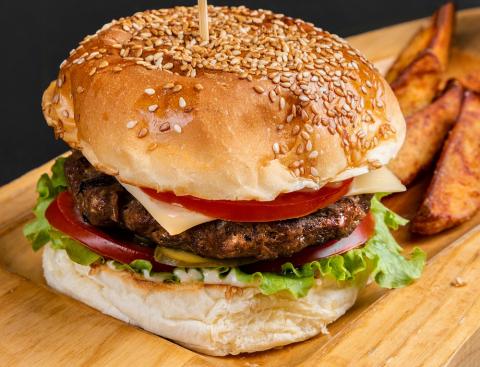
Ingredients

  • 1 Lean Pack (500g) Minced Beef
  • 1 (3g) Garlic Clove
  • 2 Small Sized, Sliced (120g) Onion
  • 2 Optional Tablespoons (2g) Flat-Leaf Parsley
  • ½ Level Spoonful Teaspoons (1g) Mixed Herbs
  • 1 Tablespoons (10g) Vegetable Oil
  • 4 (200g) Burger Buns
  • 2 (170g) Tomatoes
  • 4 Leaves (20g) Lettuce
  • 3 Tablespoons (45g) Reduced Calorie Mayonnaise
  • 2 Mild Teaspoons (10g) Mustard

This recipe has been added to your Meal Planner.

Allergy Disclaimer

Always check the label of each ingredient for allergy warnings.

Method

  1. Heat the oven to 230°c / 210°c fan oven / 450°F / gas mark 8.
  2. Peel the garlic and first onion and wash the parsley. Then crush the garlic and finely chop the onion and parsley.
  3. Use a wooden spoon to combine the burger ingredients (mince, garlic, one onion, parsley, and dried herbs) together, except for the oil. You can use a food processor if you have one.
  4. Divide the mixture into equal sized balls using your hands, or press each portion of the mixture into a plain cutter or food ring on the baking tray to make a burger. Lightly brush the top of each burger with oil.
  5. Bake the burgers for 10-15 minutes until they are cooked through, with no redness remaining and juices running clear.
  6. Meanwhile, peel and finely chop the second onion. Wash and slice the tomatoes and wash and shred the lettuce.
  7. Combine the mayonnaise, onion and mustard in a bowl to make a mayonnaise topping.
  8. When the burgers are cooked, lift them on to the buns. Top them with the tomato slices, lettuce and mayonnaise topping. Serve immediately.

Cost Saver Tips

Prepare more burgers than needed and freeze before cooking.

Nutritional Information

Based on a single serving of 247g (% of an adult's reference intake)

Energy

431 kcals ( 22 %)

1,803 kJ ( 22 %)

Fat

6.2 g ( 31 %)

Saturates

26.9 g ( %)

Sugar

4.7 g ( 5 %)

Salt

1.4 g ( 24 %)

Detailed nutritional information

Per 100g Per 247g serving
Energy Kcals 174 431
Energy Kj 730 1,803
Protein 13.5 g 33.5 g
Total Fat g g
Saturated Fat 2.5 g 6.2 g
Carbohydrates 10.9 g 26.9 g
Total Sugars 1.9 g 4.7 g
NSP Fibre 0.7 g 1.7 g
Sodium 232 mg 572 mg
Salt 0.6 g 1.4 g

Find out about nutritional labelling

Nutrition labels on the front of packaging

  • Most of the big supermarkets and many food manufacturers display nutritional information on the front of pre-packed food.
  • Front of pack nutrition labels provide information on the number of grams of fat, saturated fat, sugars and salt and the amount of energy (in kJ and kcal) in a serving or portion of a recipe.
  • The labels also include information about reference intakes (expressed as a percentage) which are guidelines about the approximate amount of particular nutrients and energy required for a healthy diet.
  • The colour coding tells you at a glance if the food has high (red), medium (amber) or low (green) amounts of fat, saturated fat, sugars and salt.
  • The more greens on the label, the healthier the choice
  • Amber means neither high nor low, so you can eat foods with all or mostly ambers on the label most of the time.
  • Reds on the label means the food is high in that nutrient and these are the foods we should cut down on. Try to eat these foods less often and in small amounts.

Food shopping tips

If you’re trying to decide which product to choose, check to see if there's a nutrition label on the front of the pack. This will help you to quickly assess how your choices stack up. You will often find a mixture of red, amber and green colour coding for the nutrients. So when you're choosing between similar products, try to go for more greens and ambers and fewer reds if you want to make a healthier choice.

Back to top

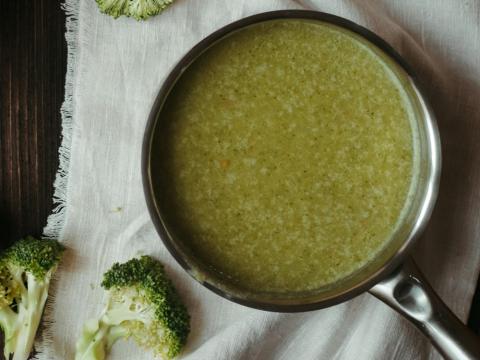
Ingredients

  • 1 Medium sized onion (150g) Onion
  • 3 Sticks (90g) Celery
  • 1 Tablespoon (10g) Vegetable Oil
  • 3 Average sized potatoes (180g) Potatoes
  • 6 2 pints Cups (1L) Water
  • 2 (14g) Reduced Salt Vegetable Stock Cube
  • 1 Large head (300g) Broccoli
  • (100g) Stilton or other blue cheese
  • Ground Black Pepperto taste 

This recipe has been added to your Meal Planner.

Allergy Disclaimer

Always check the label of each ingredient for allergy warnings.

Method

  1. Peel the onion and finely dice. Wash celery and slice. Peel potatoes and cut into small pieces.
  2. Heat oil in a large saucepan then add onion and celery for around 5 minutes until soft.
  3. Dissolve stock cube in boiling water and add to the pan with the potato. Bring to the boil and then simmer for arounf 15-20 minutes until the potatoes are soft.
  4. Chop the broccoli into small pieces and add to the pan for 3-4 minutes.
  5. Add half the stilton to the pan along with black pepper. Stir until the cheese melts
  6. Pour the soup into a blender or alternatively through a seive. Return to the pan to reheat.
  7. Serve the soup with remaining stilton crumbled on top. (you can add all stilton to the soup if preferred)

Time Saver Tips

Can be made in advance: Reheat when required

Cost Saver Tips

Look for offers on any blue cheese.

Tips for Kids

If the cheese is too strong don't serve with cheese on top.

Nutritional Information

Based on a single serving of 392g (% of an adult's reference intake)

Energy

196 kcals ( 10 %)

823 kJ ( 10 %)

Fat

6.3 g ( 31 %)

Saturates

11.8 g ( %)

Sugar

3.9 g ( 4 %)

Salt

0.8 g ( 13 %)

Detailed nutritional information

Per 100g Per 392g serving
Energy Kcals 50 196
Energy Kj 210 823
Protein 2.7 g 9.8 g
Total Fat g g
Saturated Fat 1.6 g 6.3 g
Carbohydrates 3 g 11.8 g
Total Sugars 1 g 3.9 g
NSP Fibre 0.8 g 3.1 g
Sodium 83 mg 325 mg
Salt 0.2 g 0.8 g

Find out about nutritional labelling

Nutrition labels on the front of packaging

  • Most of the big supermarkets and many food manufacturers display nutritional information on the front of pre-packed food.
  • Front of pack nutrition labels provide information on the number of grams of fat, saturated fat, sugars and salt and the amount of energy (in kJ and kcal) in a serving or portion of a recipe.
  • The labels also include information about reference intakes (expressed as a percentage) which are guidelines about the approximate amount of particular nutrients and energy required for a healthy diet.
  • The colour coding tells you at a glance if the food has high (red), medium (amber) or low (green) amounts of fat, saturated fat, sugars and salt.
  • The more greens on the label, the healthier the choice
  • Amber means neither high nor low, so you can eat foods with all or mostly ambers on the label most of the time.
  • Reds on the label means the food is high in that nutrient and these are the foods we should cut down on. Try to eat these foods less often and in small amounts.

Food shopping tips

If you’re trying to decide which product to choose, check to see if there's a nutrition label on the front of the pack. This will help you to quickly assess how your choices stack up. You will often find a mixture of red, amber and green colour coding for the nutrients. So when you're choosing between similar products, try to go for more greens and ambers and fewer reds if you want to make a healthier choice.

Back to top

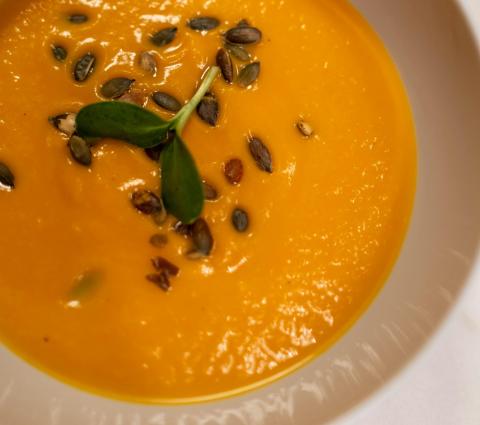
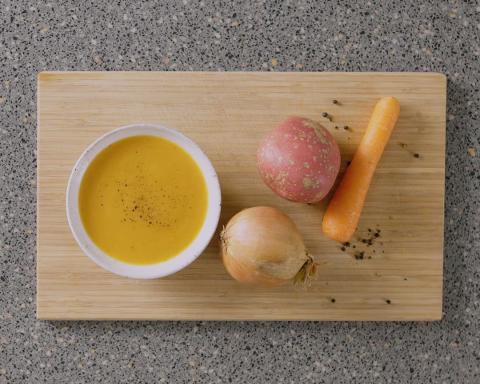
Ingredients

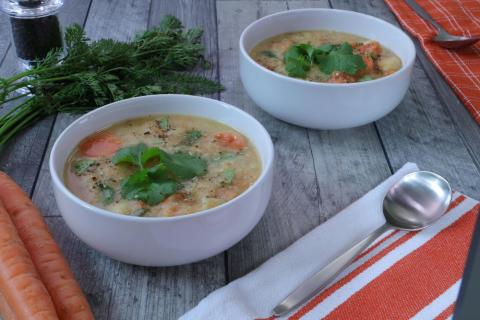
  • 1 (500g) Butternut Squash
  • 1 Medium Sized (150g) Onion
  • 3 Sticks (90g) Celery
  • 1 Medium Sized (80g) Carrot
  • 5 Cups (1L) Water
  • 2 Tablespoons (20ml) Vegetable Oil
  • 2 Reduced Salt If Possible (14g) Vegetable Stock Cubes
  • (1g) Ground Black Pepper

This recipe has been added to your Meal Planner.

Allergy Disclaimer

Always check the label of each ingredient for allergy warnings.

Method

  1. Peel the butternut squash, onion and carrot. Wash celery.
  2. Chop all the vegetables and boil water for the stock.
  3. Heat oil in a large pan then add the onions, put lid on pan and let them sweat for 3 minutes.
  4. Add carrots and celery to the onions and let them sweat for another 2 minutes
  5. Add water, stock cubes and butternut squash to the pan and stir until stock cube dissolved. Once soup begins to boil, turn down heat and simmer until vegetables are soft – about 10-15minutes. Add pepper to taste.
  6. Soup can be then sieved or blended to a smooth consistency. Heat through before serving.

Time Saver Tips

Soup can be prepared in advance and heated when required. Cool before putting in fridge or freezing.

Cost Saver Tips

Why not cook a big batch and freeze it for later on in the week?

Nutritional Information

Based on a single serving of 371g (% of an adult's reference intake)

Energy

102 kcals ( 5 %)

428 kJ ( 5 %)

Fat

0.7 g ( 4 %)

Saturates

12.6 g ( %)

Sugar

7.8 g ( 9 %)

Salt

0.4 g ( 7 %)

Detailed nutritional information

Per 100g Per 371g serving
Energy Kcals 27 102
Energy Kj 113 428
Protein 0.5 g 1.1 g
Total Fat g g
Saturated Fat 0.2 g 0.7 g
Carbohydrates 3.4 g 12.6 g
Total Sugars 2.1 g 7.8 g
NSP Fibre 0.7 g 2.7 g
Sodium 23 mg 84 mg
Salt 0.1 g 0.4 g

Find out about nutritional labelling

Nutrition labels on the front of packaging

  • Most of the big supermarkets and many food manufacturers display nutritional information on the front of pre-packed food.
  • Front of pack nutrition labels provide information on the number of grams of fat, saturated fat, sugars and salt and the amount of energy (in kJ and kcal) in a serving or portion of a recipe.
  • The labels also include information about reference intakes (expressed as a percentage) which are guidelines about the approximate amount of particular nutrients and energy required for a healthy diet.
  • The colour coding tells you at a glance if the food has high (red), medium (amber) or low (green) amounts of fat, saturated fat, sugars and salt.
  • The more greens on the label, the healthier the choice
  • Amber means neither high nor low, so you can eat foods with all or mostly ambers on the label most of the time.
  • Reds on the label means the food is high in that nutrient and these are the foods we should cut down on. Try to eat these foods less often and in small amounts.

Food shopping tips

If you’re trying to decide which product to choose, check to see if there's a nutrition label on the front of the pack. This will help you to quickly assess how your choices stack up. You will often find a mixture of red, amber and green colour coding for the nutrients. So when you're choosing between similar products, try to go for more greens and ambers and fewer reds if you want to make a healthier choice.

Back to top
Subscribe to Eat Better Feel Better