Ingredients

  • 4 Medium Eggs

This recipe has been added to your Meal Planner.

Allergy Disclaimer

Always check the label of each ingredient for allergy warnings.

Method

  1. Add boiling water to a medium sized pan and bring to the boil then turn down the heat.
  2. Using a spoon gently lower each egg into the pan.
  3. Keeping the water gently simmering, boil eggs for 5-6 minutes for a soft boiled egg or 10-12 minutes for a hard boiled egg.
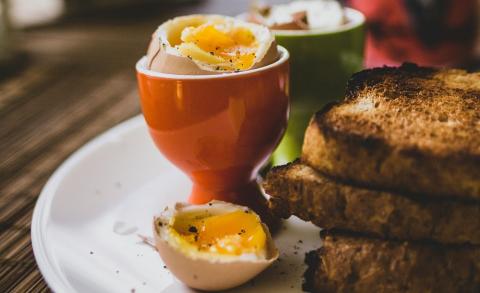
  4. Soft boiled eggs should be removed from the water and served in an egg cup.
  5. Hard boiled eggs should be cooled quickly by running cold water into the pan. Once cooled, crack the shells all over on a a hard surface and then peel the shell off.

Time Saver Tips

It’s easy to have hard-boiled eggs ready in advance. Just cook them, let them cool, and then pop them in the fridge.

Tips for Kids

Giving wholemeal bread a go is an easy way to help your little one get more fibre – they probably won’t even tell the difference!

Nutritional Information

Based on a single serving of 60g (% of an adult's reference intake)

Energy

86 kcals ( 4 %)

360 kJ ( 4 %)

Fat

1.6 g ( 8 %)

Saturates

0.1 g ( %)

Sugar

0.1 g ( 1 %)

Salt

0.2 g ( 4 %)

Detailed nutritional information

Per 100g Per 60g serving
Energy Kcals 143 86
Energy Kj 601 360
Protein 14.1 g 8.5 g
Total Fat g g
Saturated Fat 2.7 g 1.6 g
Carbohydrates 0.1 g 0.1 g
Total Sugars 0.1 g 0.1 g
NSP Fibre 0 g 0 g
Sodium 150 mg 90 mg
Salt 0.4 g 0.2 g

Find out about nutritional labelling

Nutrition labels on the front of packaging

  • Most of the big supermarkets and many food manufacturers display nutritional information on the front of pre-packed food.
  • Front of pack nutrition labels provide information on the number of grams of fat, saturated fat, sugars and salt and the amount of energy (in kJ and kcal) in a serving or portion of a recipe.
  • The labels also include information about reference intakes (expressed as a percentage) which are guidelines about the approximate amount of particular nutrients and energy required for a healthy diet.
  • The colour coding tells you at a glance if the food has high (red), medium (amber) or low (green) amounts of fat, saturated fat, sugars and salt.
  • The more greens on the label, the healthier the choice
  • Amber means neither high nor low, so you can eat foods with all or mostly ambers on the label most of the time.
  • Reds on the label means the food is high in that nutrient and these are the foods we should cut down on. Try to eat these foods less often and in small amounts.

Food shopping tips

If you’re trying to decide which product to choose, check to see if there's a nutrition label on the front of the pack. This will help you to quickly assess how your choices stack up. You will often find a mixture of red, amber and green colour coding for the nutrients. So when you're choosing between similar products, try to go for more greens and ambers and fewer reds if you want to make a healthier choice.
Back to top

Ingredients

  • 4 (240g) Flour Tortillas
  • 4 (200g) Eggs
  • 5 Tablespoons (75ml) Semi-Skimmed Milk
  • 1 (85g) Tomato
  • 1 (10g) Spring Onion
  • 1 (160g) Green Pepper
  • 1 Tablespoon (10g) Vegetable Oil
  • 8 (80g) Mushrooms
  • 1 to taste Pinch (1g) Ground Black Pepper

This recipe has been added to your Meal Planner.

Allergy Disclaimer

Always check the label of each ingredient for allergy warnings.

Method

  1. Crack eggs into a bowl and beat together with a fork and stir in the milk.
  2. Finely chop the tomato, spring onion, pepper and mushrooms.
  3. Heat quarter of oil in a medium frying pan, pour in quarter of the egg mixture and cook for a few moments before adding quarter of the chopped vegetables to the pan.
  4. Once the egg has set, slide the omelette onto a tortilla and add black pepper to taste. Repeat for the remaining tortillas.
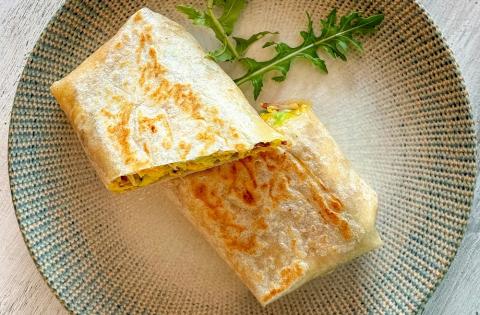
  5. Roll up the tortilla once cooled slightly, slice in half and serve or wrap in tin foil to enjoy later.

Time Saver Tips

Can be cooked and then wrap in tin foil to eat on the go.

Cost Saver Tips

Try with other vegetables you have left over.

Tips for Kids

They will enjoy rolling their own wraps. Use their favourite coloured pepper

Nutritional Information

Based on a single serving of 190g (% of an adult's reference intake)

Energy

312 kcals ( 16 %)

1,309 kJ ( 16 %)

Fat

3.8 g ( 19 %)

Saturates

35 g ( %)

Sugar

4 g ( 4 %)

Salt

1 g ( 17 %)

Detailed nutritional information

Per 100g Per 190g serving
Energy Kcals 164 312
Energy Kj 689 1,309
Protein 7.2 g 13.7 g
Total Fat g g
Saturated Fat 2 g 3.8 g
Carbohydrates 18.4 g 35 g
Total Sugars 2.1 g 4 g
NSP Fibre 1.8 g 3.4 g
Sodium 183 mg 348 mg
Salt 0.5 g 1 g

Find out about nutritional labelling

Nutrition labels on the front of packaging

  • Most of the big supermarkets and many food manufacturers display nutritional information on the front of pre-packed food.
  • Front of pack nutrition labels provide information on the number of grams of fat, saturated fat, sugars and salt and the amount of energy (in kJ and kcal) in a serving or portion of a recipe.
  • The labels also include information about reference intakes (expressed as a percentage) which are guidelines about the approximate amount of particular nutrients and energy required for a healthy diet.
  • The colour coding tells you at a glance if the food has high (red), medium (amber) or low (green) amounts of fat, saturated fat, sugars and salt.
  • The more greens on the label, the healthier the choice
  • Amber means neither high nor low, so you can eat foods with all or mostly ambers on the label most of the time.
  • Reds on the label means the food is high in that nutrient and these are the foods we should cut down on. Try to eat these foods less often and in small amounts.

Food shopping tips

If you’re trying to decide which product to choose, check to see if there's a nutrition label on the front of the pack. This will help you to quickly assess how your choices stack up. You will often find a mixture of red, amber and green colour coding for the nutrients. So when you're choosing between similar products, try to go for more greens and ambers and fewer reds if you want to make a healthier choice.

Back to top

Ingredients

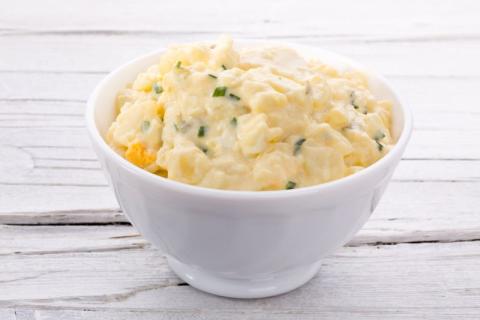
  • 6 Eggs
  • 1 Heaped tablespoon (30g) Low Fat Mayonnaise
  • 1 Tablespoon (40g) Low Fat Plain Yoghurt
  • Black Pepper to taste

This recipe has been added to your Meal Planner.

Allergy Disclaimer

Always check the label of each ingredient for allergy warnings.

Method

  1. Add boiling water to a medium sized pan and bring to the boil then turn down the heat.
  2. Using a spoon gently lower each egg into the pan.
  3. Keeping the water gently simmering, boil eggs for 10-12 minutes then remove from heat and fill the pan with cold water.
  4. Once cooled, crack the shells all over on a hard surface and then peel the shell off.
  5. In a bowl mash the eggs with a fork and mix with the mayonnaise and yoghurt. Add black pepper to taste.


Time Saver Tips

It’s handy to hard-boil eggs in advance – once cooled, keep them in the fridge so they’re ready to use. If you're in a rush, egg mayo makes a great, fuss-free topping for toast or baked potatoes.
Tips for Kids

The kids can help with cracking and peeling the eggs as well mashing them up.

Nutritional Information

Based on a single serving of 108g (% of an adult's reference intake)

Energy

156 kcals ( 8 %)

650 kJ ( 8 %)

Fat

2.7 g ( 14 %)

Saturates

1.5 g ( %)

Sugar

1 g ( 1 %)

Salt

0.4 g ( 7 %)

Detailed nutritional information

Per 100g Per 108g serving
Energy Kcals 145 156
Energy Kj 602 650
Protein 12.3 g 13.3 g
Total Fat g g
Saturated Fat 2.5 g 2.7 g
Carbohydrates 1.3 g 1.5 g
Total Sugars 1 g 1 g
NSP Fibre 0 g 0 g
Sodium 131 mg 142 mg
Salt 0.3 g 0.4 g

Find out about nutritional labelling

Nutrition labels on the front of packaging

  • Most of the big supermarkets and many food manufacturers display nutritional information on the front of pre-packed food.
  • Front of pack nutrition labels provide information on the number of grams of fat, saturated fat, sugars and salt and the amount of energy (in kJ and kcal) in a serving or portion of a recipe.
  • The labels also include information about reference intakes (expressed as a percentage) which are guidelines about the approximate amount of particular nutrients and energy required for a healthy diet.
  • The colour coding tells you at a glance if the food has high (red), medium (amber) or low (green) amounts of fat, saturated fat, sugars and salt.
  • The more greens on the label, the healthier the choice
  • Amber means neither high nor low, so you can eat foods with all or mostly ambers on the label most of the time.
  • Reds on the label means the food is high in that nutrient and these are the foods we should cut down on. Try to eat these foods less often and in small amounts.

Food shopping tips

If you’re trying to decide which product to choose, check to see if there's a nutrition label on the front of the pack. This will help you to quickly assess how your choices stack up. You will often find a mixture of red, amber and green colour coding for the nutrients. So when you're choosing between similar products, try to go for more greens and ambers and fewer reds if you want to make a healthier choice.

Back to top

Ingredients

  • 8 Thin Slices (280g) Ham
  • 4 (40g) Spring Onions
  • 2 (320g) Peppers (Any Colour)
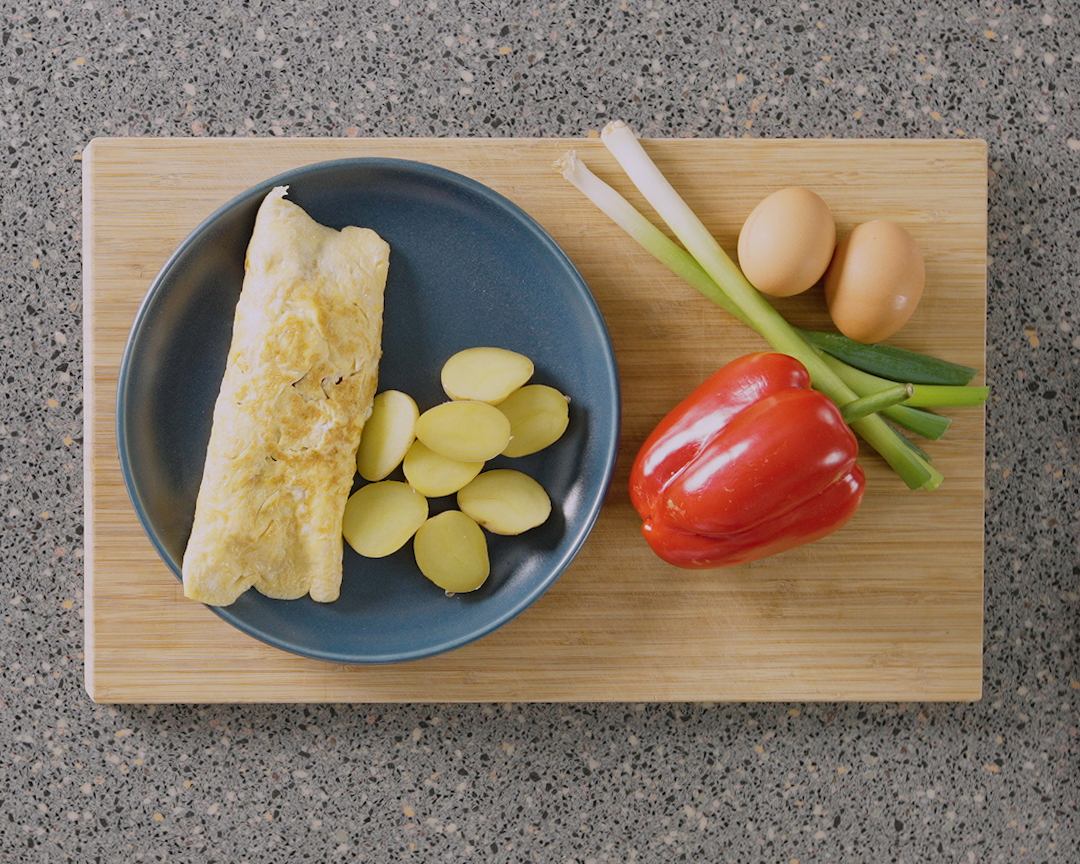
  • 8 Eggs
  • 4 Teaspoons (12g) Vegetable Oil
  • 12 Average (480g) New Potatoes

This recipe has been added to your Meal Planner.

Allergy Disclaimer

Always check the label of each ingredient for allergy warnings.

Method

  1. Wash the new potatoes, add to a pan of boiling water and simmer until tender.
  2. Wash the peppers and spring onions. Chop the ham, peppers and spring onions into small pieces and mix together in a bowl.
  3. Add 1 teaspoon of oil to the frying pan and heat to medium hot.
  4. Add the ham, spring onions and peppers to the pan and cook for 5 minutes then pour onto a plate.
  5. Crack 2 eggs into a bowl or cup and beat with a fork. Pour into the frying pan and stir until the egg starts to set.
  6. Turn down the heat and add one quarter of the filling.
  7. Cook until the egg is set then fold the omelette over in the pan.
  8. Repeat steps 3, 5, 6 and 7 to make another 3 omelettes. Serve hot with boiled new potatoes.

Time Saver Tips

Why not make a supersize omelette in one pan, grill to cook through, then cut into quarters? It’s so much quicker than making lots of smaller omelettes!

Cost Saver Tips

Canned ham is often cheaper than sliced ham. Or you can really make this recipe your own by adding any leftover meat or vegetables you have. A tasty way to save! You can also use any type of potato, boiled or baked - leaving the skins on can also help boost fibre - bonus!

Tips for Kids

To make this a real family favourite, you could try adding your little one’s favourite fillings – like mushrooms, sweetcorn or tuna. Or why not serve with a side salad or additional vegetables, to boost that five a day? For variety, you could swap the meat for fish or extra vegetables.

Nutritional Information

Based on a single serving of 352g (% of an adult's reference intake)

Energy

346 kcals ( 17 %)

1,457 kJ ( 17 %)

Fat

3.7 g ( 19 %)

Saturates

26.6 g ( %)

Sugar

6.3 g ( 7 %)

Salt

1.8 g ( 30 %)

Detailed nutritional information

Per 100g Per 352g serving
Energy Kcals 98 346
Energy Kj 346 1,457
Protein 8 g 28.1 g
Total Fat g g
Saturated Fat 1 g 3.7 g
Carbohydrates 7.5 g 26.6 g
Total Sugars 1.8 g 6.3 g
NSP Fibre 0.9 g 3.3 g
Sodium 207 mg 729 mg
Salt 0.5 g 1.8 g

Find out about nutritional labelling

Nutrition labels on the front of packaging

  • Most of the big supermarkets and many food manufacturers display nutritional information on the front of pre-packed food.
  • Front of pack nutrition labels provide information on the number of grams of fat, saturated fat, sugars and salt and the amount of energy (in kJ and kcal) in a serving or portion of a recipe.
  • The labels also include information about reference intakes (expressed as a percentage) which are guidelines about the approximate amount of particular nutrients and energy required for a healthy diet.
  • The colour coding tells you at a glance if the food has high (red), medium (amber) or low (green) amounts of fat, saturated fat, sugars and salt.
  • The more greens on the label, the healthier the choice
  • Amber means neither high nor low, so you can eat foods with all or mostly ambers on the label most of the time.
  • Reds on the label means the food is high in that nutrient and these are the foods we should cut down on. Try to eat these foods less often and in small amounts.

Food shopping tips

If you’re trying to decide which product to choose, check to see if there's a nutrition label on the front of the pack. This will help you to quickly assess how your choices stack up. You will often find a mixture of red, amber and green colour coding for the nutrients. So when you're choosing between similar products, try to go for more greens and ambers and fewer reds if you want to make a healthier choice.

Back to top

Ingredients

  • 4 Small (400g) Chicken Breasts
  • 3 Tablespoons (60g) Plain Flour
  • 1 Medium Egg
  • 3 Cups (150g) Breadcrumbs
  • 5 Large (1kg) Potatoes
  • 2 Tablespoons (20g) Vegetable Oil
  • 1 Can (420g) Baked Beans (choose reduced salt & sugar whenever possible)

This recipe has been added to your Meal Planner.

Allergy Disclaimer

Always check the label of each ingredient for allergy warnings.

Method

  1. Wash potatoes and then cut in half and then into wedges. Cook in a pan of boiling water for 10 minutes.
  2. Preheat the oven to 200°C / 180°C fan oven / 400°F / gas mark 6.
  3. Dice chicken into approximately 2cm x 2 cm cubes.
  4. Break egg into a bowl and whisk using a fork. Put the flour and breadcrumbs on separate plates. Cover a baking tray with greaseproof paper.
  5. Coat each cube of chicken in flour, then dip in the egg and roll in breadcrumbs until all surfaces are covered. Place on the baking tray.
  6. Drain the wedges, then place on another baking tray  and drizzle the oil over them.
  7. Cook wedges and nuggets in the oven for approximately 20 minutes, turning over half way. Ensure the chicken is white in the middle before serving.
  8. Heat the baked beans through on the hob or microwave and serve with the nuggets and wedges.

Time Saver Tips

Prepare the nuggets while the potatoes are cooking. You can also make the nuggets in advance and keep them in the fridge until needed.
Cost Saver Tips

Keep your eyes peeled for chicken that’s on offer and put it in the freezer. Chicken thighs are cheaper and work just as well in this as chicken breasts. You could even buy chicken in bulk and freeze it for later. Vegetables like sweetcorn and peas work really well from frozen or tinned. Baked beans work well too – basically whatever you’ve got in! To spice it up, why not try sprinkling some chilli powder onto the wedges before baking them in the oven? A great way to use up any leftover bread is by making your own breadcrumbs. Just take six slices of medium bread, toast it a little under the grill, cut off the crusts and slice each piece open so you can toast the inside. Once it’s cooled down, rub between your fingers into crumbs. You could even try using wholemeal bread for a bit of extra fibre.

Tips for Kids

They will love helping to make the nuggets - just make sure they wash their hands after handling raw chicken.

Nutritional Information

Based on a single serving of 499g (% of an adult's reference intake)

Energy

681 kcals ( 34 %)

2,887 kJ ( 34 %)

Fat

1.4 g ( 7 %)

Saturates

113.9 g ( %)

Sugar

10.5 g ( 12 %)

Salt

1.5 g ( 25 %)

Detailed nutritional information

Per 100g Per 499g serving
Energy Kcals 136 681
Energy Kj 579 2,887
Protein 8.5 g 42.3 g
Total Fat g g
Saturated Fat 0.3 g 1.4 g
Carbohydrates 22.8 g 113.9 g
Total Sugars 2.1 g 10.5 g
NSP Fibre 2.2 g 10.8 g
Sodium 102 mg 509 mg
Salt 0.3 g 1.5 g

Find out about nutritional labelling

Nutrition labels on the front of packaging

  • Most of the big supermarkets and many food manufacturers display nutritional information on the front of pre-packed food.
  • Front of pack nutrition labels provide information on the number of grams of fat, saturated fat, sugars and salt and the amount of energy (in kJ and kcal) in a serving or portion of a recipe.
  • The labels also include information about reference intakes (expressed as a percentage) which are guidelines about the approximate amount of particular nutrients and energy required for a healthy diet.
  • The colour coding tells you at a glance if the food has high (red), medium (amber) or low (green) amounts of fat, saturated fat, sugars and salt.
  • The more greens on the label, the healthier the choice
  • Amber means neither high nor low, so you can eat foods with all or mostly ambers on the label most of the time.
  • Reds on the label means the food is high in that nutrient and these are the foods we should cut down on. Try to eat these foods less often and in small amounts.

Food shopping tips

If you’re trying to decide which product to choose, check to see if there's a nutrition label on the front of the pack. This will help you to quickly assess how your choices stack up. You will often find a mixture of red, amber and green colour coding for the nutrients. So when you're choosing between similar products, try to go for more greens and ambers and fewer reds if you want to make a healthier choice.

Back to top

Ingredients

  • 4 (200g) Eggs
  • 4 small or 2 large (400g) Mackerel
  • 4 Mugs (225g) Rice
  • 2 Tablespoons (20g) Vegetable Oil
  • 1 medium sized onion (150g) Onion
  • 4 (12g) Garlic Cloves
  • 1 Tin (400g) Chopped Tomatoes
  • Juice Of 2 Lemons
  • 2 handfuls (40g) Fresh Coriander
  • 2 Teaspoons (12g) Curry Powder

This recipe has been added to your Meal Planner.

Allergy Disclaimer

Always check the label of each ingredient for allergy warnings.

Method

  1. Cook rice as per manufacturer's instructions.
  2. Meanwhile, using a sharp knife, remove the skin from the mackerel and break it into large pieces.
  3. Peel the onion and garlic then dice.
  4. Heat oil in a large frying pan and fry onion and garlic for 5 minutes until they soften.
  5. Add curry powder to the pan and fry for a further 2 minutes.
  6. Meanwhile poach the eggs in a large pan of boiling water. Swirl the water with a spoon just before adding each egg to the water. Remove after 4-5 minutes.
  7. While eggs are poaching stir tomatoes into the frying pan and simmer for 5 minutes then add the lemon juice.
  8. Roughly chop the coriander.
  9. Drain the rice, add to the pan with the fish and heat through, stirring continuously. Add the coriander just before serving
  10. Serve rice and fish mixture with a warm poached egg on top.


Time Saver Tips

Buy skinless mackerel or even try canned mackerel. A great use of leftover rice but remember rice should be cooled within 2 hours and only reheated once.

Cost Saver Tips

Canned mackerel is cheaper or try with other frozen or fresh fish. Just add raw fish to the frying pan for a couple of minutes before the rice to ensure it is cooked.

Tips for Kids

They will enjoy a trip to your local fishmonger.

Nutritional Information

Based on a single serving of 430g (% of an adult's reference intake)

Energy

684 kcals ( 34 %)

2,872 kJ ( 34 %)

Fat

8.2 g ( 41 %)

Saturates

52 g ( %)

Sugar

4.7 g ( 5 %)

Salt

2.2 g ( 36 %)

Detailed nutritional information

Per 100g Per 430g serving
Energy Kcals 159 684
Energy Kj 668 2,872
Protein 6.8 g 29.2 g
Total Fat g g
Saturated Fat 1.9 g 8.2 g
Carbohydrates 12.1 g 52 g
Total Sugars 1.1 g 4.7 g
NSP Fibre 0.5 g 2.2 g
Sodium 191 mg 821 mg
Salt 0.5 g 2.2 g

Find out about nutritional labelling

Nutrition labels on the front of packaging

  • Most of the big supermarkets and many food manufacturers display nutritional information on the front of pre-packed food.
  • Front of pack nutrition labels provide information on the number of grams of fat, saturated fat, sugars and salt and the amount of energy (in kJ and kcal) in a serving or portion of a recipe.
  • The labels also include information about reference intakes (expressed as a percentage) which are guidelines about the approximate amount of particular nutrients and energy required for a healthy diet.
  • The colour coding tells you at a glance if the food has high (red), medium (amber) or low (green) amounts of fat, saturated fat, sugars and salt.
  • The more greens on the label, the healthier the choice
  • Amber means neither high nor low, so you can eat foods with all or mostly ambers on the label most of the time.
  • Reds on the label means the food is high in that nutrient and these are the foods we should cut down on. Try to eat these foods less often and in small amounts.

Food shopping tips

If you’re trying to decide which product to choose, check to see if there's a nutrition label on the front of the pack. This will help you to quickly assess how your choices stack up. You will often find a mixture of red, amber and green colour coding for the nutrients. So when you're choosing between similar products, try to go for more greens and ambers and fewer reds if you want to make a healthier choice.

Back to top

Ingredients

  • 4 (200g) Free Range Eggs
  • 1 (160g) Red Pepper
  • 1 Teaspoon (6g) Reduced Sugar And Salt Tomato Ketchup
  • 1 Can (400g) Chopped Tomatoes
  • 1 Tablespoon (10g) Vegetable Oil
  • 4 Slices (144g) Wholemeal Bread
  • 1 to taste Pinch (1g) Ground Black Pepper

This recipe has been added to your Meal Planner.

Allergy Disclaimer

Always check the label of each ingredient for allergy warnings.

Method

  1. Wash, de-seed and finely chop the pepper.
  2. Fry the pepper in a large frying pan in the oil until it is tender, then add the chopped tomatoes and tomato ketchup. Simmer for 5-10 minutes.
  3. Make 4 'holes' in the tomato and pepper mix, and crack an egg into each one. Continue to cook gently until the eggs are done to your liking.  
  4. Meanwhile, toast the bread.
  5. Serve the eggs and tomatoes on toast, sprinkled with black pepper to taste. 

Cost Saver Tips

You can buy frozen mixed peppers cheaply; they would work well in this dish. You could also add courgettes, cherry tomatoes or jalapeno peppers if you like spicy food.

Tips for Kids

Use tomatoes on their own if peppers are not popular, or add some sweetcorn.

Nutritional Information

Based on a single serving of 213g (% of an adult's reference intake)

Energy

208 kcals ( 10 %)

873 kJ ( 10 %)

Fat

1.8 g ( 9 %)

Saturates

20 g ( %)

Sugar

7 g ( 8 %)

Salt

0.7 g ( 11 %)

Detailed nutritional information

Per 100g Per 213g serving
Energy Kcals 98 208
Energy Kj 410 873
Protein 5.4 g 11.6 g
Total Fat g g
Saturated Fat 0.8 g 1.8 g
Carbohydrates 9.4 g 20 g
Total Sugars 3.3 g 7 g
NSP Fibre 1.5 g 3.2 g
Sodium 125 mg 267 mg
Salt 0.3 g 0.7 g

Find out about nutritional labelling

Nutrition labels on the front of packaging

  • Most of the big supermarkets and many food manufacturers display nutritional information on the front of pre-packed food.
  • Front of pack nutrition labels provide information on the number of grams of fat, saturated fat, sugars and salt and the amount of energy (in kJ and kcal) in a serving or portion of a recipe.
  • The labels also include information about reference intakes (expressed as a percentage) which are guidelines about the approximate amount of particular nutrients and energy required for a healthy diet.
  • The colour coding tells you at a glance if the food has high (red), medium (amber) or low (green) amounts of fat, saturated fat, sugars and salt.
  • The more greens on the label, the healthier the choice
  • Amber means neither high nor low, so you can eat foods with all or mostly ambers on the label most of the time.
  • Reds on the label means the food is high in that nutrient and these are the foods we should cut down on. Try to eat these foods less often and in small amounts.

Food shopping tips

If you’re trying to decide which product to choose, check to see if there's a nutrition label on the front of the pack. This will help you to quickly assess how your choices stack up. You will often find a mixture of red, amber and green colour coding for the nutrients. So when you're choosing between similar products, try to go for more greens and ambers and fewer reds if you want to make a healthier choice.

Back to top

Ingredients

  • 5 Level Tablespoons (100g) Plain Flour
  • 1 Level Teaspoon (4g) Baking Powder
  • 1 Medium Egg
  • 7 Tablespoons (100ml) Semi-Skimmed Milk
  • 3 Tablespoons (100g) Frozen Sweetcorn
  • 3 Tablespoons (100g) Frozen Peas
  • 1 (10g) Spring Onion
  • 1 Pinch Black Pepper
  • 2 Teaspoons (6g) Vegetable Oil
  • 2 Heaped tablespoons (60g) Half Fat Crème Fraîche

This recipe has been added to your Meal Planner.

Allergy Disclaimer

Always check the label of each ingredient for allergy warnings.

Method

  1. Sieve the four and baking powder into a large bowl. Crack the egg into the bowl then add the milk and mix well.
  2. Trim the tops and tails of the spring onion and then slice. Add spring onion, peas and sweetcorn to the bowl and mix well. Hold back a small handful of spring onion for garnishing at the end.
  3. Add black pepper to taste and mix in.
  4. Add half the oil to a frying pan and heat on a medium heat. Add a tablespoon of mixture to the pan and press down with a spatula or the back of a spoon. Repeat until you have 4 fritters.
  5. Turn the fritters over after approximately 5 minutes or until golden brown. Once cooked, repeat for the remainder of the mixture. It should make 8 fritters.
  6. Garnish with spring onion and serve while hot with crème fraîche for dipping.

Time Saver Tips

Why not prepare this in advance and keep in the fridge until you’re ready to cook it? Talk about an easy meal!
Cost Saver Tips

This is a great recipe to use any leftovers you’ve got. You could try using ingredients like red onions and finely chopped peppers or courgette, too. Don’t worry if you don’t have plain flour – any type of flour works, including wholemeal or cornflour. If using self-raising, just leave out the baking powder. Soured cream can be used instead of half fat creme fraiche, however the fat content will be a little higher. Alternatively you could try the fritters with salsa or guacamole.
Tips for Kids

Fritters are great on their own as a light meal. You could even serve them with other vegetables and potatoes or rice to make this into a main meal. Or why not see if your wee one likes them in a bread roll with salad? Yum!

Nutritional Information

Based on a single serving of 125g (% of an adult's reference intake)

Energy

188 kcals ( 9 %)

793 kJ ( 9 %)

Fat

2.4 g ( 12 %)

Saturates

27.2 g ( %)

Sugar

3.8 g ( 4 %)

Salt

0.4 g ( 6 %)

Detailed nutritional information

Per 100g Per 125g serving
Energy Kcals 160 188
Energy Kj 634 793
Protein 5.9 g 7.4 g
Total Fat g g
Saturated Fat 1.9 g 2.4 g
Carbohydrates 21.8 g 27.2 g
Total Sugars 3 g 3.8 g
NSP Fibre 2.4 g 3 g
Sodium 124 mg 155 mg
Salt 0.3 g 0.4 g

Find out about nutritional labelling

Nutrition labels on the front of packaging

  • Most of the big supermarkets and many food manufacturers display nutritional information on the front of pre-packed food.
  • Front of pack nutrition labels provide information on the number of grams of fat, saturated fat, sugars and salt and the amount of energy (in kJ and kcal) in a serving or portion of a recipe.
  • The labels also include information about reference intakes (expressed as a percentage) which are guidelines about the approximate amount of particular nutrients and energy required for a healthy diet.
  • The colour coding tells you at a glance if the food has high (red), medium (amber) or low (green) amounts of fat, saturated fat, sugars and salt.
  • The more greens on the label, the healthier the choice
  • Amber means neither high nor low, so you can eat foods with all or mostly ambers on the label most of the time.
  • Reds on the label means the food is high in that nutrient and these are the foods we should cut down on. Try to eat these foods less often and in small amounts.

Food shopping tips

If you’re trying to decide which product to choose, check to see if there's a nutrition label on the front of the pack. This will help you to quickly assess how your choices stack up. You will often find a mixture of red, amber and green colour coding for the nutrients. So when you're choosing between similar products, try to go for more greens and ambers and fewer reds if you want to make a healthier choice.

Back to top

Ingredients

  • 8 Eggs
  • 4 Medium Slices Wholemeal Bread
  • 4 Teaspoons (12g) Vegetable Oil
  • 1 Pinch Black Pepper to taste
  • 4 Teaspoons (20g) Low Fat Spread

This recipe has been added to your Meal Planner.

Allergy Disclaimer

Always check the label of each ingredient for allergy warnings.

Method

  1. Add 1 teaspoon of oil to the frying pan and heat to medium hot.
  2. Crack 2 eggs into a bowl or cup. Beat them together with the black pepper then pour into the frying pan.
  3. Stir with a fork until the egg starts to set then cook until it is set.
  4. Fold the omelette over in the pan. Spread a slice of toast with 1 teaspoon of low fat spread and serve the omelette on top.  
  5. Repeat the steps above to make another 3 omelettes.

Cost Saver Tips

Serve with salad for a light meal option and try adding some boiled potatoes for a main meal.

Tips for Kids

Choose their favourite fillings to make this omelette super tasty – such as cheese, ham, smoked salmon, peppers, mushrooms or sweetcorn. If they aren't keen on wholemeal toast, try 50:50.

Nutritional Information

Based on a single serving of 140g (% of an adult's reference intake)

Energy

286 kcals ( 14 %)

1,199 kJ ( 14 %)

Fat

3.6 g ( 18 %)

Saturates

19.9 g ( %)

Sugar

1.4 g ( 2 %)

Salt

0.9 g ( 15 %)

Detailed nutritional information

Per 100g Per 140g serving
Energy Kcals 204 286
Energy Kj 857 1,199
Protein 12.3 g 17.2 g
Total Fat g g
Saturated Fat 2.6 g 3.6 g
Carbohydrates 14.2 g 19.9 g
Total Sugars 1 g 1.4 g
NSP Fibre 2.4 g 3.4 g
Sodium 271 mg 379 mg
Salt 0.7 g 0.9 g

Find out about nutritional labelling

Nutrition labels on the front of packaging

  • Most of the big supermarkets and many food manufacturers display nutritional information on the front of pre-packed food.
  • Front of pack nutrition labels provide information on the number of grams of fat, saturated fat, sugars and salt and the amount of energy (in kJ and kcal) in a serving or portion of a recipe.
  • The labels also include information about reference intakes (expressed as a percentage) which are guidelines about the approximate amount of particular nutrients and energy required for a healthy diet.
  • The colour coding tells you at a glance if the food has high (red), medium (amber) or low (green) amounts of fat, saturated fat, sugars and salt.
  • The more greens on the label, the healthier the choice
  • Amber means neither high nor low, so you can eat foods with all or mostly ambers on the label most of the time.
  • Reds on the label means the food is high in that nutrient and these are the foods we should cut down on. Try to eat these foods less often and in small amounts.

Food shopping tips

If you’re trying to decide which product to choose, check to see if there's a nutrition label on the front of the pack. This will help you to quickly assess how your choices stack up. You will often find a mixture of red, amber and green colour coding for the nutrients. So when you're choosing between similar products, try to go for more greens and ambers and fewer reds if you want to make a healthier choice.

Back to top

Ingredients

  • Eggs

This recipe has been added to your Meal Planner.

Allergy Disclaimer

Always check the label of each ingredient for allergy warnings.

Method


  1. Add boiling water to a medium sized pan and turn down the heat so it's barely simmering.
  2. Crack an egg into a cup, then slowly pour it into the water. Repeat with each egg.
  3. Cook each egg for 3-4 minutes depending how running you like the yolk.
  4. Gently remove from the pan using a slotted spoon to drain the water.


Cost Saver Tips

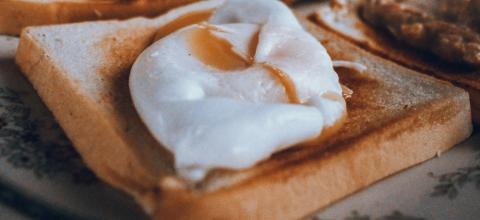
Poached eggs are great served with some toast. Or why not see if your little one enjoys trying poached egg and baked beans for a healthy breakfast or lunch? (Remember, reduced-sugar and low-salt baked beans are healthier.)

Tips for Kids

A poached egg on a slice of wholemeal bread is a great way to get some more fibre into your little one’s meals.

Nutritional Information

Based on a single serving of 50g (% of an adult's reference intake)

Energy

75 kcals ( 4 %)

313 kJ ( 4 %)

Fat

1.3 g ( 8 %)

Saturates

0.1 g ( %)

Sugar

0.1 g ( 1 %)

Salt

0.2 g ( 4 %)

Detailed nutritional information

Per 100g Per 50g serving
Energy Kcals 149 75
Energy Kj 626 313
Protein 13.3 g 6.7 g
Total Fat g g
Saturated Fat 3 g 1.3 g
Carbohydrates 0.1 g 0.1 g
Total Sugars 0.1 g 0.1 g
NSP Fibre 0 g 0 g
Sodium 121 mg 61 mg
Salt 0.3 g 0.2 g

Find out about nutritional labelling

Nutrition labels on the front of packaging

  • Most of the big supermarkets and many food manufacturers display nutritional information on the front of pre-packed food.
  • Front of pack nutrition labels provide information on the number of grams of fat, saturated fat, sugars and salt and the amount of energy (in kJ and kcal) in a serving or portion of a recipe.
  • The labels also include information about reference intakes (expressed as a percentage) which are guidelines about the approximate amount of particular nutrients and energy required for a healthy diet.
  • The colour coding tells you at a glance if the food has high (red), medium (amber) or low (green) amounts of fat, saturated fat, sugars and salt.
  • The more greens on the label, the healthier the choice
  • Amber means neither high nor low, so you can eat foods with all or mostly ambers on the label most of the time.
  • Reds on the label means the food is high in that nutrient and these are the foods we should cut down on. Try to eat these foods less often and in small amounts.

Food shopping tips

If you’re trying to decide which product to choose, check to see if there's a nutrition label on the front of the pack. This will help you to quickly assess how your choices stack up. You will often find a mixture of red, amber and green colour coding for the nutrients. So when you're choosing between similar products, try to go for more greens and ambers and fewer reds if you want to make a healthier choice.

Back to top
Subscribe to Egg