Ingredients

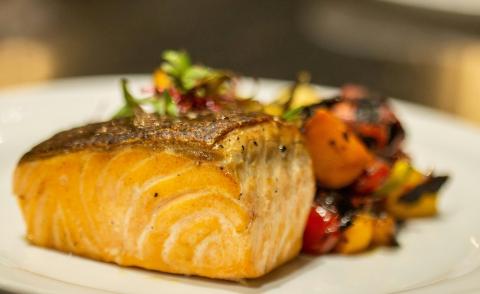
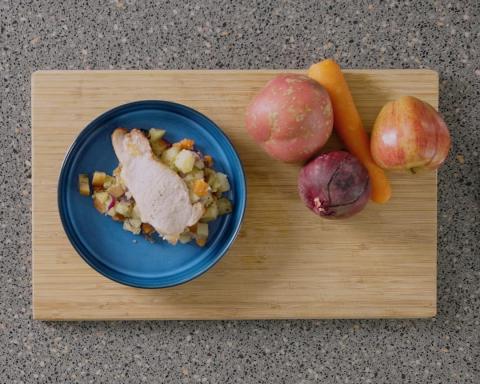
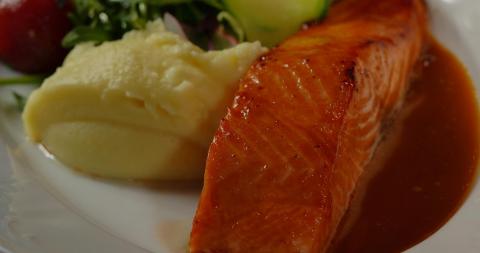
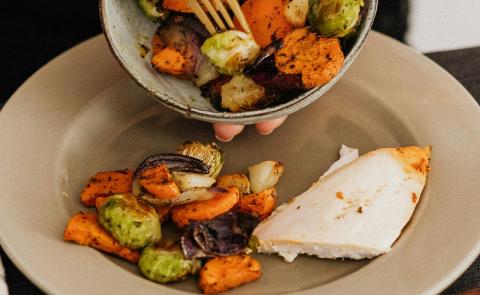
  • 4 Fillets (440g) Pink Salmon
  • 2 Tablespoons (20g) Vegetable Oil
  • 1 Teaspoon (1g) Dried Thyme
  • 6 (800g) Potatoes
  • 2 (280g) Carrots
  • ½ (500g) Turnip
  • 2 (180g) Parsnips
  • 3 Teaspoons (24g) Honey

This recipe has been added to your Meal Planner.

Allergy Disclaimer

Always check the label of each ingredient for allergy warnings.

Method

  1. Preheat the oven to 170°C / 150°C fan oven / 310°F / gas mark 3.
  2. Wash and peel potatoes and vegetables then cut into small cubes of similar size.
  3. Cook in a pan of boiling water for 10 minutes.
  4. Meanwhile line a baking tray with tin foil and place the salmon fillets onto it.
  5. In a small bowl pour half the oil, add the thyme and mix well. Using a pastry brush or your fingers, spread the oil on top of each fillet of salmon.
  6. Drain the water from the vegetables and place back into the pan. Add the remaining oil to the pan and mix to coat the vegetables.
  7. Spread the vegetables onto another baking tray and drizzle honey over the top. Roast in the oven for approximately 20-30 minutes until the vegetables are beginning to brown.
  8. The salmon should be added to the oven with approximately 15 minutes left to ensure it is ready at the same time as the vegetables.
  9. Once the salmon has cooked remove from oven, and if desired turn the heat up to crisp the vegetables further.

Time Saver Tips

Try roasting the potatoes and carrots without peeling.

Cost Saver Tips

Frozen salmon is often cheaper. Try with other herbs, such as basil, oregano if you don't have thyme in the cupboard.

Tips for Kids

Try taking them to your local fishmongers to choose the salmon or their favourite fish. Get them to mix the oil and herbs and brush this on to the salmon. If using fingers, wash them afterwards!

Nutritional Information

Based on a single serving of 516g (% of an adult's reference intake)

Energy

443 kcals ( 22 %)

1,863 kJ ( 22 %)

Fat

2.6 g ( 13 %)

Saturates

50 g ( %)

Sugar

15 g ( 17 %)

Salt

0.5 g ( 8 %)

Detailed nutritional information

Per 100g Per 516g serving
Energy Kcals 86 443
Energy Kj 361 1,863
Protein 4.8 g 24.8 g
Total Fat g g
Saturated Fat 0.5 g 2.6 g
Carbohydrates 9.7 g 50 g
Total Sugars 2.9 g 15 g
NSP Fibre 1.6 g 8.2 g
Sodium 24 mg 124 mg
Salt 0.1 g 0.5 g

Find out about nutritional labelling

Nutrition labels on the front of packaging

  • Most of the big supermarkets and many food manufacturers display nutritional information on the front of pre-packed food.
  • Front of pack nutrition labels provide information on the number of grams of fat, saturated fat, sugars and salt and the amount of energy (in kJ and kcal) in a serving or portion of a recipe.
  • The labels also include information about reference intakes (expressed as a percentage) which are guidelines about the approximate amount of particular nutrients and energy required for a healthy diet.
  • The colour coding tells you at a glance if the food has high (red), medium (amber) or low (green) amounts of fat, saturated fat, sugars and salt.
  • The more greens on the label, the healthier the choice
  • Amber means neither high nor low, so you can eat foods with all or mostly ambers on the label most of the time.
  • Reds on the label means the food is high in that nutrient and these are the foods we should cut down on. Try to eat these foods less often and in small amounts.

Food shopping tips

If you’re trying to decide which product to choose, check to see if there's a nutrition label on the front of the pack. This will help you to quickly assess how your choices stack up. You will often find a mixture of red, amber and green colour coding for the nutrients. So when you're choosing between similar products, try to go for more greens and ambers and fewer reds if you want to make a healthier choice.
Back to top

Ingredients

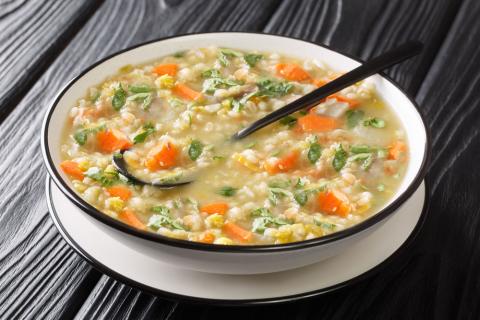
  • 8 (600g) Chicken Thighs
  • 1 Pint (600ml) Water
  • 1 (60g) Onion
  • 1 Tablespoon (20g) Pearl Barley
  • 1 (10g) Chicken Or Vegetable Reduced Salt Stock Cube
  • 2 (320g) Leeks
  • 1 Stick (30g) Celery
  • 1 Teaspoon (1g) Dried Thyme
  • (10g) Parsley
  • 1 Pinch Ground Black Pepper

This recipe has been added to your Meal Planner.

Allergy Disclaimer

Always check the label of each ingredient for allergy warnings.

Method

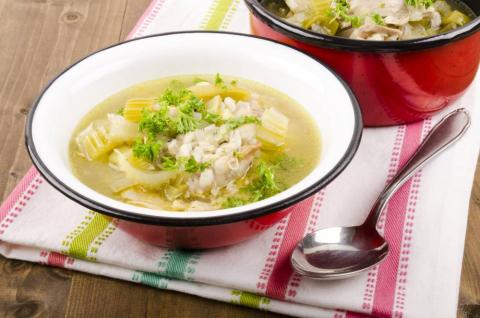
  1. Peel and chop the onion.
  2. In a large pan add the chicken thighs, water, onion and barley. Bring to the boil and then reduce heat and simmer for 1 hour.
  3. Remove the chicken from the pan and remove the skin and bone from each thigh using a sharp knife. Cut the chicken into bite size pieces and return to the pan.
  4. Wash the celery and leeks then finely chop then add to the pan with the thyme, parsley and stock cube. Stir to dissolve the stock cube, adding more water if required.
  5. Add pepper to taste and simmer until the vegetables are tender, approximately 20-30 minutes.

Time Saver Tips

Prepare in advance and heat through when required.

Cost Saver Tips

For a super speedy meal later on, why not batch cook this? Let it cool down then keep it in the fridge or freezer. This is a great recipe for leftover chicken. Just remember that you can’t freeze the soup if you use chicken that’s already been frozen and defrosted. No worries if you’ve run out of onions – celery or leeks are a good alternative. You could also use spring onion, too.

Tips for Kids

Try chopping vegetables really small or blend them so your little one can’t spot them – a sneaky but tasty way that could help get your little one eating a little more veg! You could even ask them if they’d like to help you prepare the vegetables. This might make them more likely to want to eat it when it’s ready!

Nutritional Information

Based on a single serving of 269g (% of an adult's reference intake)

Energy

156 kcals ( 8 %)

656 kJ ( 8 %)

Fat

0.8 g ( 4 %)

Saturates

9.1 g ( %)

Sugar

2.7 g ( 3 %)

Salt

0.8 g ( 13 %)

Detailed nutritional information

Per 100g Per 269g serving
Energy Kcals 58 156
Energy Kj 244 656
Protein 9.1 g 24.5 g
Total Fat g g
Saturated Fat 0.3 g 0.8 g
Carbohydrates 3.4 g 9.1 g
Total Sugars 1 g 2.7 g
NSP Fibre 0.6 g 1.6 g
Sodium 105 mg 282 mg
Salt 0.3 g 0.8 g

Find out about nutritional labelling

Nutrition labels on the front of packaging

  • Most of the big supermarkets and many food manufacturers display nutritional information on the front of pre-packed food.
  • Front of pack nutrition labels provide information on the number of grams of fat, saturated fat, sugars and salt and the amount of energy (in kJ and kcal) in a serving or portion of a recipe.
  • The labels also include information about reference intakes (expressed as a percentage) which are guidelines about the approximate amount of particular nutrients and energy required for a healthy diet.
  • The colour coding tells you at a glance if the food has high (red), medium (amber) or low (green) amounts of fat, saturated fat, sugars and salt.
  • The more greens on the label, the healthier the choice
  • Amber means neither high nor low, so you can eat foods with all or mostly ambers on the label most of the time.
  • Reds on the label means the food is high in that nutrient and these are the foods we should cut down on. Try to eat these foods less often and in small amounts.

Food shopping tips

If you’re trying to decide which product to choose, check to see if there's a nutrition label on the front of the pack. This will help you to quickly assess how your choices stack up. You will often find a mixture of red, amber and green colour coding for the nutrients. So when you're choosing between similar products, try to go for more greens and ambers and fewer reds if you want to make a healthier choice.

Back to top

Ingredients

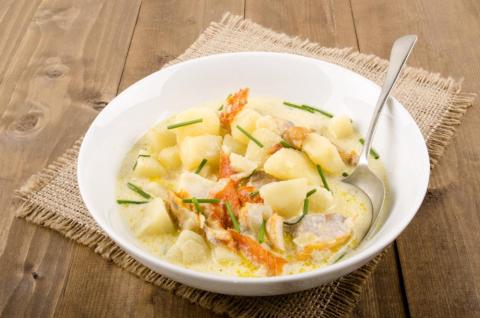
  • 2 (skinless and boneless) (240g) Smoked Haddock Fillets
  • ½ Cups (135ml) Water
  • 1 (150g) Onion
  • 1 Pint (600ml) Semi-Skimmed Milk
  • 4 (500g) Potatoes
  • (25g) Low Fat Spread
  • to taste Ground Black Pepper

This recipe has been added to your Meal Planner.

Allergy Disclaimer

Always check the label of each ingredient for allergy warnings.

Method

  1. Wash, peel and dice potatoes. Place in a large pan with boiling water and cook until soft, approximately 20 minutes.
  2. Peel onion and chop finely.
  3. Place the haddock in a medium sized frying pan with enough water to cover it, no more. Bring to the boil and add the chopped onion, then turn down the heat and simmer gently.
  4. When the haddock is cooked, separate the flakes using a fork. If they don't separate easily a little more cooking is needed.
  5. In a small pan, bring milk to the boil and then add this to the fish.
  6. Drain potatoes, return to the pan then add low fat spread and mash using a masher or fork until smooth.
  7. Stir potato into the fish, to thicken the soup and add black pepper to taste.

Time Saver Tips

Buy skinless & boneless haddock

Cost Saver Tips

Frozen fish is cheaper. Allow fish to defrost before cooking. Make in bulk and keep for another day.

Tips for Kids

Take a trip to your local fishmongers.

Nutritional Information

Based on a single serving of 397g (% of an adult's reference intake)

Energy

246 kcals ( 12 %)

1,032 kJ ( 12 %)

Fat

2.4 g ( 12 %)

Saturates

28.6 g ( %)

Sugar

9.9 g ( 11 %)

Salt

1.6 g ( 27 %)

Detailed nutritional information

Per 100g Per 397g serving
Energy Kcals 62 246
Energy Kj 260 1,032
Protein 5.6 g 22.2 g
Total Fat g g
Saturated Fat 0.6 g 2.4 g
Carbohydrates 7.2 g 28.6 g
Total Sugars 2.5 g 9.9 g
NSP Fibre 0.5 g 2 g
Sodium 180 mg 715 mg
Salt 0.4 g 1.6 g

Find out about nutritional labelling

Nutrition labels on the front of packaging

  • Most of the big supermarkets and many food manufacturers display nutritional information on the front of pre-packed food.
  • Front of pack nutrition labels provide information on the number of grams of fat, saturated fat, sugars and salt and the amount of energy (in kJ and kcal) in a serving or portion of a recipe.
  • The labels also include information about reference intakes (expressed as a percentage) which are guidelines about the approximate amount of particular nutrients and energy required for a healthy diet.
  • The colour coding tells you at a glance if the food has high (red), medium (amber) or low (green) amounts of fat, saturated fat, sugars and salt.
  • The more greens on the label, the healthier the choice
  • Amber means neither high nor low, so you can eat foods with all or mostly ambers on the label most of the time.
  • Reds on the label means the food is high in that nutrient and these are the foods we should cut down on. Try to eat these foods less often and in small amounts.

Food shopping tips

If you’re trying to decide which product to choose, check to see if there's a nutrition label on the front of the pack. This will help you to quickly assess how your choices stack up. You will often find a mixture of red, amber and green colour coding for the nutrients. So when you're choosing between similar products, try to go for more greens and ambers and fewer reds if you want to make a healthier choice.

Back to top

Ingredients

  • 2 Medium (160g) Carrots
  • ¼ Medium (250g) Swede
  • 1 Medium (150g) Onion
  • 1 Stick (30g) Celery
  • 1 (160g) Leek
  • ½ Cup (100g) Pearl Barley
  • 2 Pints (1,200ml) Water
  • 2 (14g) Beef, Lamb or Vegetable Stock Cubes (choose reduced salt whenever possible)
  • 1 Pinch Black Pepper to taste

This recipe has been added to your Meal Planner.

Allergy Disclaimer

Always check the label of each ingredient for allergy warnings.

Method

  1. Peel carrots, onion and swede. Remove outer layer of leek and wash celery.
  2. Dice all vegetables.
  3. Place vegetables in a large pan and add boiling water. Add stock cubes and pearl barley to the pan and stir, allowing stock cubes to fully dissolve.
  4. Once water is boiling reduce heat and simmer until barley is soft, approximately 2-3 hours.
  5. Add black pepper to taste. More water can be added if necessary.

Time Saver Tips

Barley can be soaked overnight to reduce cooking time. Broth can be made in advance and reheated when needed.

Cost Saver Tips

A good use of leftover vegetables. Make in bulk and freeze once cooled for another day.

Tips for Kids

Chopping the vegetables extra small or blending them is a good way to help your kids eat more if they’re a bit squeamish about their veggies. Letting them help you prepare the vegetables might also make your little one more likely to eat their veggies! Try serving with wholemeal bread to up their fibre intake.

Nutritional Information

Based on a single serving of 375g (% of an adult's reference intake)

Energy

129 kcals ( 6 %)

548 kJ ( 6 %)

Fat

0 g ( 0 %)

Saturates

33.9 g ( %)

Sugar

7.4 g ( 8 %)

Salt

0.8 g ( 13 %)

Detailed nutritional information

Per 100g Per 375g serving
Energy Kcals 34 129
Energy Kj 146 548
Protein 0.9 g 3.4 g
Total Fat g g
Saturated Fat 0 g 0 g
Carbohydrates 7.8 g 33.9 g
Total Sugars 2 g 7.4 g
NSP Fibre 0.7 g 2.7 g
Sodium 83 mg 311 mg
Salt 0.2 g 0.8 g

Find out about nutritional labelling

Nutrition labels on the front of packaging

  • Most of the big supermarkets and many food manufacturers display nutritional information on the front of pre-packed food.
  • Front of pack nutrition labels provide information on the number of grams of fat, saturated fat, sugars and salt and the amount of energy (in kJ and kcal) in a serving or portion of a recipe.
  • The labels also include information about reference intakes (expressed as a percentage) which are guidelines about the approximate amount of particular nutrients and energy required for a healthy diet.
  • The colour coding tells you at a glance if the food has high (red), medium (amber) or low (green) amounts of fat, saturated fat, sugars and salt.
  • The more greens on the label, the healthier the choice
  • Amber means neither high nor low, so you can eat foods with all or mostly ambers on the label most of the time.
  • Reds on the label means the food is high in that nutrient and these are the foods we should cut down on. Try to eat these foods less often and in small amounts.

Food shopping tips

If you’re trying to decide which product to choose, check to see if there's a nutrition label on the front of the pack. This will help you to quickly assess how your choices stack up. You will often find a mixture of red, amber and green colour coding for the nutrients. So when you're choosing between similar products, try to go for more greens and ambers and fewer reds if you want to make a healthier choice.

Back to top
Subscribe to Scottish Recipes