This article was created with

eat-better-feel-better-logo-2.png

Ingredients

  • 4 (80g) Trifle Sponges
  • 1 Can  (320g) Mixed Fruit or fresh such as peaches, pineapple, kiwi, strawberries, grapes etc
  • 8 Light Tablespoons (80g) Aerosol/Squirty Cream
  • (300g) Ready-Made Custard

This recipe has been added to your Meal Planner.

Allergy Disclaimer

Always check the label of each ingredient for allergy warnings.

Method

  1. Prepare the fruit by either washing and chopping the fresh fruit or draining the canned fruit
  2. Place the sponges in the bottom of the dish
  3. Place the fruit on top of the sponges, but keep some fruit aside for decoration
  4. Spoon the custard over the fruit and chill in the fridge for 15 minutes
  5. Decorate with the cream and some of the leftover fruit and serve immediately

Time Saver Tips

This can be prepared in advance and kept in the fridge until you are ready to decorate with the cream. Once the cream is added, serve immediately.

Cost Saver Tips

This can be made with any fresh or canned fruit, so use whatever is on offer.

Tips for Kids

Kids will love decorating the top of the trifle with the squirty cream! Use their favourite fruit.

Nutritional Information

Based on a single serving of 195g (% of an adult's reference intake)

Energy

231 kcals ( 12 %)

969 kJ ( 12 %)

Fat

3.3 g ( 17 %)

Saturates

28.1 g ( %)

Sugar

21.8 g ( 24 %)

Salt

0.3 g ( 4 %)

Detailed nutritional information

Per 100g Per 195g serving
Energy Kcals 119 231
Energy Kj 497 969
Protein 2.2 g 4.2 g
Total Fat g g
Saturated Fat 1.7 g 3.3 g
Carbohydrates 14.4 g 28.1 g
Total Sugars 11.2 g 21.8 g
NSP Fibre 0.5 g 1 g
Sodium 54 mg 105 mg
Salt 0.1 g 0.3 g

Find out about nutritional labelling

Nutrition labels on the front of packaging

  • Most of the big supermarkets and many food manufacturers display nutritional information on the front of pre-packed food.
  • Front of pack nutrition labels provide information on the number of grams of fat, saturated fat, sugars and salt and the amount of energy (in kJ and kcal) in a serving or portion of a recipe.
  • The labels also include information about reference intakes (expressed as a percentage) which are guidelines about the approximate amount of particular nutrients and energy required for a healthy diet.
  • The colour coding tells you at a glance if the food has high (red), medium (amber) or low (green) amounts of fat, saturated fat, sugars and salt.
  • The more greens on the label, the healthier the choice
  • Amber means neither high nor low, so you can eat foods with all or mostly ambers on the label most of the time.
  • Reds on the label means the food is high in that nutrient and these are the foods we should cut down on. Try to eat these foods less often and in small amounts.

Food shopping tips

If you’re trying to decide which product to choose, check to see if there's a nutrition label on the front of the pack. This will help you to quickly assess how your choices stack up. You will often find a mixture of red, amber and green colour coding for the nutrients. So when you're choosing between similar products, try to go for more greens and ambers and fewer reds if you want to make a healthier choice.
Back to top

Ingredients

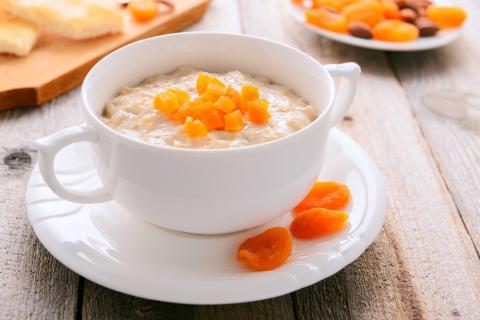
  • 10 (80g) Dried Apricots
  • 2 (200g) Apples
  • 2 Level Teaspoons (8g) Sugar (Optional)
  • 1 Pint (600ml) Water
  • 7 Tablespoons (100g) Scottish Porridge Oats

This recipe has been added to your Meal Planner.

Allergy Disclaimer

Always check the label of each ingredient for allergy warnings.

Method

  1. Chop the apricots. Wash, peel, core and chop the apples.
  2. Mix the apricots and apples with the sugar if desired.
  3. Pour the water into a saucepan and sprinkle on the oats. Bring to the boil, stirring continuously for 1 minute.
  4. Add the fruit mixture to the pan and simmer, stirring for about 3 minutes or until the porridge is thick.
  5. Serve hot.

Time Saver Tips

Don't peel the apple. Porridge can be easily cooked in the microwave - take care to stir frequently.

Cost Saver Tips

This recipe can be made with any fresh, seasonal, frozen or dried fruit, so choose whatever is on offer.

Tips for Kids

Use their favourite fruit. They may prefer it made with milk instead of water.

Nutritional Information

Based on a single serving of 258g (% of an adult's reference intake)

Energy

259 kcals ( 13 %)

1,099 kJ ( 13 %)

Fat

0.6 g ( 3 %)

Saturates

51.9 g ( %)

Sugar

16.8 g ( 19 %)

Salt

0.0 g ( 0 %)

Detailed nutritional information

Per 100g Per 258g serving
Energy Kcals 100 259
Energy Kj 426 1,099
Protein 2.6 g 6.6 g
Total Fat g g
Saturated Fat 0.2 g 0.6 g
Carbohydrates 20.1 g 51.9 g
Total Sugars 6.5 g 16.8 g
NSP Fibre 3.1 g 8 g
Sodium 5.1 mg 13.3 mg
Salt 0.0 g 0.0 g

Find out about nutritional labelling

Nutrition labels on the front of packaging

  • Most of the big supermarkets and many food manufacturers display nutritional information on the front of pre-packed food.
  • Front of pack nutrition labels provide information on the number of grams of fat, saturated fat, sugars and salt and the amount of energy (in kJ and kcal) in a serving or portion of a recipe.
  • The labels also include information about reference intakes (expressed as a percentage) which are guidelines about the approximate amount of particular nutrients and energy required for a healthy diet.
  • The colour coding tells you at a glance if the food has high (red), medium (amber) or low (green) amounts of fat, saturated fat, sugars and salt.
  • The more greens on the label, the healthier the choice
  • Amber means neither high nor low, so you can eat foods with all or mostly ambers on the label most of the time.
  • Reds on the label means the food is high in that nutrient and these are the foods we should cut down on. Try to eat these foods less often and in small amounts.

Food shopping tips

If you’re trying to decide which product to choose, check to see if there's a nutrition label on the front of the pack. This will help you to quickly assess how your choices stack up. You will often find a mixture of red, amber and green colour coding for the nutrients. So when you're choosing between similar products, try to go for more greens and ambers and fewer reds if you want to make a healthier choice.

Back to top

Ingredients

  • 1 Pack (250g) Mushrooms
  • 1 Tablespoon (15g) Low Fat Spread
  • 1 (3g) Garlic Clove
  • 1 Pinch (1g) Chilli Powder
  • 2 (Optional) Sprigs Parsley

This recipe has been added to your Meal Planner.

Allergy Disclaimer

Always check the label of each ingredient for allergy warnings.

Method

  1. Rinse or wipe the mushrooms and parsley. Chop the parsley.
  2. Peel and finely chop the garlic.
  3. Heat the low fat spread in a pan.
  4. Add the garlic and chilli powder.
  5. Add the mushrooms and cook on a high heat for 3-5 minutes.
  6. Garnish with chopped parsley and serve immediately.

Cost Saver Tips

You could serve this with a slice of wholemeal bread or toast to soak up those nice juices. Any leftover parsley can be used in soup or other vegetable dishes. Don’t worry if you don’t have parsley in – it’s still tasty without it. Button or chestnut, it doesn’t matter – any mushrooms work well in this, so it’s good to use up what you have or what’s on offer.

Tips for Kids

If your little one’s finding this a bit too spicy, cool things down by using less chilli powder – or even remove it all together.

Nutritional Information

Based on a single serving of 57g (% of an adult's reference intake)

Energy

30 kcals ( 2 %)

126 kJ ( 2 %)

Fat

0.4 g ( %)

Saturates

0.4 g ( %)

Sugar

0.2 g ( 0.1 %)

Salt

0.1 g ( 1 %)

Detailed nutritional information

Per 100g Per 57g serving
Energy Kcals 53 30
Energy Kj 221 126
Protein 4.8 g 2.8 g
Total Fat g g
Saturated Fat 0.7 g 0.4 g
Carbohydrates 0.7 g 0.4 g
Total Sugars 0.3 g 0.2 g
NSP Fibre 1.3 g 0.7 g
Sodium 52 mg 30 mg
Salt 0.1 g 0.1 g

Find out about nutritional labelling

Nutrition labels on the front of packaging

  • Most of the big supermarkets and many food manufacturers display nutritional information on the front of pre-packed food.
  • Front of pack nutrition labels provide information on the number of grams of fat, saturated fat, sugars and salt and the amount of energy (in kJ and kcal) in a serving or portion of a recipe.
  • The labels also include information about reference intakes (expressed as a percentage) which are guidelines about the approximate amount of particular nutrients and energy required for a healthy diet.
  • The colour coding tells you at a glance if the food has high (red), medium (amber) or low (green) amounts of fat, saturated fat, sugars and salt.
  • The more greens on the label, the healthier the choice
  • Amber means neither high nor low, so you can eat foods with all or mostly ambers on the label most of the time.
  • Reds on the label means the food is high in that nutrient and these are the foods we should cut down on. Try to eat these foods less often and in small amounts.

Food shopping tips

If you’re trying to decide which product to choose, check to see if there's a nutrition label on the front of the pack. This will help you to quickly assess how your choices stack up. You will often find a mixture of red, amber and green colour coding for the nutrients. So when you're choosing between similar products, try to go for more greens and ambers and fewer reds if you want to make a healthier choice.

Back to top

Ingredients

  • 4 Cups (300g) Dried Pasta
  • 1/2 Pack (110g) Green Beans
  • 3 Spears (135g) Broccoli
  • 2 Tablespoons (30g) Low Fat Spread
  • 1 (100g) Courgette
  • 1 Tub (200g) Low Fat Soft Cheese With Garlic and Herbs
  • 4 Tablespoons (60ml) Semi-Skimmed Milk
  • to taste Ground Black Pepper
  • 1 (optional) Tablespoon (25g) Pine Nuts

This recipe has been added to your Meal Planner.

Allergy Disclaimer

Always check the label of each ingredient for allergy warnings.

Method


  1. Break broccoli into small florets. Trim ends off green beans and cut in half. Dice the courgette.
  2. In a large pan cook pasta as per manufacturer's instructions. During the last 5 minutes of cooking add the broccoli and green beans to the pan.
  3. Whilst pasta is cooking heat the low fat spread in a large frying pan and gently fry the courgette for 4-5 minutes until it softens. Add the soft cheese and milk to the pan and stir until it melts. Season with black pepper.
  4. Stir the pasta and vegetables into the sauce. Heat through for 2-3 minutes.
  5. Serve warm with pine nuts sprinkled on top if desired.

Cost Saver Tips

Can be made with any leftover vegetables. Omit the pine nuts

Tips for Kids

Make with their favourite vegetables. Try tricolour pasta to make it more colourful or use their favourite pasta shape.

Nutritional Information

Based on a single serving of 309g (% of an adult's reference intake)

Energy

430 kcals ( 21 %)

1,805 kJ ( 21 %)

Fat

4.3 g ( 22 %)

Saturates

63 g ( %)

Sugar

5.3 g ( 6 %)

Salt

0.6 g ( 10 %)

Detailed nutritional information

Per 100g Per 309g serving
Energy Kcals 139 430
Energy Kj 584 1,805
Protein 6.5 g 20 g
Total Fat g g
Saturated Fat 1.4 g 4.3 g
Carbohydrates 20.4 g 63 g
Total Sugars 1.7 g 5.3 g
NSP Fibre 2 g 6.2 g
Sodium 98 mg 303 mg
Salt 0.2 g 0.6 g

Find out about nutritional labelling

Nutrition labels on the front of packaging

  • Most of the big supermarkets and many food manufacturers display nutritional information on the front of pre-packed food.
  • Front of pack nutrition labels provide information on the number of grams of fat, saturated fat, sugars and salt and the amount of energy (in kJ and kcal) in a serving or portion of a recipe.
  • The labels also include information about reference intakes (expressed as a percentage) which are guidelines about the approximate amount of particular nutrients and energy required for a healthy diet.
  • The colour coding tells you at a glance if the food has high (red), medium (amber) or low (green) amounts of fat, saturated fat, sugars and salt.
  • The more greens on the label, the healthier the choice
  • Amber means neither high nor low, so you can eat foods with all or mostly ambers on the label most of the time.
  • Reds on the label means the food is high in that nutrient and these are the foods we should cut down on. Try to eat these foods less often and in small amounts.

Food shopping tips

If you’re trying to decide which product to choose, check to see if there's a nutrition label on the front of the pack. This will help you to quickly assess how your choices stack up. You will often find a mixture of red, amber and green colour coding for the nutrients. So when you're choosing between similar products, try to go for more greens and ambers and fewer reds if you want to make a healthier choice.

Back to top

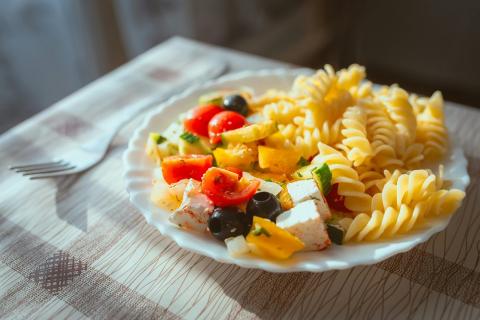
Ingredients

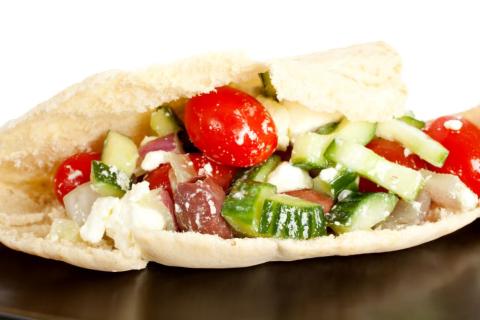
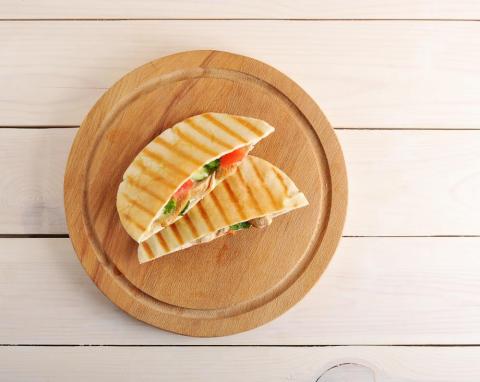
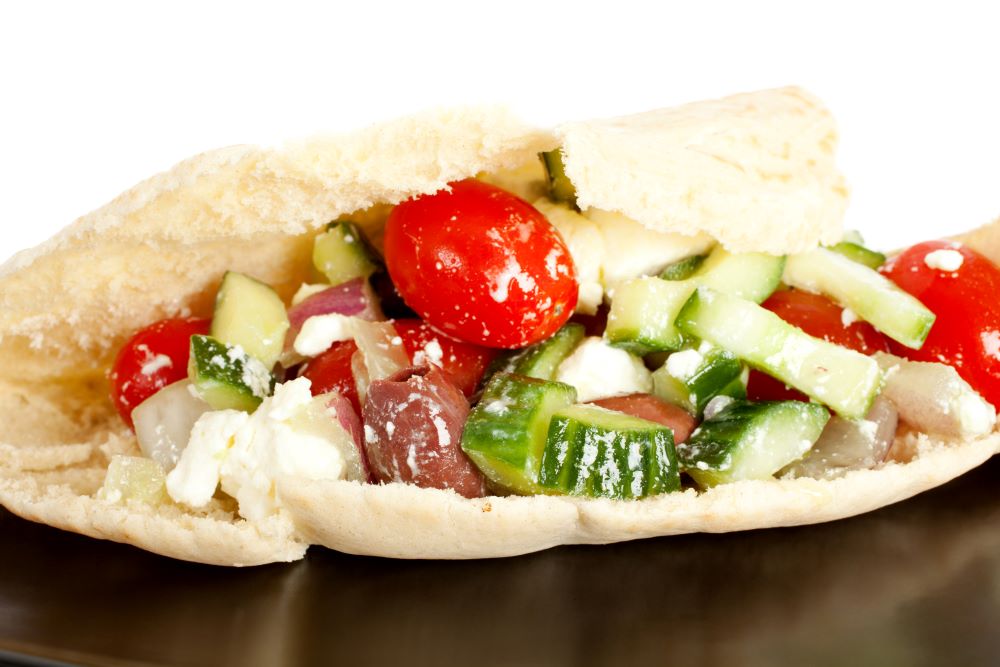
  • 4 Pitta Breads
  • 2 Tablespoons (20g) Olive Oil
  • 1 Lemon
  • (140g) Feta Cheese
  • 2 Medium Sized (170g) Tomatoes
  • 1 (160g) Yellow Pepper
  • 1 Approx. 2 Inches Long Piece (120g) Cucumber

This recipe has been added to your Meal Planner.

Allergy Disclaimer

Always check the label of each ingredient for allergy warnings.

Method

  1. Mix the olive oil and the juice of the lemon together in a bowl.
  2. Wash the tomatoes, pepper and cucumber and chop into small pieces.
  3. Cut the feta cheese into small chunks.
  4. Add the tomatoes, pepper, cucumber and feta to the bowl and mix.
  5. Open the pitta breads, transfer the salad mixture to the pitta breads using a slotted spoon, and serve.

Cost Saver Tips

Instead of Feta, you could save money by buying Greek style salad cheese.

Tips for Kids

Use their favourite salad vegetables and make this as colourful as possible.

Nutritional Information

Based on a single serving of 220g (% of an adult's reference intake)

Energy

316 kcals ( 16 %)

1,324 kJ ( 16 %)

Fat

5.7 g ( 29 %)

Saturates

35.5 g ( %)

Sugar

5.9 g ( 7 %)

Salt

2 g ( 33 %)

Detailed nutritional information

Per 100g Per 220g serving
Energy Kcals 143 316
Energy Kj 602 1,324
Protein 5.7 g 12.6 g
Total Fat g g
Saturated Fat 2.6 g 5.7 g
Carbohydrates 16.1 g 35.5 g
Total Sugars 2.7 g 5.9 g
NSP Fibre 1.3 g 2.9 g
Sodium 357 mg 785 mg
Salt 0.9 g 2 g

Find out about nutritional labelling

Nutrition labels on the front of packaging

  • Most of the big supermarkets and many food manufacturers display nutritional information on the front of pre-packed food.
  • Front of pack nutrition labels provide information on the number of grams of fat, saturated fat, sugars and salt and the amount of energy (in kJ and kcal) in a serving or portion of a recipe.
  • The labels also include information about reference intakes (expressed as a percentage) which are guidelines about the approximate amount of particular nutrients and energy required for a healthy diet.
  • The colour coding tells you at a glance if the food has high (red), medium (amber) or low (green) amounts of fat, saturated fat, sugars and salt.
  • The more greens on the label, the healthier the choice
  • Amber means neither high nor low, so you can eat foods with all or mostly ambers on the label most of the time.
  • Reds on the label means the food is high in that nutrient and these are the foods we should cut down on. Try to eat these foods less often and in small amounts.

Food shopping tips

If you’re trying to decide which product to choose, check to see if there's a nutrition label on the front of the pack. This will help you to quickly assess how your choices stack up. You will often find a mixture of red, amber and green colour coding for the nutrients. So when you're choosing between similar products, try to go for more greens and ambers and fewer reds if you want to make a healthier choice.

Back to top

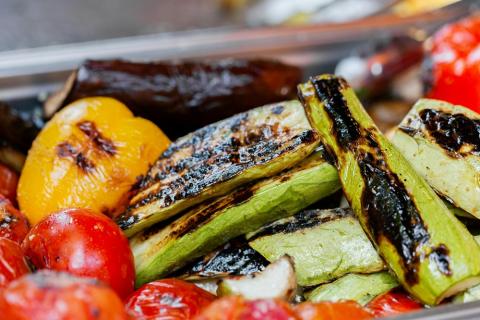
Ingredients

  • 1 (260g) Aubergine
  • 1 Medium sized (100g) Courgette
  • 2 (320g) Yellow Peppers
  • 12 (120g) Cherry Tomatoes
  • 4 (40g) Spring Onions
  • 1 Tablespoon (10g) Olive Oil
  • 1 Pinch (1g) Ground Black Pepper
  • ½ Pack (60g) Fine Asparagus
  • 1 (3g) Garlic Clove
  • ½ Juiced (10g) Lemon
  • 1 For the dressing Tablespoon (10g) Olive Oil
  • ½ Large tub Tub (250g) Low Fat Plain Yoghurt

This recipe has been added to your Meal Planner.

Allergy Disclaimer

Always check the label of each ingredient for allergy warnings.

Method

  1. Wash the vegetables. Slice the aubergine and courgette into thin strips lengthwise. Deseed and slice the peppers. Cut the tomatoes in half and slice the spring onions
  2. Brush the vegetabes with a little oil and season with ground black pepper. If you don't have a brush, just use your hands to ensure the vegetables are covered in a thin layer of oil
  3. Place the aubergine, courgette, peppers and asparagus onto a hot grill pan (or frying pan if you don't have a grill pan) and cook until the vegetables are coloured on both sides and soft
  4. Add the tomatoes and spring onions and cook for 1 minute until hot
  5. Peel and finely chop the garlic, and whisk the dressing ingredients together in a bowl. Use a fork if you don't have a whisk
  6. Place the hot vegetables on a plate and serve the dressing on the side or drizzled over the hot vegetables

Cost Saver Tips

Not all these vegetables need to be used - choose whatever is on offer.

Tips for Kids

The kids can help mix the dressing ingredients together in the bowl. Make this salad as colourful as possible.

Nutritional Information

Based on a single serving of 261g (% of an adult's reference intake)

Energy

131 kcals ( 7 %)

547 kJ ( 7 %)

Fat

1.2 g ( 6 %)

Saturates

11.9 g ( %)

Sugar

11.5 g ( 13 %)

Salt

0.1 g ( 2 %)

Detailed nutritional information

Per 100g Per 261g serving
Energy Kcals 50 131
Energy Kj 210 547
Protein 2.3 g 6.1 g
Total Fat g g
Saturated Fat 0.5 g 1.2 g
Carbohydrates 4.6 g 11.9 g
Total Sugars 4.4 g 11.5 g
NSP Fibre 1.4 g 3.7 g
Sodium 23 mg 59 mg
Salt 0.1 g 0.1 g

Find out about nutritional labelling

Nutrition labels on the front of packaging

  • Most of the big supermarkets and many food manufacturers display nutritional information on the front of pre-packed food.
  • Front of pack nutrition labels provide information on the number of grams of fat, saturated fat, sugars and salt and the amount of energy (in kJ and kcal) in a serving or portion of a recipe.
  • The labels also include information about reference intakes (expressed as a percentage) which are guidelines about the approximate amount of particular nutrients and energy required for a healthy diet.
  • The colour coding tells you at a glance if the food has high (red), medium (amber) or low (green) amounts of fat, saturated fat, sugars and salt.
  • The more greens on the label, the healthier the choice
  • Amber means neither high nor low, so you can eat foods with all or mostly ambers on the label most of the time.
  • Reds on the label means the food is high in that nutrient and these are the foods we should cut down on. Try to eat these foods less often and in small amounts.

Food shopping tips

If you’re trying to decide which product to choose, check to see if there's a nutrition label on the front of the pack. This will help you to quickly assess how your choices stack up. You will often find a mixture of red, amber and green colour coding for the nutrients. So when you're choosing between similar products, try to go for more greens and ambers and fewer reds if you want to make a healthier choice.

Back to top

Ingredients

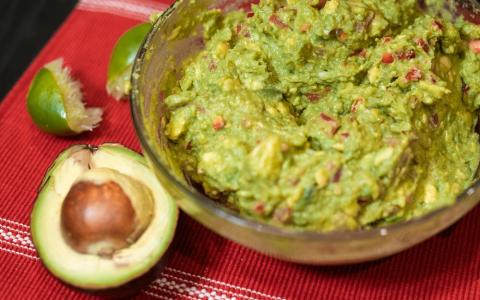
  • 2 Large Sized (390g) Avocados
  • 3 (9g) Garlic Cloves
  • 2 (20g) Spring Onions
  • 2 Teaspoons (6g) Olive Oil
  • 1 Pinch (1g) Chilli Powder
  • 1 Lemon
  • 2 Medium Sized (160g) Carrots
  • 1 Sticks (30g) Celery
  • 1 Approx. 3 Inches Long Piece (180g) Cucumber

This recipe has been added to your Meal Planner.

Allergy Disclaimer

Always check the label of each ingredient for allergy warnings.

Method

  1. Wash the carrots, celery and cucumber and chop into sticks.
  2. Peel and finely chop the garlic.
  3. Wash and finely chop the spring onions.
  4. Cut the avocado in half lengthways around the stone and open the two halves. Remove the stone. Scoop out the flesh into a bowl and mash with a fork.
  5. Add the garlic, spring onions, olive oil, chilli powder and the juice of the lemon to the avocado and mix well.
  6. Serve with the vegetable sticks.

Tips for Kids

Chop their favourite vegetables to dip in the guacamole – finger food is fun!

Nutritional Information

Based on a single serving of 204g (% of an adult's reference intake)

Energy

236 kcals ( 12 %)

972 kJ ( 12 %)

Fat

4.3 g ( 22 %)

Saturates

6 g ( %)

Sugar

4.2 g ( 5 %)

Salt

0.1 g ( 1 %)

Detailed nutritional information

Per 100g Per 204g serving
Energy Kcals 116 236
Energy Kj 477 972
Protein 1.3 g 2.7 g
Total Fat g g
Saturated Fat 2.1 g 4.3 g
Carbohydrates 2.9 g 6 g
Total Sugars 2 g 4.2 g
NSP Fibre 2.4 g 5.4 g
Sodium 12 mg 25 mg
Salt 0.0 g 0.1 g

Find out about nutritional labelling

Nutrition labels on the front of packaging

  • Most of the big supermarkets and many food manufacturers display nutritional information on the front of pre-packed food.
  • Front of pack nutrition labels provide information on the number of grams of fat, saturated fat, sugars and salt and the amount of energy (in kJ and kcal) in a serving or portion of a recipe.
  • The labels also include information about reference intakes (expressed as a percentage) which are guidelines about the approximate amount of particular nutrients and energy required for a healthy diet.
  • The colour coding tells you at a glance if the food has high (red), medium (amber) or low (green) amounts of fat, saturated fat, sugars and salt.
  • The more greens on the label, the healthier the choice
  • Amber means neither high nor low, so you can eat foods with all or mostly ambers on the label most of the time.
  • Reds on the label means the food is high in that nutrient and these are the foods we should cut down on. Try to eat these foods less often and in small amounts.

Food shopping tips

If you’re trying to decide which product to choose, check to see if there's a nutrition label on the front of the pack. This will help you to quickly assess how your choices stack up. You will often find a mixture of red, amber and green colour coding for the nutrients. So when you're choosing between similar products, try to go for more greens and ambers and fewer reds if you want to make a healthier choice.

Back to top

Ingredients

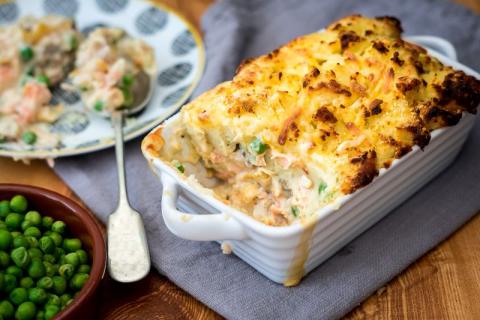
  • 2 Medium (240g) Haddock Fillets
  • 3 Large (600g) Potatoes
  • 1 (160g) Leek
  • 2 Cups (200g) Frozen Peas
  • ½ (4g) Fish or Vegetable Stock Cube (choose reduced salt whenever possible)
  • ¼ Pint (150ml) Water
  • 1 Pinch Black Pepper
  • 20 Tablespoons (200g) Cheddar Cheese (choose reduced fat whenever possible)

This recipe has been added to your Meal Planner.

Allergy Disclaimer

Always check the label of each ingredient for allergy warnings.

Method

  1. Preheat the oven to 190°C / 170°C fan oven / 360°F / gas mark 5.
  2. Peel and slice the potatoes then boil until they soften, approximately 10 minutes.
  3. Meanwhile cut the fish into cubes and place in an oven proof dish. Wash and remove outer layer of leek and then slice finely. Add this along with the peas and black pepper.
  4. Dissolve the stock cube in boiling water and then pour over the fish and vegetables.
  5. Drain potatoes and arrange on top of the fish. Grate cheese and sprinkle on top of the potatoes.
  6. Bake in the oven for 30 minutes and then increase the heat to 230°C / 210°C fan oven / 450°F / gas mark 7. Serve once browned and crisp.

Cost Saver Tips

Any white fish could be used, such as cod. Look out for offers! Frozen fish is often cheaper (but ensure it's defrosted thoroughly before you use it).

Tips for Kids

Why not take them to a trip to the fishmonger?

Nutritional Information

Based on a single serving of 335g (% of an adult's reference intake)

Energy

314 kcals ( 16 %)

1,324 kJ ( 16 %)

Fat

5.1 g ( 26 %)

Saturates

29.5 g ( %)

Sugar

4.9 g ( 5 %)

Salt

1.4 g ( 23 %)

Detailed nutritional information

Per 100g Per 335g serving
Energy Kcals 94 314
Energy Kj 395 1,324
Protein 9.4 g 31.4 g
Total Fat g g
Saturated Fat 1.5 g 5.1 g
Carbohydrates 8.8 g 29.5 g
Total Sugars 1.5 g 4.9 g
NSP Fibre 1.7 g 5.6 g
Sodium 162 mg 542 mg
Salt 0.4 g 1.4 g

Find out about nutritional labelling

Nutrition labels on the front of packaging

  • Most of the big supermarkets and many food manufacturers display nutritional information on the front of pre-packed food.
  • Front of pack nutrition labels provide information on the number of grams of fat, saturated fat, sugars and salt and the amount of energy (in kJ and kcal) in a serving or portion of a recipe.
  • The labels also include information about reference intakes (expressed as a percentage) which are guidelines about the approximate amount of particular nutrients and energy required for a healthy diet.
  • The colour coding tells you at a glance if the food has high (red), medium (amber) or low (green) amounts of fat, saturated fat, sugars and salt.
  • The more greens on the label, the healthier the choice
  • Amber means neither high nor low, so you can eat foods with all or mostly ambers on the label most of the time.
  • Reds on the label means the food is high in that nutrient and these are the foods we should cut down on. Try to eat these foods less often and in small amounts.

Food shopping tips

If you’re trying to decide which product to choose, check to see if there's a nutrition label on the front of the pack. This will help you to quickly assess how your choices stack up. You will often find a mixture of red, amber and green colour coding for the nutrients. So when you're choosing between similar products, try to go for more greens and ambers and fewer reds if you want to make a healthier choice.

Back to top

Ingredients

  • 4 Slices (144g) Wholemeal Bread
  • 4 Tablespoon (120g) Reduced Fat Cream Cheese
  • 4 Wafer thin Slices (44g) Ham
  • ½ (200g) Cucumber

This recipe has been added to your Meal Planner.

Allergy Disclaimer

Always check the label of each ingredient for allergy warnings.

Method

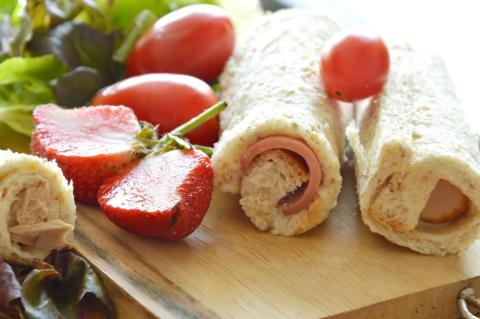
  1. Remove the bread crusts, then flatten each slice using a rolling pin or the palm of your hand.
  2. Spread the soft cheese evenly on each slice then add a slice of ham to each.
  3. Cut the cucumber in half length ways then cut in half again so you have four strips.
  4. Place a strip of cucumber at the end of each slice of bread and then roll the bread around the cucumber and continue rolling to the end of the bread.
  5. Cut each roll into four pieces and serve.

Tips for Kids

They will enjoy making these rolls.

Nutritional Information

Based on a single serving of 119g (% of an adult's reference intake)

Energy

144 kcals ( 7 %)

605 kJ ( 7 %)

Fat

2.5 g ( 12 %)

Saturates

17 g ( %)

Sugar

2.7 g ( 3 %)

Salt

0.8 g ( 13 %)

Detailed nutritional information

Per 100g Per 119g serving
Energy Kcals 121 144
Energy Kj 508 605
Protein 7.5 g 8.9 g
Total Fat g g
Saturated Fat 2.1 g 2.5 g
Carbohydrates 14.3 g 17 g
Total Sugars 2.3 g 2.7 g
NSP Fibre 1.8 g 2.1 g
Sodium 266 mg 317 mg
Salt 0.7 g 0.8 g

Find out about nutritional labelling

Nutrition labels on the front of packaging

  • Most of the big supermarkets and many food manufacturers display nutritional information on the front of pre-packed food.
  • Front of pack nutrition labels provide information on the number of grams of fat, saturated fat, sugars and salt and the amount of energy (in kJ and kcal) in a serving or portion of a recipe.
  • The labels also include information about reference intakes (expressed as a percentage) which are guidelines about the approximate amount of particular nutrients and energy required for a healthy diet.
  • The colour coding tells you at a glance if the food has high (red), medium (amber) or low (green) amounts of fat, saturated fat, sugars and salt.
  • The more greens on the label, the healthier the choice
  • Amber means neither high nor low, so you can eat foods with all or mostly ambers on the label most of the time.
  • Reds on the label means the food is high in that nutrient and these are the foods we should cut down on. Try to eat these foods less often and in small amounts.

Food shopping tips

If you’re trying to decide which product to choose, check to see if there's a nutrition label on the front of the pack. This will help you to quickly assess how your choices stack up. You will often find a mixture of red, amber and green colour coding for the nutrients. So when you're choosing between similar products, try to go for more greens and ambers and fewer reds if you want to make a healthier choice.

Back to top

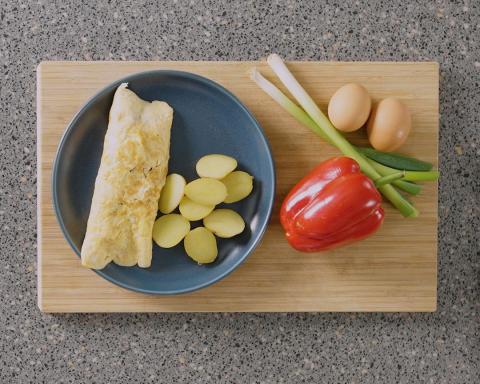
Ingredients

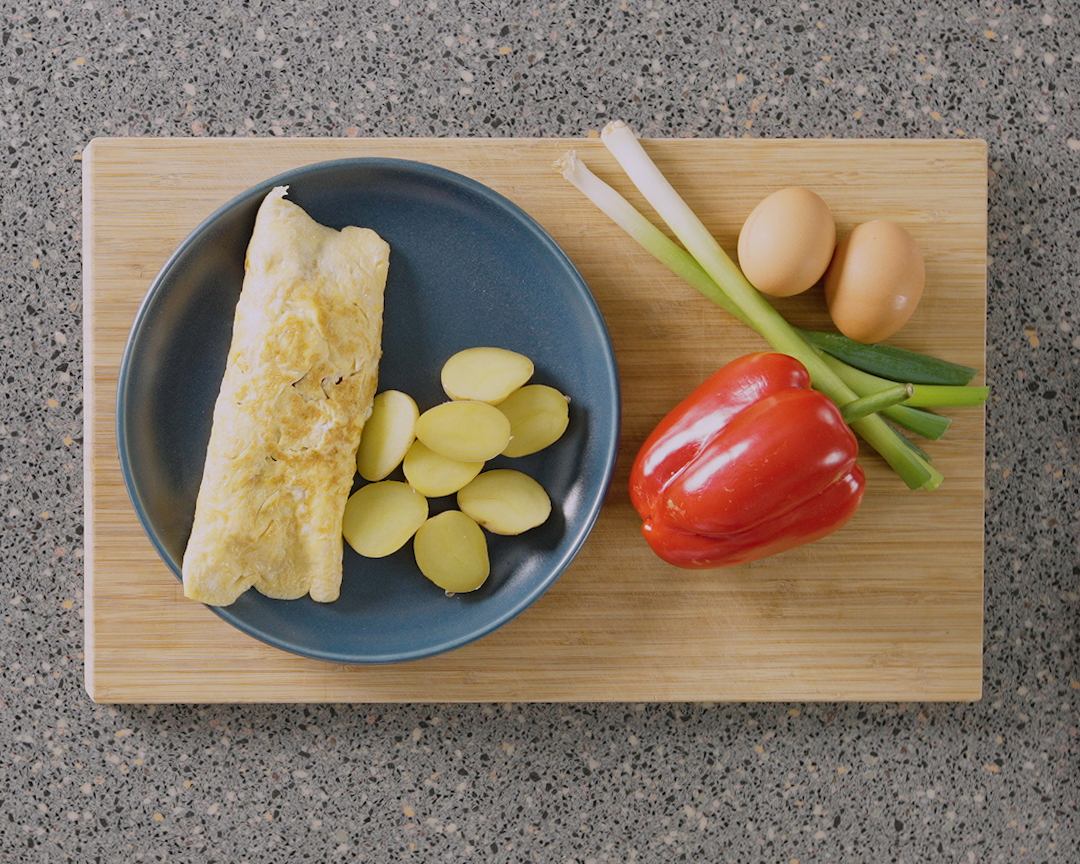
  • 8 Thin Slices (280g) Ham
  • 4 (40g) Spring Onions
  • 2 (320g) Peppers (Any Colour)
  • 8 Eggs
  • 4 Teaspoons (12g) Vegetable Oil
  • 12 Average (480g) New Potatoes

This recipe has been added to your Meal Planner.

Allergy Disclaimer

Always check the label of each ingredient for allergy warnings.

Method

  1. Wash the new potatoes, add to a pan of boiling water and simmer until tender.
  2. Wash the peppers and spring onions. Chop the ham, peppers and spring onions into small pieces and mix together in a bowl.
  3. Add 1 teaspoon of oil to the frying pan and heat to medium hot.
  4. Add the ham, spring onions and peppers to the pan and cook for 5 minutes then pour onto a plate.
  5. Crack 2 eggs into a bowl or cup and beat with a fork. Pour into the frying pan and stir until the egg starts to set.
  6. Turn down the heat and add one quarter of the filling.
  7. Cook until the egg is set then fold the omelette over in the pan.
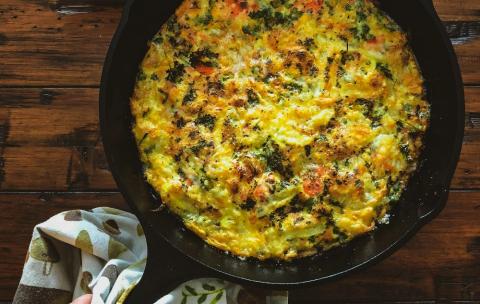
  8. Repeat steps 3, 5, 6 and 7 to make another 3 omelettes. Serve hot with boiled new potatoes.

Time Saver Tips

Why not make a supersize omelette in one pan, grill to cook through, then cut into quarters? It’s so much quicker than making lots of smaller omelettes!

Cost Saver Tips

Canned ham is often cheaper than sliced ham. Or you can really make this recipe your own by adding any leftover meat or vegetables you have. A tasty way to save! You can also use any type of potato, boiled or baked - leaving the skins on can also help boost fibre - bonus!
Tips for Kids

To make this a real family favourite, you could try adding your little one’s favourite fillings – like mushrooms, sweetcorn or tuna. Or why not serve with a side salad or additional vegetables, to boost that five a day? For variety, you could swap the meat for fish or extra vegetables.
Nutritional Information

Based on a single serving of 352g (% of an adult's reference intake)
Energy

346 kcals ( 17 %)

1,457 kJ ( 17 %)

Fat

3.7 g ( 19 %)

Saturates

26.6 g ( %)

Sugar

6.3 g ( 7 %)

Salt

1.8 g ( 30 %)

Detailed nutritional information

Per 100g Per 352g serving
Energy Kcals 98 346
Energy Kj 346 1,457
Protein 8 g 28.1 g
Total Fat g g
Saturated Fat 1 g 3.7 g
Carbohydrates 7.5 g 26.6 g
Total Sugars 1.8 g 6.3 g
NSP Fibre 0.9 g 3.3 g
Sodium 207 mg 729 mg
Salt 0.5 g 1.8 g

Find out about nutritional labelling

Nutrition labels on the front of packaging

  • Most of the big supermarkets and many food manufacturers display nutritional information on the front of pre-packed food.
  • Front of pack nutrition labels provide information on the number of grams of fat, saturated fat, sugars and salt and the amount of energy (in kJ and kcal) in a serving or portion of a recipe.
  • The labels also include information about reference intakes (expressed as a percentage) which are guidelines about the approximate amount of particular nutrients and energy required for a healthy diet.
  • The colour coding tells you at a glance if the food has high (red), medium (amber) or low (green) amounts of fat, saturated fat, sugars and salt.
  • The more greens on the label, the healthier the choice
  • Amber means neither high nor low, so you can eat foods with all or mostly ambers on the label most of the time.
  • Reds on the label means the food is high in that nutrient and these are the foods we should cut down on. Try to eat these foods less often and in small amounts.

Food shopping tips

If you’re trying to decide which product to choose, check to see if there's a nutrition label on the front of the pack. This will help you to quickly assess how your choices stack up. You will often find a mixture of red, amber and green colour coding for the nutrients. So when you're choosing between similar products, try to go for more greens and ambers and fewer reds if you want to make a healthier choice.

Back to top
Subscribe to Eat Better Feel Better