This article was created with

eat-better-feel-better-logo-2.png

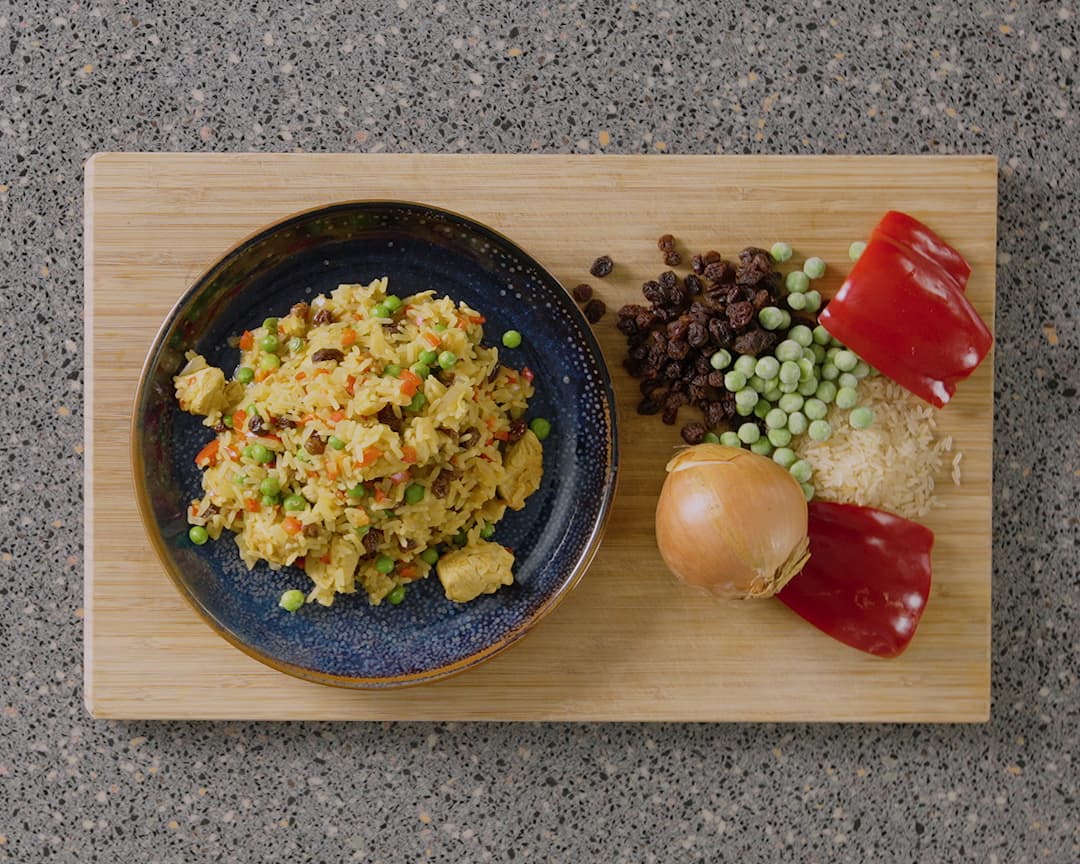
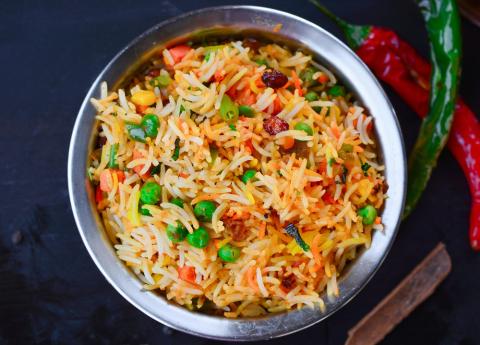
Ingredients

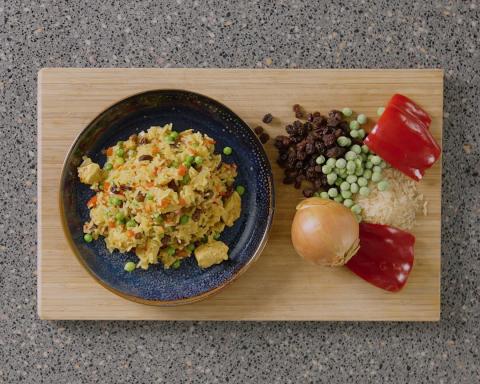
  • 1 Tablespoon (10g) Vegetable Oil
  • (400g) Diced Chicken Breast or 4 Small Chicken Breasts
  • 1 Medium (150g) Onion
  • 1 Medium (160g) Red Pepper
  • 16 Tablespoons (200g) Dried Easy Cook Long Grain Rice
  • 3 Teaspoons (9g) Medium Curry Powder
  • 2 Mugs (500ml) Water
  • 4 Tablespoons (120g) Frozen Peas
  • 3 Tablespoons (75g) Seedless Raisins

This recipe has been added to your Meal Planner.

Allergy Disclaimer

Always check the label of each ingredient for allergy warnings.

Method

  1. Peel and finely chop the onion. Wash, deseed and chop the pepper.
  2. Heat the oil in a large saucepan and fry the chicken for 5 minutes until browned.
  3. Add the onion and pepper and fry until soft.
  4. Stir in the rice and curry powder and fry for another 2 minutes.
  5. Add the water and raisins.
  6. Bring to the boil and simmer for 20-25 minutes until the rice is cooked, stirring occasionally. Add more water if necessary. Add the peas 5 minutes before the end of cooking.
  7. Once the rice is cooked, use a slotted spoon to dish up and enjoy hot.

You can use white or brown rice or even a mix of the two depending on what you have. 

Time Saver Tips

Why not make this in bulk and freeze some of it on the day you make it for an easy meal another time? Just make sure you chill the food (ideally within an hour after cooking) before freezing. Also, why not boil the rice while preparing the vegetables and chicken and adding it to the pan cooked?

Cost Saver Tips

Any meat such as lamb, beef or pork works really well in this. It’s good to keep a look out for offers or cheaper cuts of meat such as chicken thighs that you can dice yourself, or even buy whole chicken breasts and dice them yourself. This recipe is ideal for using up any leftover cooked meat from a roast chicken or turkey. To make this vegetarian, you could pop in a can or two of kidney beans or cannellini beans instead – these are super healthy and tasty. Why not try using whatever vegetables you have in? Fresh work best, but even frozen peas and sweetcorn from the freezer taste good. Raisins add a nice finishing touch, but no need to worry if you don’t have any.

Tips for Kids

Why not get your little one to help with adding the raisins and stirring? They might like sneaking a few raisins as a snack while cooking, too! You could try seeing if your little one would like to help you prepare the vegetables. Knowing they’ve helped make this might even make them more likely to eat it. It’s totally fine to use a bit less curry powder if your little one isn’t too keen on spicy food. You could even have some chilli flakes on the table for anyone who likes things on the spicy side!

Nutritional Information

Based on a single serving of 356g (% of an adult's reference intake)

Energy

401 kcals ( 20 %)

1,701 kJ ( 20 %)

Fat

0.7 g ( 4 %)

Saturates

62.8 g ( %)

Sugar

18.8 g ( 21 %)

Salt

0.2 g ( 3 %)

Detailed nutritional information

Per 100g Per 356g serving
Energy Kcals 113 401
Energy Kj 478 1,701
Protein 8.5 g 30.4 g
Total Fat g g
Saturated Fat 0.2 g 0.7 g
Carbohydrates 17.6 g 62.8 g
Total Sugars 5.3 g 18.8 g
NSP Fibre 1.3 g 4.7 g
Sodium 24 mg 86 mg
Salt 0.1 g 0.2 g

Find out about nutritional labelling

Nutrition labels on the front of packaging

  • Most of the big supermarkets and many food manufacturers display nutritional information on the front of pre-packed food.
  • Front of pack nutrition labels provide information on the number of grams of fat, saturated fat, sugars and salt and the amount of energy (in kJ and kcal) in a serving or portion of a recipe.
  • The labels also include information about reference intakes (expressed as a percentage) which are guidelines about the approximate amount of particular nutrients and energy required for a healthy diet.
  • The colour coding tells you at a glance if the food has high (red), medium (amber) or low (green) amounts of fat, saturated fat, sugars and salt.
  • The more greens on the label, the healthier the choice
  • Amber means neither high nor low, so you can eat foods with all or mostly ambers on the label most of the time.
  • Reds on the label means the food is high in that nutrient and these are the foods we should cut down on. Try to eat these foods less often and in small amounts.

Food shopping tips

If you’re trying to decide which product to choose, check to see if there's a nutrition label on the front of the pack. This will help you to quickly assess how your choices stack up. You will often find a mixture of red, amber and green colour coding for the nutrients. So when you're choosing between similar products, try to go for more greens and ambers and fewer reds if you want to make a healthier choice.
Back to top

Ingredients

  • 1 Mug (300g) Easy Cook Rice
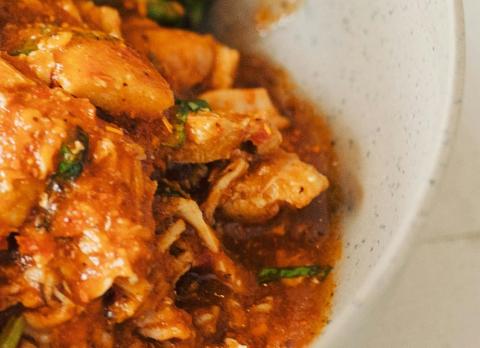
  • 4 (1kg) Chicken Leg Quarters
  • 2 Medium (300g) Onions
  • 2 (6g) Garlic Cloves or 10g Garlic Puree
  • 2 (320g) Red Peppers
  • 4 Teaspoons (12g) Paprika
  • 1 (7g) Chicken Stock Cube (choose reduced salt whenever possible)
  • 1 Pint (500ml) Boiling Water
  • 2 Tablespoons (30g) Tomato Puree
  • 1 Pinch Black Pepper to taste

This recipe has been added to your Meal Planner.

Allergy Disclaimer

Always check the label of each ingredient for allergy warnings.

Method

  1. Preheat oven to 200°C / 180°C fan oven / 400°F / gas 6.
  2. Using a knife remove skin from chicken.
  3. Peel and chop the onions, then peel and finely chop or crush garlic and dice red peppers.
  4. Dissolve the stock cube in water and stir in the tomato puree.
  5. Place all ingredients, except the rice, into an oven proof dish and add black pepper to taste.
  6. Cover with a lid or tinfoil and bake in the oven for 60 minutes.
  7. Cook the rice as per the instructions on the packet just before casserole is ready to serve.
  8. Serve rice and casserole together. Check chicken is white all the way through before serving.

Cost Saver Tips

Why not buy a whole chicken or use chicken drumsticks or thighs? You can use the leftovers in other chicken-based recipes from this site. It’s always good to buy meat when it’s on offer or in bulk. That way you can freeze until needed. Just always follow defrosting instructions. When defrosting meat, remember to keep it covered on the bottom shelf of the fridge so harmful bacteria can't drip onto other food.

Tips for Kids

Take this up a notch by adding your little one’s favourite veggies. Frozen peas and sweetcorn work great in this dish – just stir them in for the last few minutes of cooking. Looking to make sure they get some more fibre? Brown rice is an easy option – it just takes a wee bit longer to cook. You could also serve this with potatoes.
Nutritional Information

Based on a single serving of 630g (% of an adult's reference intake)

Energy

701 kcals ( 35 %)

2,943 kJ ( 35 %)

Fat

4.6 g ( 23 %)

Saturates

81.6 g ( %)

Sugar

8.3 g ( 9 %)

Salt

1.1 g ( 18 %)

Detailed nutritional information

Per 100g Per 630g serving
Energy Kcals 108 701
Energy Kj 457 2,943
Protein 8.9 g 57 g
Total Fat g g
Saturated Fat 0.7 g 4.6 g
Carbohydrates 13 g 81.6 g
Total Sugars 1.3 g 8.3 g
NSP Fibre 0.9 g 7 g
Sodium 71 mg 449 mg
Salt 0.2 g 1.1 g

Find out about nutritional labelling

Nutrition labels on the front of packaging

  • Most of the big supermarkets and many food manufacturers display nutritional information on the front of pre-packed food.
  • Front of pack nutrition labels provide information on the number of grams of fat, saturated fat, sugars and salt and the amount of energy (in kJ and kcal) in a serving or portion of a recipe.
  • The labels also include information about reference intakes (expressed as a percentage) which are guidelines about the approximate amount of particular nutrients and energy required for a healthy diet.
  • The colour coding tells you at a glance if the food has high (red), medium (amber) or low (green) amounts of fat, saturated fat, sugars and salt.
  • The more greens on the label, the healthier the choice
  • Amber means neither high nor low, so you can eat foods with all or mostly ambers on the label most of the time.
  • Reds on the label means the food is high in that nutrient and these are the foods we should cut down on. Try to eat these foods less often and in small amounts.

Food shopping tips

If you’re trying to decide which product to choose, check to see if there's a nutrition label on the front of the pack. This will help you to quickly assess how your choices stack up. You will often find a mixture of red, amber and green colour coding for the nutrients. So when you're choosing between similar products, try to go for more greens and ambers and fewer reds if you want to make a healthier choice.

Back to top

Ingredients

  • 1 Tablespoon (10g) Vegetable Oil
  • 4 Small Sized (400g) Chicken Breasts
  • 2 Medium Sized (300g) Onions
  • 2 (6g) Garlic Cloves or 1 Teaspoon (5g) Garlic Puree
  • 4 (40g) Spring Onions
  • 1 (160g) Red Pepper
  • ½ Pack (100g) Pak Choi
  • 2 Medium Sized (160g) Carrots
  • ½ Teaspoon (2g) Ground Ginger
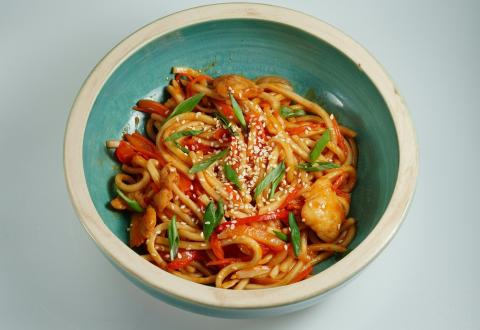
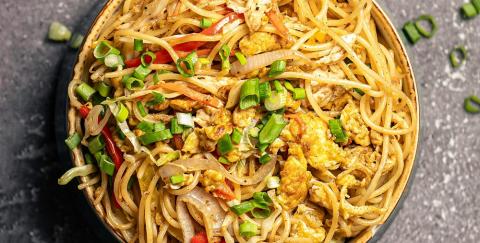
  • 2 Packs (600g) Straight To Wok Noodles
  • 4 Teaspoons (20g) Soy Sauce (use reduced salt when possible)

This recipe has been added to your Meal Planner.

Allergy Disclaimer

Always check the label of each ingredient for allergy warnings.

Method

  1. Peel and chop the onions and garlic.
  2. Wash and slice the spring onions.
  3. Wash, de-seed and thinly slice the pepper.
  4. Wash and shred the pak choi.
  5. Wash, peel and thinly slice the carrots.
  6. Heat the oil in a large frying pan or wok.
  7. Stir fry the chicken, onion and garlic until golden brown
  8. Reduce the heat and add the spring onions, pepper, pak choi, carrots and ground ginger. Stir until the vegetables are soft.
  9. Add the noodles to the pan and stir fry for 1-2 minutes, separating the noodles with a fork, until the noodles are hot.
  10. Add soy sauce to taste and serve.

Time Saver Tips

This easy dish can be cooked all in the one pan and keeps the washing up to a minimum!

Cost Saver Tips

Green cabbage can be used instead of pak choi. Use dried egg noodles if cheaper, and add them to the pan once cooked. Buy whole chicken breasts and dice them yourself. Or chow mein can be made with turkey or pork instead of chicken, and tofu or other meat alternatives can be used for a vegetarian option.Try using a thumb-sized piece of fresh root ginger (peeled and chopped) instead of ground ginger. You could also try adding different vegetables such as baby sweetcorn, sugar-snap peas or beansprouts.

Tips for Kids

Give the children chopsticks to eat the dish with!

Nutritional Information

Based on a single serving of 343g (% of an adult's reference intake)

Energy

432 kcals ( 22 %)

1,831 kJ ( 22 %)

Fat

0.8 g ( 4 %)

Saturates

65.1 g ( %)

Sugar

9.6 g ( 11 %)

Salt

1.4 g ( 23 %)

Detailed nutritional information

Per 100g Per 343g serving
Energy Kcals 126 432
Energy Kj 534 1,831
Protein 10 g 34.4 g
Total Fat g g
Saturated Fat 0.2 g 0.8 g
Carbohydrates 19 g 65.1 g
Total Sugars 2.8 g 9.6 g
NSP Fibre 2.3 g 7.9 g
Sodium 163 mg 559 mg
Salt 0.4 g 1.4 g

Find out about nutritional labelling

Nutrition labels on the front of packaging

  • Most of the big supermarkets and many food manufacturers display nutritional information on the front of pre-packed food.
  • Front of pack nutrition labels provide information on the number of grams of fat, saturated fat, sugars and salt and the amount of energy (in kJ and kcal) in a serving or portion of a recipe.
  • The labels also include information about reference intakes (expressed as a percentage) which are guidelines about the approximate amount of particular nutrients and energy required for a healthy diet.
  • The colour coding tells you at a glance if the food has high (red), medium (amber) or low (green) amounts of fat, saturated fat, sugars and salt.
  • The more greens on the label, the healthier the choice
  • Amber means neither high nor low, so you can eat foods with all or mostly ambers on the label most of the time.
  • Reds on the label means the food is high in that nutrient and these are the foods we should cut down on. Try to eat these foods less often and in small amounts.

Food shopping tips

If you’re trying to decide which product to choose, check to see if there's a nutrition label on the front of the pack. This will help you to quickly assess how your choices stack up. You will often find a mixture of red, amber and green colour coding for the nutrients. So when you're choosing between similar products, try to go for more greens and ambers and fewer reds if you want to make a healthier choice.

Back to top

Ingredients

  • 4 (600g) Chicken Breasts
  • 2 Teaspoons (10g) Low Fat Spread
  • 4 (12g) Garlic Cloves
  • 2 Teaspoons (2g) Basil
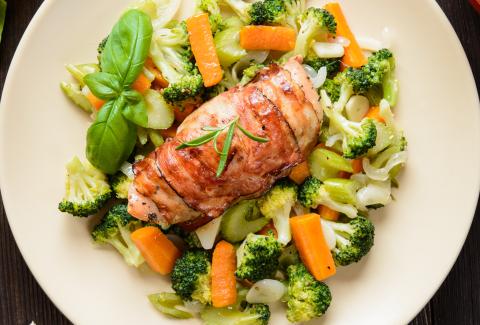
  • 4 Rashers (100g) Smoked Back Bacon
  • 2 Teaspoons (20g) Vegetable Oil
  • 8 Spears (360g) Broccoli
  • 18 (720g) New Potatoes

This recipe has been added to your Meal Planner.

Allergy Disclaimer

Always check the label of each ingredient for allergy warnings.

Method

  1. Peel and finely chop the garlic.
  2. Make a paste with the low fat spread, garlic and basil.
  3. Slit each chicken breast horizontally to make a pocket and fill each pocket with a quarter of the paste.
  4. Trim the fat off the bacon and wrap each breast in one rasher. Hold together with cocktail sticks if you need to.
  5. Fry the chicken parcels in oil in a pan with a lid until the bacon crisps. Then put the lid on and simmer for 20 minutes. Alternatively, you can bake the chicken parcels in the oven for 20 minutes at 180°C / 350°F / 160°C fan oven / gas mark 4.
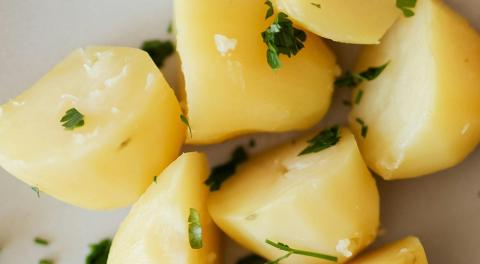
  6. Wash the new potatoes, cut them in half and add them to a pan of boiling water. Simmer for around 15 minutes until tender.
  7. Rinse the broccoli and cut into small pieces. Cook in a pan of boiling water for 4-5 minutes until tender.
  8. Serve the chicken Kiev hot with the broccoli and new potatoes.

Time Saver Tips

The broccoli can be cooked in the same pan as the new potatoes for the last 5 minutes of cooking time, which saves washing another pan!

Cost Saver Tips

Don't let any leftover veggies go to waste – serve them with the chicken Kiev.

Tips for Kids

Let the kids get involved – ask them to help stick the cocktail sticks into the Kiev to hold the chicken and bacon together. You can then serve it with their favourite vegetables.

Nutritional Information

Based on a single serving of 426g (% of an adult's reference intake)

Energy

401 kcals ( 20 %)

1,689 kJ ( 20 %)

Fat

2.2 g ( 11 %)

Saturates

26.7 g ( %)

Sugar

2.6 g ( 3 %)

Salt

1.2 g ( 20 %)

Detailed nutritional information

Per 100g Per 426g serving
Energy Kcals 94 401
Energy Kj 397 1,689
Protein 10.9 g 46.5 g
Total Fat g g
Saturated Fat 0.5 g 2.2 g
Carbohydrates 6.3 g 26.7 g
Total Sugars 0.6 g 2.6 g
NSP Fibre 1.2 g 5.1 g
Sodium 111 mg 473 mg
Salt 0.3 g 1.2 g

Find out about nutritional labelling

Nutrition labels on the front of packaging

  • Most of the big supermarkets and many food manufacturers display nutritional information on the front of pre-packed food.
  • Front of pack nutrition labels provide information on the number of grams of fat, saturated fat, sugars and salt and the amount of energy (in kJ and kcal) in a serving or portion of a recipe.
  • The labels also include information about reference intakes (expressed as a percentage) which are guidelines about the approximate amount of particular nutrients and energy required for a healthy diet.
  • The colour coding tells you at a glance if the food has high (red), medium (amber) or low (green) amounts of fat, saturated fat, sugars and salt.
  • The more greens on the label, the healthier the choice
  • Amber means neither high nor low, so you can eat foods with all or mostly ambers on the label most of the time.
  • Reds on the label means the food is high in that nutrient and these are the foods we should cut down on. Try to eat these foods less often and in small amounts.

Food shopping tips

If you’re trying to decide which product to choose, check to see if there's a nutrition label on the front of the pack. This will help you to quickly assess how your choices stack up. You will often find a mixture of red, amber and green colour coding for the nutrients. So when you're choosing between similar products, try to go for more greens and ambers and fewer reds if you want to make a healthier choice.

Back to top

Ingredients

  • 4 Medium Sized (520g) Chicken Breasts
  • 7 Tablespoons (100g) Breadcrumbs
  • 2 (100g) Eggs
  • 2 ½ Level Tablespoons Tablespoons (50Array) Plain Flour
  • To Taste Ground Black Pepper
  • 2 (6g) Garlic Cloves
  • 2 Teaspoons (2g) Dried Parsley
  • 7 Tablespoons (100g) Low Fat Spread
  • 16 (640g) New Potatoes
  • 1 ½ Packs (320g) Green Beans

This recipe has been added to your Meal Planner.

Allergy Disclaimer

Always check the label of each ingredient for allergy warnings.

Method

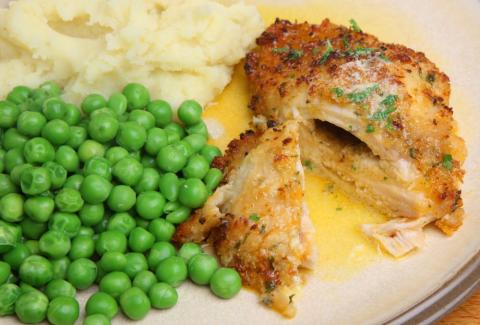
  1. Peel and crush the garlic, then mix with the spread and parsley. Place the mixture into cling film and roll into a sausage shape. Place in the freezer while preparing the chicken.
  2. Preheat the oven to 180°C / 160°C fan oven / 350°F / gas mark 5.
  3. Place the point of a sharp knife into the fat end of one of the chicken breasts until it reaches halfway then make a pocket to put the spread in. Repeat this with each chicken breast.
  4. When the spread is firm remove from the freezer and cut into four. Place a piece into each chicken breast and flatten with hands to seal.
  5. Crack the eggs into a bowl and beat together with black pepper. Add the flour and breadcrumbs onto separate plates.
  6. Coat each chicken breast with flour, then egg and finally breadcrumbs.
  7. Place Kievs on a baking tray and place in oven for 25- 30 minutes until cooked through and golden brown.
  8. Wash potatoes and cook in boiling water for approximately 15 minutes. Use a knife to check they are cooked through.
  9. Wash and trim the ends off the green beans then cook in boiling water until tender approximately 5 minutes.
  10. Serve Kievs with potatoes and green beans.

Time Saver Tips

Prepare spread in advance and leave in the freezer until you are ready to use it.

Cost Saver Tips

Make your own breadcrumbs. Use frozen green beans or other vegetables you have.

Tips for Kids

Serve with their favourite vegetables.

Nutritional Information

Based on a single serving of 426g (% of an adult's reference intake)

Energy

537 kcals ( 27 %)

2,254 kJ ( 27 %)

Fat

3.8 g ( 19 %)

Saturates

60.9 g ( %)

Sugar

5.1 g ( 6 %)

Salt

0.9 g ( 15 %)

Detailed nutritional information

Per 100g Per 426g serving
Energy Kcals 126 537
Energy Kj 529 2,254
Protein 10.2 g 43.5 g
Total Fat g g
Saturated Fat 0.9 g 3.8 g
Carbohydrates 14.3 g 60.9 g
Total Sugars 1.2 g 5.1 g
NSP Fibre 1 g 4.3 g
Sodium 93 mg 396 mg
Salt 0.2 g 0.9 g

Find out about nutritional labelling

Nutrition labels on the front of packaging

  • Most of the big supermarkets and many food manufacturers display nutritional information on the front of pre-packed food.
  • Front of pack nutrition labels provide information on the number of grams of fat, saturated fat, sugars and salt and the amount of energy (in kJ and kcal) in a serving or portion of a recipe.
  • The labels also include information about reference intakes (expressed as a percentage) which are guidelines about the approximate amount of particular nutrients and energy required for a healthy diet.
  • The colour coding tells you at a glance if the food has high (red), medium (amber) or low (green) amounts of fat, saturated fat, sugars and salt.
  • The more greens on the label, the healthier the choice
  • Amber means neither high nor low, so you can eat foods with all or mostly ambers on the label most of the time.
  • Reds on the label means the food is high in that nutrient and these are the foods we should cut down on. Try to eat these foods less often and in small amounts.

Food shopping tips

If you’re trying to decide which product to choose, check to see if there's a nutrition label on the front of the pack. This will help you to quickly assess how your choices stack up. You will often find a mixture of red, amber and green colour coding for the nutrients. So when you're choosing between similar products, try to go for more greens and ambers and fewer reds if you want to make a healthier choice.

Back to top

Ingredients

  • 1 Pack (240g) Roast / Cooked Chicken
  • (250g) Egg Noodles
  • 4 (40g) Spring Onions
  • 1 (160g) Pepper
  • ½ (180g) Cucumber
  • 5 Teaspoons (25g) Soy Sauce

This recipe has been added to your Meal Planner.

Allergy Disclaimer

Always check the label of each ingredient for allergy warnings.

Method

  1. Cook the noodles as instructed on the packet and rinse with cold water.
  2. While noodles are cooking wash the vegetables.
  3. Remove the outer layer of spring onions, cut off both ends then finely chop. Then slice the pepper and cucumber.
  4. In a large bowl mix all ingredients together then serve.

Cost Saver Tips

Don't let salad or cooked veg go off in the fridge – use it up with this easy recipe.

Tips for Kids

Let them help with chopping and mixing. Use some of their favourite vegetables.

Nutritional Information

Based on a single serving of 285g (% of an adult's reference intake)

Energy

345 kcals ( 17 %)

1,448 kJ ( 17 %)

Fat

1.7 g ( 9 %)

Saturates

49.9 g ( %)

Sugar

3.4 g ( 4 %)

Salt

1.7 g ( 28 %)

Detailed nutritional information

Per 100g Per 285g serving
Energy Kcals 121 345
Energy Kj 508 1,448
Protein 8.9 g 25.4 g
Total Fat g g
Saturated Fat 0.6 g 1.7 g
Carbohydrates 17.5 g 49.9 g
Total Sugars 1.2 g 3.4 g
NSP Fibre 1.3 g 3.7 g
Sodium 245 mg 698 mg
Salt 0.6 g 1.7 g

Find out about nutritional labelling

Nutrition labels on the front of packaging

  • Most of the big supermarkets and many food manufacturers display nutritional information on the front of pre-packed food.
  • Front of pack nutrition labels provide information on the number of grams of fat, saturated fat, sugars and salt and the amount of energy (in kJ and kcal) in a serving or portion of a recipe.
  • The labels also include information about reference intakes (expressed as a percentage) which are guidelines about the approximate amount of particular nutrients and energy required for a healthy diet.
  • The colour coding tells you at a glance if the food has high (red), medium (amber) or low (green) amounts of fat, saturated fat, sugars and salt.
  • The more greens on the label, the healthier the choice
  • Amber means neither high nor low, so you can eat foods with all or mostly ambers on the label most of the time.
  • Reds on the label means the food is high in that nutrient and these are the foods we should cut down on. Try to eat these foods less often and in small amounts.

Food shopping tips

If you’re trying to decide which product to choose, check to see if there's a nutrition label on the front of the pack. This will help you to quickly assess how your choices stack up. You will often find a mixture of red, amber and green colour coding for the nutrients. So when you're choosing between similar products, try to go for more greens and ambers and fewer reds if you want to make a healthier choice.

Back to top

Ingredients

  • 4 (400g) Chicken Breasts
  • 2 Tablespoons (20ml) Vegetable Oil
  • to taste Ground Black Pepper
  • 4 (1kg) Potatoes
  • 2 (280g) Carrots
  • 2 (500g) Cauliflower
  • 8 Spears (360g) Broccoli
  • (75ml) Semi-Skimmed Milk
  • 1 Teaspoon (5g) Low Fat Spread
  • 2 Tablespoons (30g) Reduced Salt Gravy Granules
  • (300ml) Water

This recipe has been added to your Meal Planner.

Allergy Disclaimer

Always check the label of each ingredient for allergy warnings.

Method

  1. Peel and dice potato. Peel and slice carrots. Wash and divide broccoli spears and cauliflower florets
  2. In a large pan boil potatoes until soft, approximately 20 minutes.
  3. Heat grill on a high heat, drizzle oil  and sprinkle black pepper over both sides of the chicken breasts. Cook under grill for approximately 8-10 minutes turning occasionally.
  4. In another pan boil the carrots, broccoli and cauliflower until softened, approximately 5-10 minutes.
  5. Once potatoes are soft, drain and then mash with milk and spread using a fork or masher. Once the vegetables are soft, drain the water and keep it to make the gravy.
  6. Dissolve gravy granules in water from vegetables, mixing well.
  7. Serve chicken, mashed potato and vegetables with gravy.

Source: Love Food Hate Waste

Time Saver Tips

Don't peel carrots

Cost Saver Tips

Use any seasonal vegetables or those on offer.

Tips for Kids

Serve with their favourite vegetables.

Nutritional Information

Based on a single serving of 651g (% of an adult's reference intake)

Energy

501 kcals ( 25 %)

2,103 kJ ( 25 %)

Fat

3.3 g ( 17 %)

Saturates

55.3 g ( %)

Sugar

g ( %)

Salt

1.3 g ( 22 %)

Detailed nutritional information

Per 100g Per 651g serving
Energy Kcals 77 501
Energy Kj 323 2,103
Protein 6.4 g 41.7 g
Total Fat g g
Saturated Fat 0.5 g 3.3 g
Carbohydrates 8.5 g 55.3 g
Total Sugars g g
NSP Fibre 1.2 g 7.8 g
Sodium 80 mg 521 mg
Salt 0.2 g 1.3 g

Find out about nutritional labelling

Nutrition labels on the front of packaging

  • Most of the big supermarkets and many food manufacturers display nutritional information on the front of pre-packed food.
  • Front of pack nutrition labels provide information on the number of grams of fat, saturated fat, sugars and salt and the amount of energy (in kJ and kcal) in a serving or portion of a recipe.
  • The labels also include information about reference intakes (expressed as a percentage) which are guidelines about the approximate amount of particular nutrients and energy required for a healthy diet.
  • The colour coding tells you at a glance if the food has high (red), medium (amber) or low (green) amounts of fat, saturated fat, sugars and salt.
  • The more greens on the label, the healthier the choice
  • Amber means neither high nor low, so you can eat foods with all or mostly ambers on the label most of the time.
  • Reds on the label means the food is high in that nutrient and these are the foods we should cut down on. Try to eat these foods less often and in small amounts.

Food shopping tips

If you’re trying to decide which product to choose, check to see if there's a nutrition label on the front of the pack. This will help you to quickly assess how your choices stack up. You will often find a mixture of red, amber and green colour coding for the nutrients. So when you're choosing between similar products, try to go for more greens and ambers and fewer reds if you want to make a healthier choice.

Back to top

Ingredients

  • 1 (240g) Lettuce
  • 4 or use cooked chicken (400g) Chicken Breasts
  • 2 medium sized (170g) Tomatoes
  • 16 Slices (96g) Cucumber
  • ½ (80g) Red Pepper
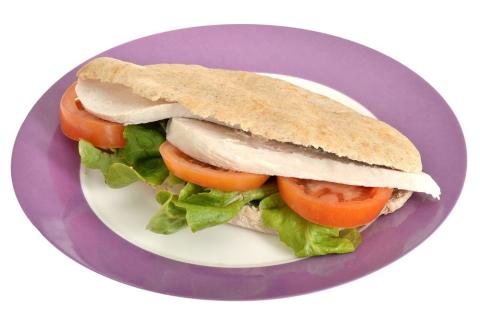
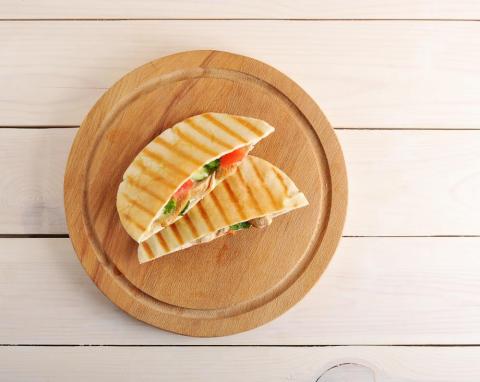
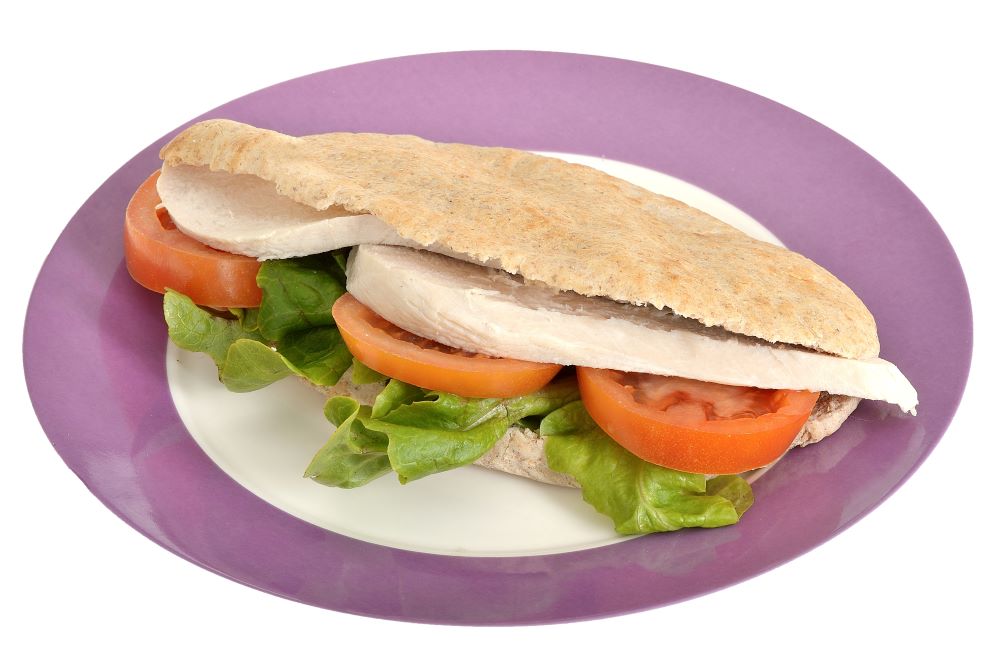
  • 4 wholemeal (380g) Pitta Breads
  • 4 Tablespoons (120ml) Fat Free Salad Dressing

This recipe has been added to your Meal Planner.

Allergy Disclaimer

Always check the label of each ingredient for allergy warnings.

Method

  1. If using raw chicken breasts place them in a pan with enough water to cover and bring to the boil. After 15- 20 minutes, drain the water and cool
  2. Wash the vegetables and shred the lettuce and slice the tomatoes, pepper and cucumber. Mix them together in a bowl with the dressing
  3. Once all the vegetables are well drained, thoroughly mix together then add dressing and mix throughly again
  4. Toast the pitta breads under the grill or in a toaster. Meanwhile cut the chicken into strips and add to the salad
  5. Slice the pittas to open them like a pocket and divide the mixture between them

Time Saver Tips

Use cooked chicken

Cost Saver Tips

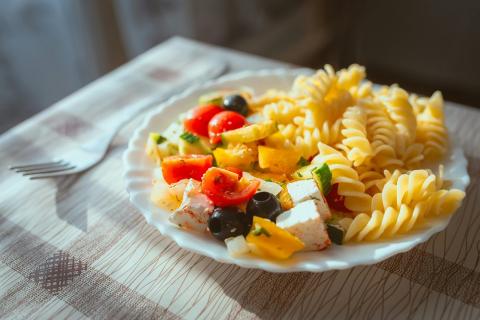
Buy a whole chicken or use leftover chicken or turkey. Try the salad dressing from the greek pasta salad recipe rather than buying ready made.

Tips for Kids

Let them help to chop vegetables and mixing everything together. They can use their favourite colour pepper.

Nutritional Information

Based on a single serving of 371g (% of an adult's reference intake)

Energy

360 kcals ( 18 %)

1,499 kJ ( 18 %)

Fat

2.2 g ( 11 %)

Saturates

50.4 g ( %)

Sugar

8.9 g ( 10 %)

Salt

1.8 g ( 3 %)

Detailed nutritional information

Per 100g Per 371g serving
Energy Kcals 97 360
Energy Kj 407 1,499
Protein 11.8 g 43.8 g
Total Fat g g
Saturated Fat 0.6 g 2.2 g
Carbohydrates 13.6 g 50.4 g
Total Sugars 2.4 g 8.9 g
NSP Fibre 0.8 g 3 g
Sodium 199 mg 738 mg
Salt 0.5 g 1.8 g

Find out about nutritional labelling

Nutrition labels on the front of packaging

  • Most of the big supermarkets and many food manufacturers display nutritional information on the front of pre-packed food.
  • Front of pack nutrition labels provide information on the number of grams of fat, saturated fat, sugars and salt and the amount of energy (in kJ and kcal) in a serving or portion of a recipe.
  • The labels also include information about reference intakes (expressed as a percentage) which are guidelines about the approximate amount of particular nutrients and energy required for a healthy diet.
  • The colour coding tells you at a glance if the food has high (red), medium (amber) or low (green) amounts of fat, saturated fat, sugars and salt.
  • The more greens on the label, the healthier the choice
  • Amber means neither high nor low, so you can eat foods with all or mostly ambers on the label most of the time.
  • Reds on the label means the food is high in that nutrient and these are the foods we should cut down on. Try to eat these foods less often and in small amounts.

Food shopping tips

If you’re trying to decide which product to choose, check to see if there's a nutrition label on the front of the pack. This will help you to quickly assess how your choices stack up. You will often find a mixture of red, amber and green colour coding for the nutrients. So when you're choosing between similar products, try to go for more greens and ambers and fewer reds if you want to make a healthier choice.

Back to top

Ingredients

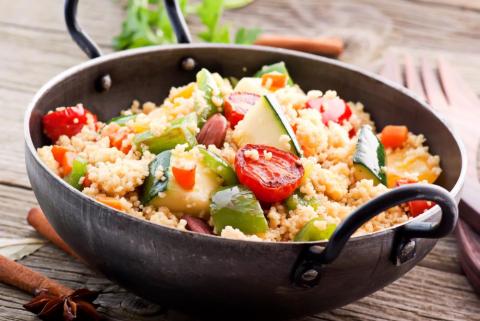
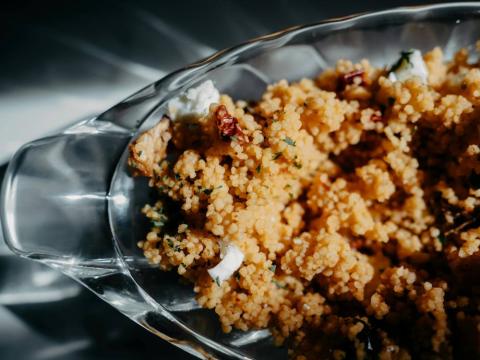
  • 10 Tablespoons (300g) Couscous
  • 1 (7g) Vegetable Stock Cube (use reduced salt whenever possible)
  • Boiling (350ml) Boiling Water
  • 1 Tablespoon (10g) Vegetable Oil
  • 1 Medium (150g) Onion
  • 2 (6g) Garlic Cloves or 1 Teaspoon (5g) Garlic Puree
  • 2 Large (300g) Courgettes
  • 16 (240g) Cherry Tomatoes
  • 1 Tin (240g) Chickpeas in Unsalted Water, Drained
  • Juice of 1 Lemon

This recipe has been added to your Meal Planner.

Allergy Disclaimer

Always check the label of each ingredient for allergy warnings.

Method

  1. Dissolve the stock cube in a heat proof bowl or jug of boiling water.
  2. Add the couscous to the bowl and cover the bowl with a plate or cling film and allow to sit for 5-10 minutes.
  3. Peel and chop the onion and garlic. Wash the courgettes and tomatoes. Chop the tomatoes in half and chop the courgettes into bite-size pieces.
  4. Heat the oil in a saucepan over a medium heat.
  5. Add the onion and garlic and cook for 2 minutes.
  6. Add the courgettes, tomatoes and chickpeas and cook until vegetables are soft whilst stirring every so often.
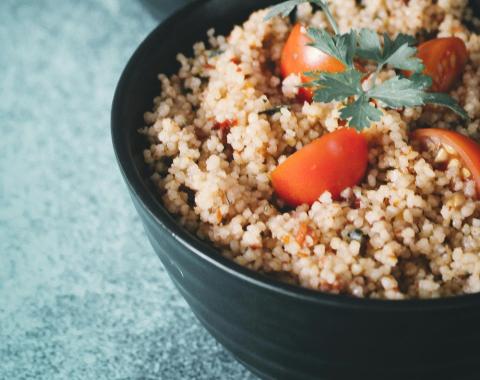
  7. When the couscous has soaked up all of the water, add the vegetables and lemon juice. Mix together and serve.

Cost Saver Tips

This dish is a great use of leftover vegetables. Any raw tomatoes could be used but they may need to be cut into smaller pieces depending on size.

Tips for Kids

Choose your child’s favourite vegetables to add to the couscous.

Nutritional Information

Based on a single serving of 368g (% of an adult's reference intake)

Energy

421 kcals ( 21 %)

1,790 kJ ( 21 %)

Fat

0.7 g ( 5 %)

Saturates

79.7 g ( %)

Sugar

7.8 g ( 9 %)

Salt

1 g ( 17 %)

Detailed nutritional information

Per 100g Per 368g serving
Energy Kcals 114 421
Energy Kj 487 1,790
Protein 4.8 g 17.8 g
Total Fat g g
Saturated Fat 0.2 g 0.7 g
Carbohydrates 21.7 g 79.7 g
Total Sugars 2.1 g 7.8 g
NSP Fibre 2.1 g 7.8 g
Sodium 104 mg 384 mg
Salt 0.3 g 1 g

Find out about nutritional labelling

Nutrition labels on the front of packaging

  • Most of the big supermarkets and many food manufacturers display nutritional information on the front of pre-packed food.
  • Front of pack nutrition labels provide information on the number of grams of fat, saturated fat, sugars and salt and the amount of energy (in kJ and kcal) in a serving or portion of a recipe.
  • The labels also include information about reference intakes (expressed as a percentage) which are guidelines about the approximate amount of particular nutrients and energy required for a healthy diet.
  • The colour coding tells you at a glance if the food has high (red), medium (amber) or low (green) amounts of fat, saturated fat, sugars and salt.
  • The more greens on the label, the healthier the choice
  • Amber means neither high nor low, so you can eat foods with all or mostly ambers on the label most of the time.
  • Reds on the label means the food is high in that nutrient and these are the foods we should cut down on. Try to eat these foods less often and in small amounts.

Food shopping tips

If you’re trying to decide which product to choose, check to see if there's a nutrition label on the front of the pack. This will help you to quickly assess how your choices stack up. You will often find a mixture of red, amber and green colour coding for the nutrients. So when you're choosing between similar products, try to go for more greens and ambers and fewer reds if you want to make a healthier choice.

Back to top

Ingredients

  • 1 Tins (400g) Chick Peas
  • 2 Eggs
  • 3 Tablespoons (45g) Semi-Skimmed Milk
  • 4 Tablespoons (80g) Plain Flour
  • 1 Teaspoons (4g) Baking Powder
  • 2 Teaspoons (20g) Tomato Puree
  • 2 (20g) Spring Onions
  • 2 Tablespoons (20g) Vegetable Oil
  • 3 Large sized (600g) Potatoes
  • 5 Level spoonfuls Teaspoons (75g) Reduced Calorie Mayonnaise
  • 1 Pinch (1g) Ground Black Pepper
  • 4 Medium sized (340g) Tomatoes
  • ½ (180g) Cucumber
  • 8 Leaves (80g) Lettuce

This recipe has been added to your Meal Planner.

Allergy Disclaimer

Always check the label of each ingredient for allergy warnings.

Method

  1. Peel and dice potatoes and cook in boiling water for around 20 minutes until soft.
  2. Drain and rinse chick peas then mash with a fork or a food processor if you have one. Wash the spring onions and finely chop.
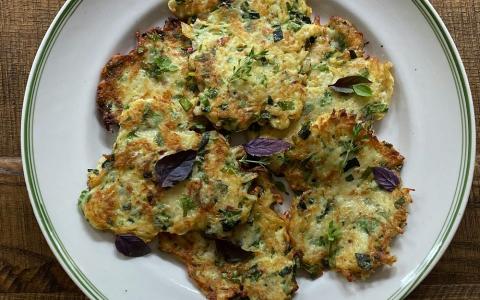
  3. Crack the eggs and add to the chick peas along with milk and mix well, then sift in flour and baking powder. Mix until smooth then add tomato puree and spring onions.
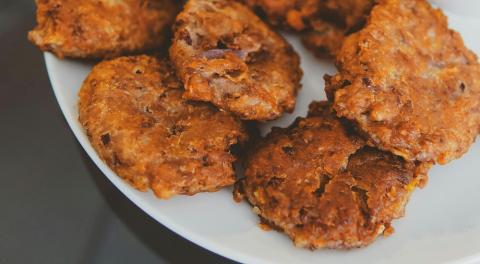
  4. In a frying pan heat the oil and the fritters- take 2 tablespoons of the mixture for each fritter. Once the you see bubbles appear turn the fritters over and cook until golden brown.
  5. Once potatoes have cooked, drain, allow to cool slightly then mix with mayonaisse and black pepper. Wash salad ingredients and chop.
  6. Serve fritters with potato salad and salad.

Time Saver Tips

There's no need to peel potatoes for this dish – quick and easy. You can also prepare the fritter mixture and potatoes in advance and store them in fridge until you're ready to cook them. And if you've got any leftover potatoes, don't forget to use them.

Cost Saver Tips

A great way of using up leftover potatoes.

Tips for Kids

Let them help with mashing chickpeas and chopping vegetables.

Nutritional Information

Based on a single serving of 400g (% of an adult's reference intake)

Energy

412 kcals ( 21 %)

1,732 kJ ( 21 %)

Fat

2.8 g ( 14 %)

Saturates

52.8 g ( %)

Sugar

8 g ( 9 %)

Salt

1.2 g ( 20 %)

Detailed nutritional information

Per 100g Per 400g serving
Energy Kcals 103 412
Energy Kj 433 1,732
Protein 3.4 g 13.6 g
Total Fat g g
Saturated Fat 0.7 g 2.8 g
Carbohydrates 13.2 g 52.8 g
Total Sugars 2 g 8 g
NSP Fibre 1.4 g 5.6 g
Sodium 130 mg 520 mg
Salt 0.3 g 1.2 g

Find out about nutritional labelling

Nutrition labels on the front of packaging

  • Most of the big supermarkets and many food manufacturers display nutritional information on the front of pre-packed food.
  • Front of pack nutrition labels provide information on the number of grams of fat, saturated fat, sugars and salt and the amount of energy (in kJ and kcal) in a serving or portion of a recipe.
  • The labels also include information about reference intakes (expressed as a percentage) which are guidelines about the approximate amount of particular nutrients and energy required for a healthy diet.
  • The colour coding tells you at a glance if the food has high (red), medium (amber) or low (green) amounts of fat, saturated fat, sugars and salt.
  • The more greens on the label, the healthier the choice
  • Amber means neither high nor low, so you can eat foods with all or mostly ambers on the label most of the time.
  • Reds on the label means the food is high in that nutrient and these are the foods we should cut down on. Try to eat these foods less often and in small amounts.

Food shopping tips

If you’re trying to decide which product to choose, check to see if there's a nutrition label on the front of the pack. This will help you to quickly assess how your choices stack up. You will often find a mixture of red, amber and green colour coding for the nutrients. So when you're choosing between similar products, try to go for more greens and ambers and fewer reds if you want to make a healthier choice.

Back to top
Subscribe to Eat Better Feel Better