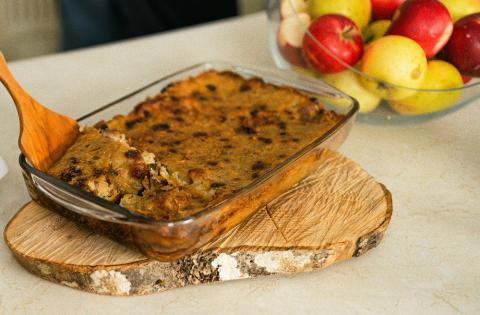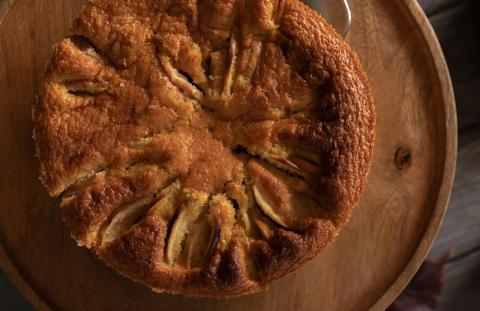
This article was created with

eat-better-feel-better-logo-2.png

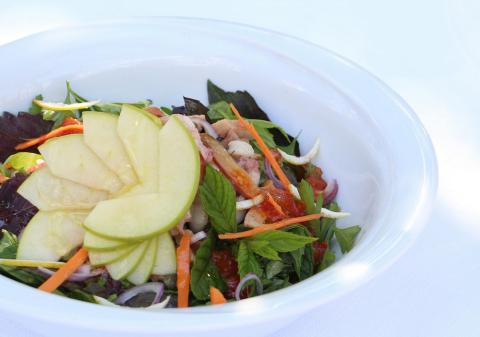
Ingredients

  • 4 Rashers (100g) Back Bacon
  • 4 (450g) Apples
  • 16 (640g) New Potatoes
  • 2 Medium (300g) Red Onions
  • 2 Tablespoons (20g) Vegetable Oil
  • 1 Tablespoons (1g) Mixed Herbs
  • 4 Tablespoons (40g) Olive Oil
  • 2 Tablespoons (30g) Lemon Juice
  • 1 Teaspoons (8g) Honey
  • ½ Teaspoons (4g) Mustard
  • 1 Optional Pinch (1g) Cinnamon

This recipe has been added to your Meal Planner.

Allergy Disclaimer

Always check the label of each ingredient for allergy warnings.

Method

  1. Wash the new potatoes and add them to a pan of boiling water. Let them simmer until tender.
  2. Trim the fat off the bacon and grill it until it is crispy.
  3. Peel and chop the onions and fry them in the oil until they're soft.
  4. Wash and chop the apples and mix them with the herbs in a bowl.
  5. Make the dressing by mixing the olive oil, lemon juice,honey,mustard and cinnamon together.
  6. When the bacon and potatoes are cooked, chop them into bite size pieces.
  7. Add the bacon, potatoes and onions to the bowl with the apples and herbs, pour the dressing on top and serve.

Tips for Kids

Let the kids help mix the dressing ingredients together. You could call it their magic potion!

Nutritional Information

Based on a single serving of 378g (% of an adult's reference intake)

Energy

389 kcals ( 19 %)

1,624 kJ ( 19 %)

Fat

3.3 g ( 17 %)

Saturates

40.8 g ( %)

Sugar

18.3 g ( 20 %)

Salt

1.3 g ( 22 %)

Detailed nutritional information

Per 100g Per 378g serving
Energy Kcals 103 389
Energy Kj 430 1,624
Protein 2.7 g 10.2 g
Total Fat g g
Saturated Fat 0.9 g 3.3 g
Carbohydrates 10.8 g 40.8 g
Total Sugars 4.9 g 18.3 g
NSP Fibre 1.4 g 5.3 g
Sodium 141 mg 534 mg
Salt 0.4 g 1.3 g

Find out about nutritional labelling

Nutrition labels on the front of packaging

  • Most of the big supermarkets and many food manufacturers display nutritional information on the front of pre-packed food.
  • Front of pack nutrition labels provide information on the number of grams of fat, saturated fat, sugars and salt and the amount of energy (in kJ and kcal) in a serving or portion of a recipe.
  • The labels also include information about reference intakes (expressed as a percentage) which are guidelines about the approximate amount of particular nutrients and energy required for a healthy diet.
  • The colour coding tells you at a glance if the food has high (red), medium (amber) or low (green) amounts of fat, saturated fat, sugars and salt.
  • The more greens on the label, the healthier the choice
  • Amber means neither high nor low, so you can eat foods with all or mostly ambers on the label most of the time.
  • Reds on the label means the food is high in that nutrient and these are the foods we should cut down on. Try to eat these foods less often and in small amounts.

Food shopping tips

If you’re trying to decide which product to choose, check to see if there's a nutrition label on the front of the pack. This will help you to quickly assess how your choices stack up. You will often find a mixture of red, amber and green colour coding for the nutrients. So when you're choosing between similar products, try to go for more greens and ambers and fewer reds if you want to make a healthier choice.
Back to top

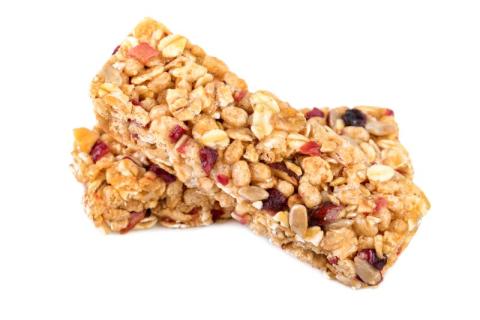
Ingredients

  • 1 Cup (112g) Porridge Oats
  • 5 Tablespoons (70g) Low Fat Spread
  • 1 Tablespoon (25g) Golden Syrup
  • 1 Tablespoon (20g) Sugar
  • 1 Heaped Spoonful Tablespoon (30g) Plain Flour
  • 1 (20g) Apple

This recipe has been added to your Meal Planner.

Allergy Disclaimer

Always check the label of each ingredient for allergy warnings.

Method

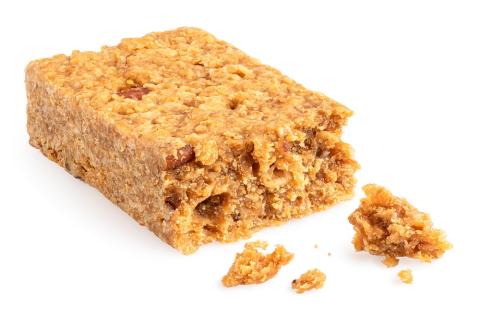
  1. Turn oven on to 180°C / 160°C fan oven / 350°F / gas mark 4. Peel, then finely chop or grate apple.
  2. Melt low fat spread in a pan over a low heat.
  3. Add sugar and syrup to the pan and continue to heat gently until sugar dissolves.
  4. Take pan off heat and mix in the apple, flour and porridge oats.
  5. Place mixture in a greased baking tray and spread the mixture so it is approximately 2 cm thick, smooth with the back of a spoon.
  6. Bake in the oven for 15-20 minutes until golden around the edges. Remove from the oven and leave to cool, then cut into portions while still warm.

Tips for Kids

Kids will love helping make this. You could even use cutters to make it into fun shapes. Why not add a handful of sultanas or other dried fruit to your recipe? You could even try using treacle or honey instead of syrup, or add a pinch of cinnamon – easy ways to see which different flavours your wee one finds tasty. As this recipe contains added sugar it’s best kept to mealtimes.

Nutritional Information

Based on a single serving of 81g (% of an adult's reference intake)

Energy

225 kcals ( 11 %)

987 kJ ( 11 %)

Fat

2 g ( 10 %)

Saturates

33.7 g ( %)

Sugar

13.9 g ( 15 %)

Salt

0.3 g ( 5 %)

Detailed nutritional information

Per 100g Per 81g serving
Energy Kcals 278 225
Energy Kj 1,168 987
Protein 5.3 g 4.3 g
Total Fat g g
Saturated Fat 2.4 g 2 g
Carbohydrates 41.6 g 33.7 g
Total Sugars 17.1 g 13.9 g
NSP Fibre 3.4 g 2.7 g
Sodium 163 mg 132 mg
Salt 0.4 g 0.3 g

Find out about nutritional labelling

Nutrition labels on the front of packaging

  • Most of the big supermarkets and many food manufacturers display nutritional information on the front of pre-packed food.
  • Front of pack nutrition labels provide information on the number of grams of fat, saturated fat, sugars and salt and the amount of energy (in kJ and kcal) in a serving or portion of a recipe.
  • The labels also include information about reference intakes (expressed as a percentage) which are guidelines about the approximate amount of particular nutrients and energy required for a healthy diet.
  • The colour coding tells you at a glance if the food has high (red), medium (amber) or low (green) amounts of fat, saturated fat, sugars and salt.
  • The more greens on the label, the healthier the choice
  • Amber means neither high nor low, so you can eat foods with all or mostly ambers on the label most of the time.
  • Reds on the label means the food is high in that nutrient and these are the foods we should cut down on. Try to eat these foods less often and in small amounts.

Food shopping tips

If you’re trying to decide which product to choose, check to see if there's a nutrition label on the front of the pack. This will help you to quickly assess how your choices stack up. You will often find a mixture of red, amber and green colour coding for the nutrients. So when you're choosing between similar products, try to go for more greens and ambers and fewer reds if you want to make a healthier choice.

Back to top

Ingredients

  • 5 Teaspoons (25g) Low Fat Spread
  • 4 Slices (144g) Wholemeal Bread
  • 2 (224g) Apples
  • 2 Tablespoons (60g) Sultanas
  • 2 (100g) Eggs
  • ¾ Pint (450ml) Semi-Skimmed Milk
  • 1 Teaspoon (3g) Ground Cinnamon
  • 3 Teaspoons (15g) Sugar

This recipe has been added to your Meal Planner.

Allergy Disclaimer

Always check the label of each ingredient for allergy warnings.

Method

  1. Preheat the oven to 180°C / 160°C fan oven / 360°F / gas mark 4.
  2. Grease a deep baking dish (approximately 20cm x 20cm) with 1/2 teaspoon of low fat spread. Spread the bread with the rest of the spread, then cut each slice into four triangles.
  3. Peel the apples and cut into thin slices (no more than 1/2 cm thick).
  4. Fill the baking dish with layers of bread, apple and sultanas. Sprinkle the cinnamon and sugar inbetween and on top of the layers.
  5. Crack the eggs in a bowl and beat togther with a fork or whisk, then stir in the milk. Pour into the baking dish, leave to soak for around 20 minutes.
  6. Bake the pudding for around 35- 40 minutes until set and golden brown.

Time Saver Tips

Can be prepared in advance and baked when needed. Don't peel the apples.

Cost Saver Tips

Look for offers on fruit.

Tips for Kids

They can help with building the layers and whisking and mixing.

Nutritional Information

Based on a single serving of 225g (% of an adult's reference intake)

Energy

266 kcals ( 13 %)

1,115 kJ ( 13 %)

Fat

2.7 g ( 14 %)

Saturates

40.3 g ( %)

Sugar

26.6 g ( 30 %)

Salt

0.7 g ( 12 %)

Detailed nutritional information

Per 100g Per 225g serving
Energy Kcals 118 266
Energy Kj 496 1,115
Protein 4.9 g 11 g
Total Fat g g
Saturated Fat 1.2 g 2.7 g
Carbohydrates 17.9 g 40.3 g
Total Sugars 11.8 g 26.6 g
NSP Fibre 1.3 g 2.9 g
Sodium 132 mg 297 mg
Salt 0.3 g 0.7 g

Find out about nutritional labelling

Nutrition labels on the front of packaging

  • Most of the big supermarkets and many food manufacturers display nutritional information on the front of pre-packed food.
  • Front of pack nutrition labels provide information on the number of grams of fat, saturated fat, sugars and salt and the amount of energy (in kJ and kcal) in a serving or portion of a recipe.
  • The labels also include information about reference intakes (expressed as a percentage) which are guidelines about the approximate amount of particular nutrients and energy required for a healthy diet.
  • The colour coding tells you at a glance if the food has high (red), medium (amber) or low (green) amounts of fat, saturated fat, sugars and salt.
  • The more greens on the label, the healthier the choice
  • Amber means neither high nor low, so you can eat foods with all or mostly ambers on the label most of the time.
  • Reds on the label means the food is high in that nutrient and these are the foods we should cut down on. Try to eat these foods less often and in small amounts.

Food shopping tips

If you’re trying to decide which product to choose, check to see if there's a nutrition label on the front of the pack. This will help you to quickly assess how your choices stack up. You will often find a mixture of red, amber and green colour coding for the nutrients. So when you're choosing between similar products, try to go for more greens and ambers and fewer reds if you want to make a healthier choice.

Back to top

Ingredients

  • 7 Level Tablespoons (140g) Self-Raising Flour
  • 3 Level Tablespoons (60g) Wholemeal Flour
  • 9 Tablespoons (140g) Low Fat Spread
  • 5 Tablespoons (100g) Brown (Demerara) Sugar
  • 2 Teaspoons (6g) Ground Mixed Spice
  • 2 Eggs
  • 3 Average (336g) Apples
  • 4 Tablespoons (120g) Raisins
  • 5 Dessert spoons (50ml) Semi-Skimmed Milk

This recipe has been added to your Meal Planner.

Allergy Disclaimer

Always check the label of each ingredient for allergy warnings.

Method

  1. Preheat the oven to 160°C / 140°C fan oven / 300°F / gas mark 4.
  2. Mix spread and sugar together in a large bowl  then crack the eggs into the bowl and in with flour and mixed spice.
  3. Peel and core the apples then cut into small chunks.
  4. Gently stir in the apple and raisins and gradually add the milk until the mixture drops off the spoon without needing to shake.
  5. Line a 20cm round or square baking tin with greaseproof (baking) paper then pour mixture into the tin and smooth with the back of the spoon.
  6. Bake in the oven for 1- 1½ hours until the cake is well risen, golden brown and firm to touch.
  7. Remove from the tin by slipping a knife around the edges to loosen the cake and allow to cool before serving.

Time Saver Tips

Can be made in advance: store i an airtight container once cooled.

Tips for Kids

They will enjoy weighing and mixing the ingredients together.

Nutritional Information

Based on a single serving of 80g (% of an adult's reference intake)

Energy

180 kcals ( 9 %)

760 kJ ( 9 %)

Fat

1.3 g ( 7 %)

Saturates

31.6 g ( %)

Sugar

19 g ( 21 %)

Salt

0.3 g ( 5 %)

Detailed nutritional information

Per 100g Per 80g serving
Energy Kcals 225 180
Energy Kj 950 760
Protein 4 g 3.2 g
Total Fat g g
Saturated Fat 1.6 g 1.3 g
Carbohydrates 39.5 g 31.6 g
Total Sugars 23.7 g 19 g
NSP Fibre 2 g 1.6 g
Sodium 147 mg 118 mg
Salt 0.4 g 0.3 g

Find out about nutritional labelling

Nutrition labels on the front of packaging

  • Most of the big supermarkets and many food manufacturers display nutritional information on the front of pre-packed food.
  • Front of pack nutrition labels provide information on the number of grams of fat, saturated fat, sugars and salt and the amount of energy (in kJ and kcal) in a serving or portion of a recipe.
  • The labels also include information about reference intakes (expressed as a percentage) which are guidelines about the approximate amount of particular nutrients and energy required for a healthy diet.
  • The colour coding tells you at a glance if the food has high (red), medium (amber) or low (green) amounts of fat, saturated fat, sugars and salt.
  • The more greens on the label, the healthier the choice
  • Amber means neither high nor low, so you can eat foods with all or mostly ambers on the label most of the time.
  • Reds on the label means the food is high in that nutrient and these are the foods we should cut down on. Try to eat these foods less often and in small amounts.

Food shopping tips

If you’re trying to decide which product to choose, check to see if there's a nutrition label on the front of the pack. This will help you to quickly assess how your choices stack up. You will often find a mixture of red, amber and green colour coding for the nutrients. So when you're choosing between similar products, try to go for more greens and ambers and fewer reds if you want to make a healthier choice.

Back to top
Subscribe to Eat Better Feel Better