Ingredients

  • 1 Teaspoon (3g) Vegetable Oil
  • 38 (Thawed) (150g) Frozen Pitted Cherries
  • 3 (Very Ripe) (300g) Bananas
  • ½ Teaspoon (3ml) Vanilla Extract
  • 5 (Medium Sized) (250g) Eggs

This recipe has been added to your Meal Planner.

Allergy Disclaimer

Always check the label of each ingredient for allergy warnings.

Method

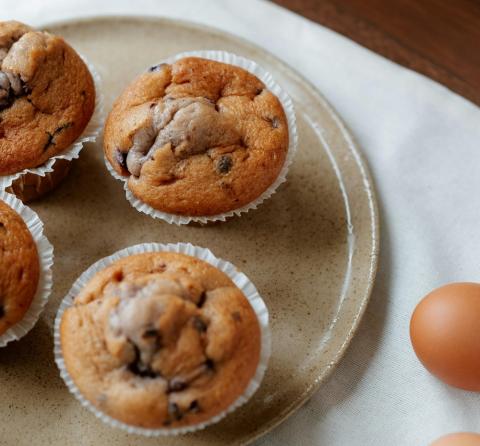
  1. Preheat the oven to190°C / 170°C fan oven / 375°F / gas mark 5.  Pour oil into one section of the muffin tray, then using fingers or kitchen roll coat each cup.
  2. Cut the cherries in half then place on a double layer of kitchen roll on a plate to dry while preparing the other ingredients.
  3. Peel the bananas and place in a large bowl. Mash thoroughly using a fork. Add the vanilla extract and mix in.
  4. Crack the eggs into the bowl and whisk togerther until well beaten.
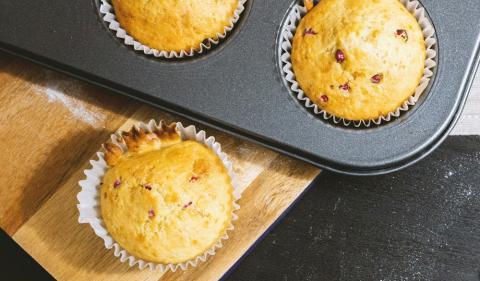
  5. Divide the cherries evenly amoung the muffin cups, then pour in the banana mix until each cup 3/4 full.
  6. Bake in the oven until set and a dome has formed, approximately 12-14 minutes.
  7. Remove from oven and run a knife around the edge of each muffin and remove them from the tin. Allow to cool slightly before serving.

Time Saver Tips

Defrost the cherries overnight.

Cost Saver Tips

Great use of overripe bananas.

Tips for Kids

They'll enjoy the mashing and mixing.

Nutritional Information

Based on a single serving of 53g (% of an adult's reference intake)

Energy

53 kcals ( 3 %)

238 kJ ( 3 %)

Fat

0.5 g ( 3 %)

Saturates

6.6 g ( %)

Sugar

6 g ( 7 %)

Salt

0.1 g ( 2 %)

Detailed nutritional information

Per 100g Per 53g serving
Energy Kcals 107 53
Energy Kj 449 238
Protein 449 g 238 g
Total Fat g g
Saturated Fat 1 g 0.5 g
Carbohydrates 12.4 g 6.6 g
Total Sugars 11.3 g 6 g
NSP Fibre 0.6 g 0.3 g
Sodium 61 mg 32 mg
Salt 0.2 g 0.1 g

Find out about nutritional labelling

Nutrition labels on the front of packaging

  • Most of the big supermarkets and many food manufacturers display nutritional information on the front of pre-packed food.
  • Front of pack nutrition labels provide information on the number of grams of fat, saturated fat, sugars and salt and the amount of energy (in kJ and kcal) in a serving or portion of a recipe.
  • The labels also include information about reference intakes (expressed as a percentage) which are guidelines about the approximate amount of particular nutrients and energy required for a healthy diet.
  • The colour coding tells you at a glance if the food has high (red), medium (amber) or low (green) amounts of fat, saturated fat, sugars and salt.
  • The more greens on the label, the healthier the choice
  • Amber means neither high nor low, so you can eat foods with all or mostly ambers on the label most of the time.
  • Reds on the label means the food is high in that nutrient and these are the foods we should cut down on. Try to eat these foods less often and in small amounts.

Food shopping tips

If you’re trying to decide which product to choose, check to see if there's a nutrition label on the front of the pack. This will help you to quickly assess how your choices stack up. You will often find a mixture of red, amber and green colour coding for the nutrients. So when you're choosing between similar products, try to go for more greens and ambers and fewer reds if you want to make a healthier choice.
Back to top

Ingredients

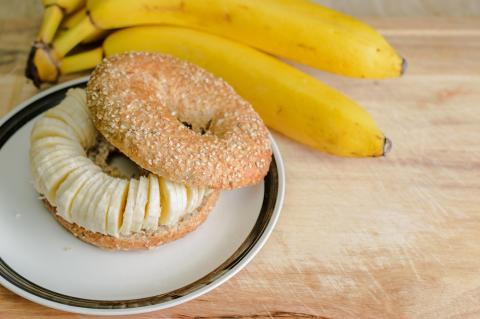
  • 4 (340g) Wholemeal Bagels
  • 2 Tablespoons (40g) Low Fat Soft Cheese
  • 5 (40g) Ready To Eat Apricots
  • 3 (240g) Bananas

This recipe has been added to your Meal Planner.

Allergy Disclaimer

Always check the label of each ingredient for allergy warnings.

Method

  1. Preheat the grill.
  2. Cut bagels in half and lightly toast the cut sides.
  3. Finely chop the apricots and mix together with soft cheese. Spread over the bottom half of each bagel
  4. Slice the bananas and place on top of the soft cheese and apricots.
  5. Place top half of bagels onto the banana to make a sandwich and serve.

Cost Saver Tips

A toaster could be used instead of grill.

Tips for Kids

They may prefer to eat the apricots separately. Low fat spread could be used instead of soft cheese. As this recipe contains added sugar it’s best kept to mealtimes.

Nutritional Information

Based on a single serving of 165g (% of an adult's reference intake)

Energy

297 kcals ( 15 %)

1,247 kJ ( 15 %)

Fat

1 g ( 5 %)

Saturates

52.6 g ( %)

Sugar

20.6 g ( 23 %)

Salt

1 g ( 17 %)

Detailed nutritional information

Per 100g Per 165g serving
Energy Kcals 180 297
Energy Kj 756 1,247
Protein 7.7 g 12.7 g
Total Fat g g
Saturated Fat 0.6 g 1 g
Carbohydrates 31.9 g 52.6 g
Total Sugars 12.5 g 20.6 g
NSP Fibre 4.4 g 7.3 g
Sodium 234 mg 386 mg
Salt 0.6 g 1 g

Find out about nutritional labelling

Nutrition labels on the front of packaging

  • Most of the big supermarkets and many food manufacturers display nutritional information on the front of pre-packed food.
  • Front of pack nutrition labels provide information on the number of grams of fat, saturated fat, sugars and salt and the amount of energy (in kJ and kcal) in a serving or portion of a recipe.
  • The labels also include information about reference intakes (expressed as a percentage) which are guidelines about the approximate amount of particular nutrients and energy required for a healthy diet.
  • The colour coding tells you at a glance if the food has high (red), medium (amber) or low (green) amounts of fat, saturated fat, sugars and salt.
  • The more greens on the label, the healthier the choice
  • Amber means neither high nor low, so you can eat foods with all or mostly ambers on the label most of the time.
  • Reds on the label means the food is high in that nutrient and these are the foods we should cut down on. Try to eat these foods less often and in small amounts.

Food shopping tips

If you’re trying to decide which product to choose, check to see if there's a nutrition label on the front of the pack. This will help you to quickly assess how your choices stack up. You will often find a mixture of red, amber and green colour coding for the nutrients. So when you're choosing between similar products, try to go for more greens and ambers and fewer reds if you want to make a healthier choice.

Back to top

Ingredients

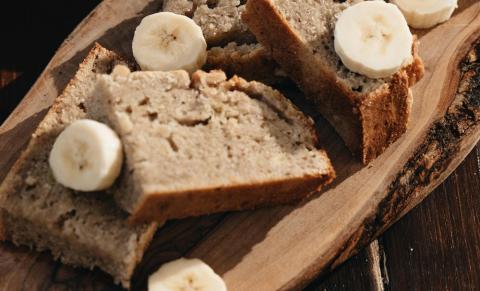
  • 3 Medium Sized (300g) Bananas
  • (30g) Low Fat Spread
  • (30g) Sugar
  • 1 Egg
  • (120g) Plain Flour
  • (40g) Wholemeal Flour
  • (8g) Baking Powder
  • (90g) Sultanas

This recipe has been added to your Meal Planner.

Allergy Disclaimer

Always check the label of each ingredient for allergy warnings.

Method

  1. Turn oven on to 190°C / 170°C fan oven / 375°F / gas mark 5.
  2. Using a spoon, mix the low fat spread and sugar together in a large bowl for about 2 minutes.
  3. Add the egg and mix it all together. Gradually add sifted flour and baking powder whilst continuing to mix until a smooth consistency is reached.
  4. Mash bananas and stir into mixture along with the sultanas.
  5. Transfer mixture to a loaf tin lined with greaseproof (baking) paper and bake in oven for approximately 35-40 minutes until risen and golden brown.
  6. Once cooled slice and serve.

Time Saver Tips

To make life easier, why not make this in advance? You can store it in an airtight container once cooled, or even make in bulk to freeze.

Cost Saver Tips

Next time you have some overripe bananas left over, this is a great way to put them to good use.

Tips for Kids

Little ones love helping in the kitchen – particularly mixing and mashing! As this recipe contains added sugar it’s best kept to mealtimes.

Nutritional Information

Based on a single serving of 85g (% of an adult's reference intake)

Energy

203 kcals ( 10 %)

853 kJ ( 10 %)

Fat

0.7 g ( 4 %)

Saturates

42.9 g ( %)

Sugar

25.8 g ( 29 %)

Salt

0.4 g ( 7 %)

Detailed nutritional information

Per 100g Per 85g serving
Energy Kcals 239 203
Energy Kj 1,004 853
Protein 4.9 g 4.2 g
Total Fat g g
Saturated Fat 0.8 g 0.7 g
Carbohydrates 50.5 g 42.9 g
Total Sugars 30.4 g 25.8 g
NSP Fibre 2.1 g 1.7 g
Sodium 197 mg 167 mg
Salt 0.5 g 0.4 g

Find out about nutritional labelling

Nutrition labels on the front of packaging

  • Most of the big supermarkets and many food manufacturers display nutritional information on the front of pre-packed food.
  • Front of pack nutrition labels provide information on the number of grams of fat, saturated fat, sugars and salt and the amount of energy (in kJ and kcal) in a serving or portion of a recipe.
  • The labels also include information about reference intakes (expressed as a percentage) which are guidelines about the approximate amount of particular nutrients and energy required for a healthy diet.
  • The colour coding tells you at a glance if the food has high (red), medium (amber) or low (green) amounts of fat, saturated fat, sugars and salt.
  • The more greens on the label, the healthier the choice
  • Amber means neither high nor low, so you can eat foods with all or mostly ambers on the label most of the time.
  • Reds on the label means the food is high in that nutrient and these are the foods we should cut down on. Try to eat these foods less often and in small amounts.

Food shopping tips

If you’re trying to decide which product to choose, check to see if there's a nutrition label on the front of the pack. This will help you to quickly assess how your choices stack up. You will often find a mixture of red, amber and green colour coding for the nutrients. So when you're choosing between similar products, try to go for more greens and ambers and fewer reds if you want to make a healthier choice.

Back to top

Ingredients

  • 4 Small bunch (320g) Bananas
  • 2 Tablespoons (80g) Peanut Butter
  • 2 Tablespoons (16g) Bran Flakes
  • 2 Tablespoons (12g) Corn Flakes
  • 1 Tablespoon (30g) Dried Mixed Fruit
  • 1 Tablespoon (30g) Chopped Nuts

This recipe has been added to your Meal Planner.

Allergy Disclaimer

Always check the label of each ingredient for allergy warnings.

Method

  1. Using the back of a spoon, crush the corn flakes and branflakes on separate plates. Place raisins and nuts on separate plates.
  2. Peel the bananas and slice each one into three pieces. Using a knife, spread peanut butter on one end of each piece of banana.
  3. Dip each piece of banana in the crushed cereal, fruit or nuts then serve.


Cost Saver Tips

Use any unsweetened cereal and dried fruit you have already.

Tips for Kids

They will enjoy dipping the bananas in their favourite toppings. As this recipe contains added sugar it’s best kept to mealtimes.

Nutritional Information

Based on a single serving of 122g (% of an adult's reference intake)

Energy

288 kcals ( 14 %)

1,209 kJ ( 14 %)

Fat

3.3 g ( 16 %)

Saturates

32.5 g ( %)

Sugar

24.8 g ( 28 %)

Salt

0.4 g ( 6 %)

Detailed nutritional information

Per 100g Per 122g serving
Energy Kcals 236 288
Energy Kj 991 1,209
Protein 6.6 g 8.1 g
Total Fat g g
Saturated Fat 2.7 g 3.3 g
Carbohydrates 26.6 g 32.5 g
Total Sugars 20.3 g 24.8 g
NSP Fibre 2.6 g 3.2 g
Sodium 131 mg 160 mg
Salt 0.3 g 0.4 g

Find out about nutritional labelling

Nutrition labels on the front of packaging

  • Most of the big supermarkets and many food manufacturers display nutritional information on the front of pre-packed food.
  • Front of pack nutrition labels provide information on the number of grams of fat, saturated fat, sugars and salt and the amount of energy (in kJ and kcal) in a serving or portion of a recipe.
  • The labels also include information about reference intakes (expressed as a percentage) which are guidelines about the approximate amount of particular nutrients and energy required for a healthy diet.
  • The colour coding tells you at a glance if the food has high (red), medium (amber) or low (green) amounts of fat, saturated fat, sugars and salt.
  • The more greens on the label, the healthier the choice
  • Amber means neither high nor low, so you can eat foods with all or mostly ambers on the label most of the time.
  • Reds on the label means the food is high in that nutrient and these are the foods we should cut down on. Try to eat these foods less often and in small amounts.

Food shopping tips

If you’re trying to decide which product to choose, check to see if there's a nutrition label on the front of the pack. This will help you to quickly assess how your choices stack up. You will often find a mixture of red, amber and green colour coding for the nutrients. So when you're choosing between similar products, try to go for more greens and ambers and fewer reds if you want to make a healthier choice.

Back to top

Ingredients

  • 1 (100g) Banana
  • 2 Medium Eggs
  • 2 Heaped tablespoons (60g) Plain Flour
  • (1g) Cinnamon

This recipe has been added to your Meal Planner.

Allergy Disclaimer

Always check the label of each ingredient for allergy warnings.

Method

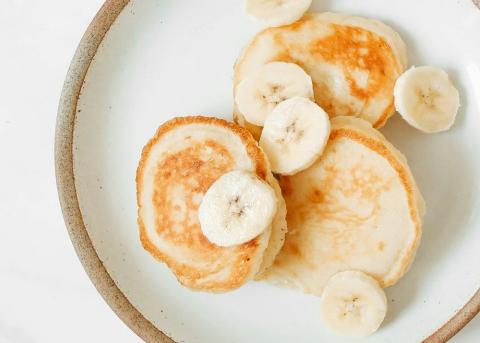
  1. Peel the banana and place in a bowl, then mash with a fork.
  2. Crack the eggs into the bowl and mix well. If you have one, use an electric whisk or blender at this stage.
  3. Once the mixture is a smooth consistency, gradually add the flour (use a sieve if you have one).
  4. When flour is mixed in fully, heat a non-stick frying pan on a medium heat.
  5. Pour 1/4 of the mixture into the pan making sure the pancake isn't too thick but also doesn't fill the whole pan. When golden brown, flip with a spatula or knife and cook on the other side.
  6. Repeat for each pancake. Depending on the size of your frying pan you may be able to cook more than one at a time. When removed from the pan sprinkle with cinnamon.
  7. Pancakes can be enjoyed hot or cold.

Time Saver Tips

Prepare in advance and store in an airtight container.

Cost Saver Tips

These pancakes are a good way to use up any overripe bananas.

Tips for Kids

They'll enjoy mashing, mixing and flipping! Try making the pancakes with wholemeal flour to up the fibre content. And serve them with the kids' favourite fruit to boost their five a day.

Nutritional Information

Based on a single serving of 61g (% of an adult's reference intake)

Energy

109 kcals ( 5 %)

460 kJ ( 5 %)

Fat

0.7 g ( 4 %)

Saturates

17.8 g ( %)

Sugar

5.3 g ( 6 %)

Salt

0.1 g ( 2 %)

Detailed nutritional information

Per 100g Per 61g serving
Energy Kcals 178 109
Energy Kj 754 460
Protein 7.9 g 4.8 g
Total Fat g g
Saturated Fat 1.2 g 0.7 g
Carbohydrates 29.2 g 17.8 g
Total Sugars 8.7 g 5.3 g
NSP Fibre 1.7 g 1 g
Sodium 64 mg 49 mg
Salt 0.2 g 0.1 g

Find out about nutritional labelling

Nutrition labels on the front of packaging

  • Most of the big supermarkets and many food manufacturers display nutritional information on the front of pre-packed food.
  • Front of pack nutrition labels provide information on the number of grams of fat, saturated fat, sugars and salt and the amount of energy (in kJ and kcal) in a serving or portion of a recipe.
  • The labels also include information about reference intakes (expressed as a percentage) which are guidelines about the approximate amount of particular nutrients and energy required for a healthy diet.
  • The colour coding tells you at a glance if the food has high (red), medium (amber) or low (green) amounts of fat, saturated fat, sugars and salt.
  • The more greens on the label, the healthier the choice
  • Amber means neither high nor low, so you can eat foods with all or mostly ambers on the label most of the time.
  • Reds on the label means the food is high in that nutrient and these are the foods we should cut down on. Try to eat these foods less often and in small amounts.

Food shopping tips

If you’re trying to decide which product to choose, check to see if there's a nutrition label on the front of the pack. This will help you to quickly assess how your choices stack up. You will often find a mixture of red, amber and green colour coding for the nutrients. So when you're choosing between similar products, try to go for more greens and ambers and fewer reds if you want to make a healthier choice.

Back to top

Ingredients

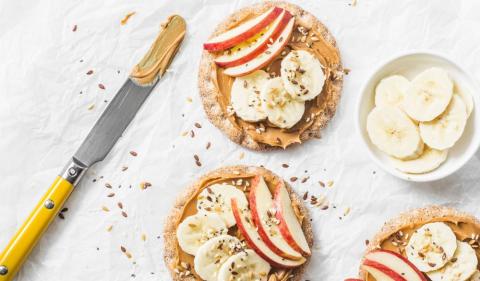
  • 4 (52g) Plain Oatcakes
  • 4 (32g) Water Biscuits
  • 5 Heaped teaspoons (80g) Peanut Butter
  • 1 (100g) Banana
  • 1 (112g) Apple

This recipe has been added to your Meal Planner.

Allergy Disclaimer

Always check the label of each ingredient for allergy warnings.

Method

  1. Peel and slice the banana. Wash and slice the apple.
  2. Divide the peanut butter between the oatcakes and water biscuits and spread.
  3. Place the banana and apple slices onto each oatcake and water biscuit.

Time Saver Tips

Top with other fruit that you have in the house.

Tips for Kids

This is a quick snack that they can help prepare. Use their favourite fruit as a topping.

Nutritional Information

Based on a single serving of 91g (% of an adult's reference intake)

Energy

242 kcals ( 12 %)

1,016 kJ ( 12 %)

Fat

3.2 g ( 16 %)

Saturates

24.4 g ( 10 %)

Sugar

9.4 g ( 10 %)

Salt

0.5 g ( 8 %)

Detailed nutritional information

Per 100g Per 91g serving
Energy Kcals 266 242
Energy Kj 1,117 1,016
Protein 7.6 g 6.9 g
Total Fat g g
Saturated Fat 3.5 g 3.2 g
Carbohydrates 26.8 g 24.4 g
Total Sugars 10.3 g 9.4 g
NSP Fibre 3.2 g 2.9 g
Sodium 225 mg 205 mg
Salt 0.6 g 0.5 g

Find out about nutritional labelling

Nutrition labels on the front of packaging

  • Most of the big supermarkets and many food manufacturers display nutritional information on the front of pre-packed food.
  • Front of pack nutrition labels provide information on the number of grams of fat, saturated fat, sugars and salt and the amount of energy (in kJ and kcal) in a serving or portion of a recipe.
  • The labels also include information about reference intakes (expressed as a percentage) which are guidelines about the approximate amount of particular nutrients and energy required for a healthy diet.
  • The colour coding tells you at a glance if the food has high (red), medium (amber) or low (green) amounts of fat, saturated fat, sugars and salt.
  • The more greens on the label, the healthier the choice
  • Amber means neither high nor low, so you can eat foods with all or mostly ambers on the label most of the time.
  • Reds on the label means the food is high in that nutrient and these are the foods we should cut down on. Try to eat these foods less often and in small amounts.

Food shopping tips

If you’re trying to decide which product to choose, check to see if there's a nutrition label on the front of the pack. This will help you to quickly assess how your choices stack up. You will often find a mixture of red, amber and green colour coding for the nutrients. So when you're choosing between similar products, try to go for more greens and ambers and fewer reds if you want to make a healthier choice.

Back to top

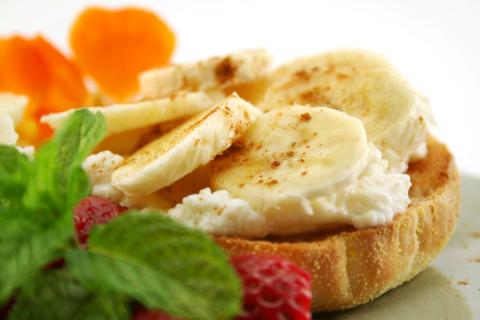
Ingredients

  • 4 (288g) Toasting Muffins
  • 4 Medium Sized (400g) Bananas

This recipe has been added to your Meal Planner.

Allergy Disclaimer

Always check the label of each ingredient for allergy warnings.

Method

  1. Slice the muffins in half and toast.
  2. Slice or mash the bananas and place on top of each half of muffin then serve.

Tips for Kids

Kids will love mashing bananas.

Nutritional Information

Based on a single serving of 168g (% of an adult's reference intake)

Energy

272 kcals ( 14 %)

1,142 kJ ( 14 %)

Fat

0.4 g ( 2 %)

Saturates

57.9 g ( %)

Sugar

23.5 g ( 26 %)

Salt

0.8 g ( 14 %)

Detailed nutritional information

Per 100g Per 168g serving
Energy Kcals 168 272
Energy Kj 680 1,142
Protein 5.3 g 8.9 g
Total Fat g g
Saturated Fat 0.2 g 0.4 g
Carbohydrates 34.5 g 57.9 g
Total Sugars 14 g 23.5 g
NSP Fibre 1.5 g 2.6 g
Sodium 200 mg 336 mg
Salt 0.5 g 0.8 g

Find out about nutritional labelling

Nutrition labels on the front of packaging

  • Most of the big supermarkets and many food manufacturers display nutritional information on the front of pre-packed food.
  • Front of pack nutrition labels provide information on the number of grams of fat, saturated fat, sugars and salt and the amount of energy (in kJ and kcal) in a serving or portion of a recipe.
  • The labels also include information about reference intakes (expressed as a percentage) which are guidelines about the approximate amount of particular nutrients and energy required for a healthy diet.
  • The colour coding tells you at a glance if the food has high (red), medium (amber) or low (green) amounts of fat, saturated fat, sugars and salt.
  • The more greens on the label, the healthier the choice
  • Amber means neither high nor low, so you can eat foods with all or mostly ambers on the label most of the time.
  • Reds on the label means the food is high in that nutrient and these are the foods we should cut down on. Try to eat these foods less often and in small amounts.

Food shopping tips

If you’re trying to decide which product to choose, check to see if there's a nutrition label on the front of the pack. This will help you to quickly assess how your choices stack up. You will often find a mixture of red, amber and green colour coding for the nutrients. So when you're choosing between similar products, try to go for more greens and ambers and fewer reds if you want to make a healthier choice.

Back to top
Subscribe to Banana