 Activities & Play
 Behaviour
 Childcare
 Children's rights
 Development & Growing Up
 Family, Friends & Relationships
 Feeding Your Baby
 Food & Eating
 Health & Safety
 Mental Health & Wellbeing
 Money & Work
 Online Behaviour & Safety
 Pregnancy & First Days
 School & Education
 Sleep


Jump to a section in this article
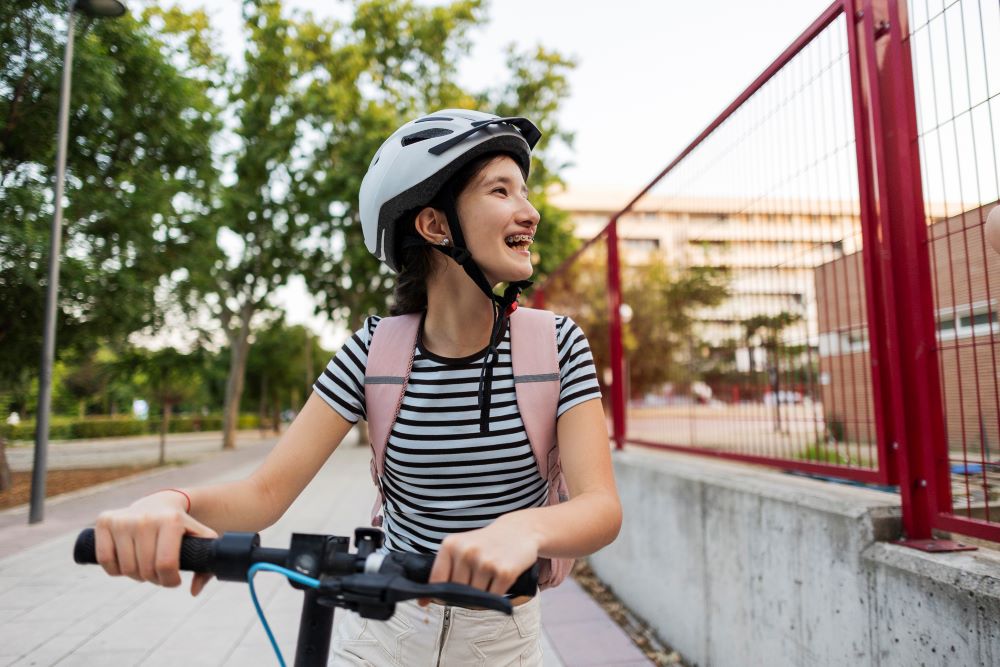
E-bikes and e-scooters are becoming increasingly popular, but the rules about where and how they can be used are different. An e-bike or e-scooter might be high on your child’s wish list, but before you buy, it’s important to check that they’ll be able to use it legally and safely.
Can my child ride an e-bike?
In Scotland, a road-legal Electrically Assisted Pedal Cycle, or EAPC, can be ridden by someone aged 14 or over. A legal EAPC:
- has pedals that can propel it
- its motor has a maximum continuous rated power of 250 watts
- electrical assistance cuts out at 15.5mph.
You don’t need a licence to ride a compliant EAPC, and you can ride it in cycle lanes and anywhere else you’d ride an ordinary pedal bike, except on the pavement.
If an e-bike doesn’t meet these legal requirements or has been modified to exceed these limits, it may instead be treated as a motorbike or moped. This means it needs to be registered, insured and taxed like a motorbike or moped. The rider would also need a driving licence and an approved helmet, and of course it can’t be ridden in cycle lanes or other places you can ride a pedal bike.
You can find out more about the rules around e-bikes on the gov.uk website.
What about an e-scooter?
The rules for e-scooters are different. E-scooters can only be used on private land, with the landowner’s permission. It is illegal to ride an e-scooter on public roads, pavements or other public spaces in Scotland. This is because they count as motor vehicles but don’t have the things motor vehicles need to be safe on the roads, like rear lights.
So, before buying an e-scooter as a present, think carefully about where your child would actually be able to use it legally.
You can find out more about the rules around e-scooters on the gov.uk website.
Why does this matter?
These rules are in place to keep everyone safe when they’re out and about, because using e-bikes and e-scooters illegally can be very dangerous for the people riding them, other road users and particularly pedestrians.
If you or your child uses a non-compliant e-bike or an e-scooter on public roads, the police may ask you to take it home or they may even seize it. The person riding it can also be reported for road traffic offences, which can result in fines and penalty points on their licence. If they don’t have a driving licence, it could affect their ability to get one in the future.
Depending on the circumstances, there may be legal consequences for you as a parent or carer if you let your child ride an e-bike or e-scooter illegally.
So all in all, it’s really not worth the risk.
How do I know if an e-bike I’m buying meets the regulations?
Before buying an e-bike, it’s important to check its specifications. Don't just rely on descriptions such as ‘road legal’. Always buy from a trusted seller and check the bike has a UKCA or CE mark.
Even if it does have a UKCA or CE mark, it’s important to check that:
- it has pedals that can propel it
- its motor has a maximum continuous rated power of no more than 250W
- the motor doesn't propel the bike at speeds above 15.5mph
- the bike is marked with its manufacturer and continuous rated power, as well as either the battery voltage or the maximum speed at which the motor can propel it
- it hasn’t been modified in any way.
What if I'm buying an e-bike second-hand?
It's worth being extra careful with a second-hand e-bike. It can be harder to tell whether second-hand, refurbished or converted bikes and their components are genuine and meet the appropriate standards. If they’re not, the e-bike may not meet the EAPC requirements, and there may be an increased risk of it going on fire.
You can find out more about buying an e-bike on the gov.uk website.
What should I do if I’ve bought an e-bike that doesn’t meet the regulations?
If you bought an e-bike believing it met the requirements for an EAPC, but later found out that it doesn't, the first thing to do is to stop using it as an ordinary e-bike on public roads or cycle paths.
Next, contact the seller. If you bought the e-bike from a business and it was advertised or described as being road legal or meeting the EAPC requirements when it doesn't, you may have consumer rights because the product doesn't match its description. Depending on the circumstances, you may be entitled to a refund, repair or replacement. These rights can also apply to second-hand goods bought from a business If you bought the bike through an online marketplace such as Amazon, eBay or Etsy, you can also use the marketplace's complaint or dispute process.
Citizens Advice Scotland has guidance on returning faulty or misdescribed goods.
If you paid by card or another payment service (like PayPal), there may be additional ways of trying to recover your money. Citizens Advice Scotland has more information on what to do if the seller doesn’t resolve the problem.
If you're unsure about your rights, you can get advice from Consumer Advice Scotland or your local Citizens Advice Bureau.
How do I charge an e-bike or e-scooter safely?
The gov.uk website has a handy checklist for charging e-bikes and e-scooters:
- DO only use the correct charger for your battery.
- DON’T overcharge the e-bike or e-scooter.
- DO unplug your charger when its fully charged and keep it in a cool place.
- DON’T leave your device charging unattended or when you’re asleep.
- DO stop using your charger or battery immediately if you notice it overheating, deforming, making hissing or cracking noises, smelling, smoking or performing poorly.
- DON’T charge or store your battery in the hallway or where it could block escape routes.
You can find out more about e-bike and e-scooter battery safety on the gov.uk website.
How can I make sure my child stays safe when they’re out and about?
To make sure your child can cycle safely, it’s a good idea to sign up for Bikeability Scotland. This is a free course offered in schools to help children build the skills and confidence they need to cycle on the road.
You can check whether your child’s school offers Bikeability Scotland training on the Cycling Scotland website.



 Activities & Play
 Behaviour